The PACT bylaw has been drafted in public since the day I started it. Every version is on GitHub. Every suggested change, accepted or rejected, is on the record.
I’m not trying to win you over with a slogan. I want to change how City Hall does business, and a public bylaw is a working piece of software as much as it’s a piece of policy. Bugs get found. Fixes get made, in daylight, not behind a closed door. This week is a clean example of exactly that.
What was wrong with it
My earlier drafts measured the City’s total property tax levy: the lump sum council votes to raise in the budget. That draft was too idealistic about what that number captures. It missed inflation. It missed a city that reassesses property values on its own schedule. It missed growth: new homes joining the tax roll raise the levy on their own, with no rate change and no council vote behind it. A bylaw that ignores all of that measures noise, not council’s decisions. We found a better mechanism.
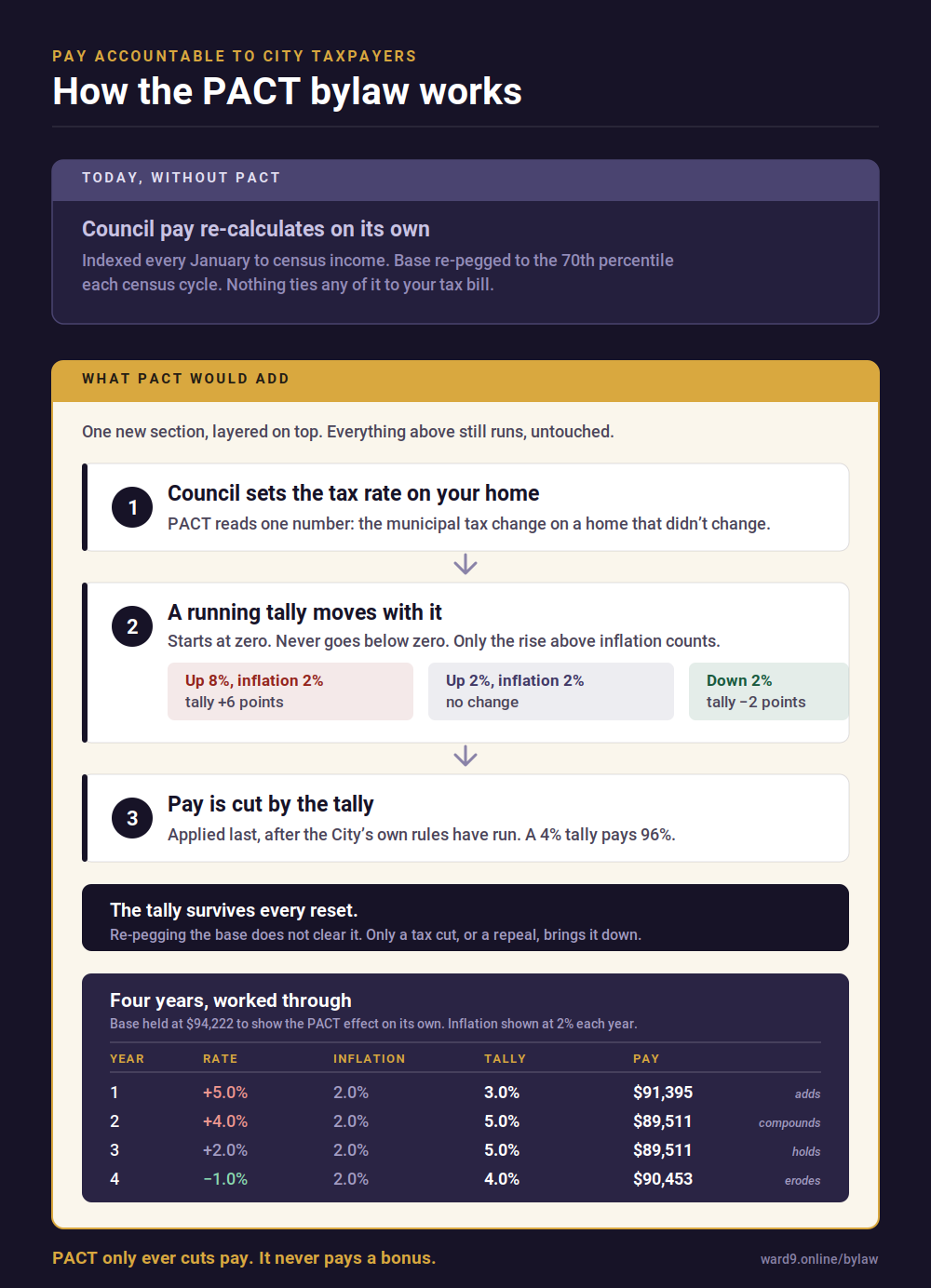
PACT now reads the number council controls: the tax rate itself, set in the annual rating by-law, measured on a home whose assessment didn’t change. That’s your bill. Growth pays for growth on its own, no special rule needed. A reassessment year doesn’t get counted as a tax cut or a tax hike either, since PACT checks the rate against what it would have taken to raise the same money on the old assessment. Council can’t hide behind MPAC, and it can’t get blamed for MPAC either.
Why the fix also makes it more likely to pass
The earlier version locked in an absolute rule for a councillor’s first term: any rate increase at all, even one that only kept pace with inflation, counted in full against pay. That matched my own zero-tax-increase promise, so it never bothered me. But I’m one vote out of fifteen. A rule that punishes ordinary inflation the same as real overspending is a harder sell to the other fourteen, and PACT only works if enough of council votes for it.
The current version fixes that from the start. A rate increase up to inflation doesn’t touch council pay, in any year. Council can cover rising wages, fuel, and contracts without losing a dollar of pay. What costs them is spending beyond that. This is a more honest bylaw, and a more realistic one: built for the votes it needs at the table, not for the version that sounds toughest in a headline.
What didn’t change
My own pledge stands exactly where it was. I will not support any increase to the tax rate during my term, for any reason.
PACT doesn’t track votes. It tracks the number. If the rate lands above inflation, every councillor’s pay drops the same amount, the ones who voted for it and the ones who voted against it alike. Losing a vote doesn’t protect you from that. Staying under inflation doesn’t cost anyone anything, no matter how they voted. PACT answers to the outcome, not the roll call.
One more fix, smaller but worth naming. The bylaw used to measure inflation against a Statistics Canada index specific to London. That index doesn’t exist. Statistics Canada tracks a fixed list of major cities, and London isn’t one of them. PACT now uses the Ontario-wide index instead, the same one the City already uses in its own pay rules. Same principle as the big fix: found in public, corrected in public.
Read it yourself
The full legal text and the complete history of every version are at github.com/mmward9/london-council-pay-bylaw. The plain-English explanation with the worked math is at ward9.online/bylaw.
If something still doesn’t hold up, say so. That’s what the “Suggest a change” button on every section is for.