On Monday, October 26, you’ll mark two choices on your ballot: a councillor for your ward and a mayor for all of London. The mayor’s seat now carries more weight than it used to, because since July 1, 2023, London’s mayor has held what the province calls strong mayor powers.1
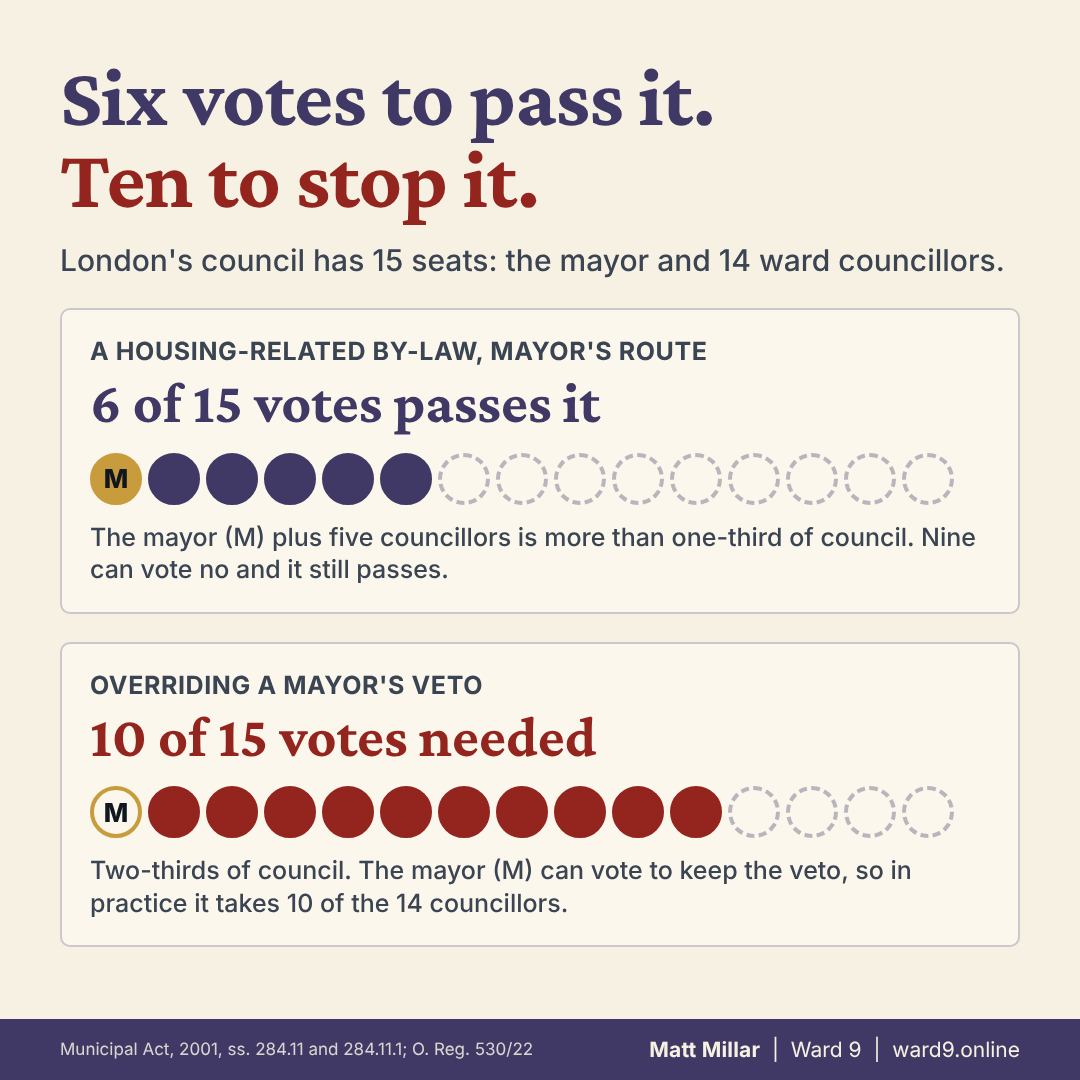
Picture the council chamber at City Hall. There are fifteen seats, one for the mayor and one for each of the fourteen ward councillors. For most of London’s history, almost everything that happened in that room took a simple majority. Under the new rules, a by-law the mayor puts forward on certain matters can pass with six of those fifteen votes, and when the mayor vetoes something council has done, it takes ten votes to overrule it.
Six votes to pass it. Ten to stop it.
I’m running to sit in one of those fifteen seats, so I’ve researched the law and every decision London’s mayor has published under it. Here’s what these powers are for, where they stop, how they’ve been used here, and what they would let a mayor do if that mayor answered to Queen’s Park before answering to you.
What the powers are for
The province created these powers to speed up two things it has written into regulation as “provincial priorities”: building 1.5 million new homes by December 31, 2031, and building and maintaining the infrastructure that supports housing, including transit, roads, utilities and servicing.2
Keep those two priorities in mind. Most of what follows depends on them.
What London’s mayor can do today
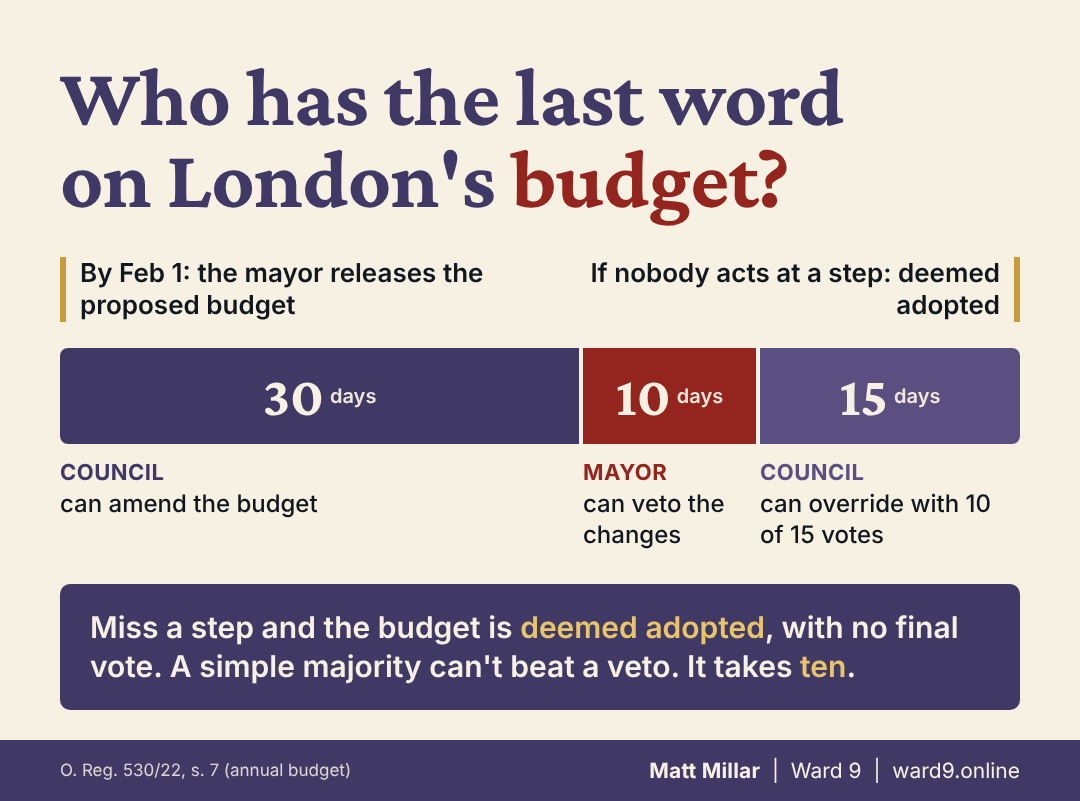
Write the budget. The mayor prepares the City’s proposed budget and has to release it by February 1 each year. Council then has 30 days to amend it. The mayor has 10 days to veto any of those amendments, and council has 15 days to override a veto, which takes two-thirds of the whole council. In London, that’s 10 of 15. If nobody acts at a given step, the budget is deemed adopted without a final vote.3
Raise property taxes. The annual budget isn’t the only route. The regulation also lets the mayor propose a mid-year amendment to raise an additional tax levy, which means collecting more money through property taxes in the same year. The process in the regulation is built for raising taxes, not lowering them.3
Here’s how it works. The mayor gives the proposed amendment to every member of council and the clerk and makes it public. Council then has 21 days to amend it, though council can vote to shorten that window. If council doesn’t act in that time, the mayor’s proposal is deemed adopted. If council does amend it, the mayor has 5 days to veto the amendment in writing, with reasons, and can shorten that window too. A vetoed amendment is treated as if it never passed. Council then has 10 days to override the veto, which takes ten of the fifteen votes. The mayor is a member of council and can vote too, so in practice that means ten of the fourteen councillors. If the clocks run out without an override, the mayor’s proposal is deemed adopted.3
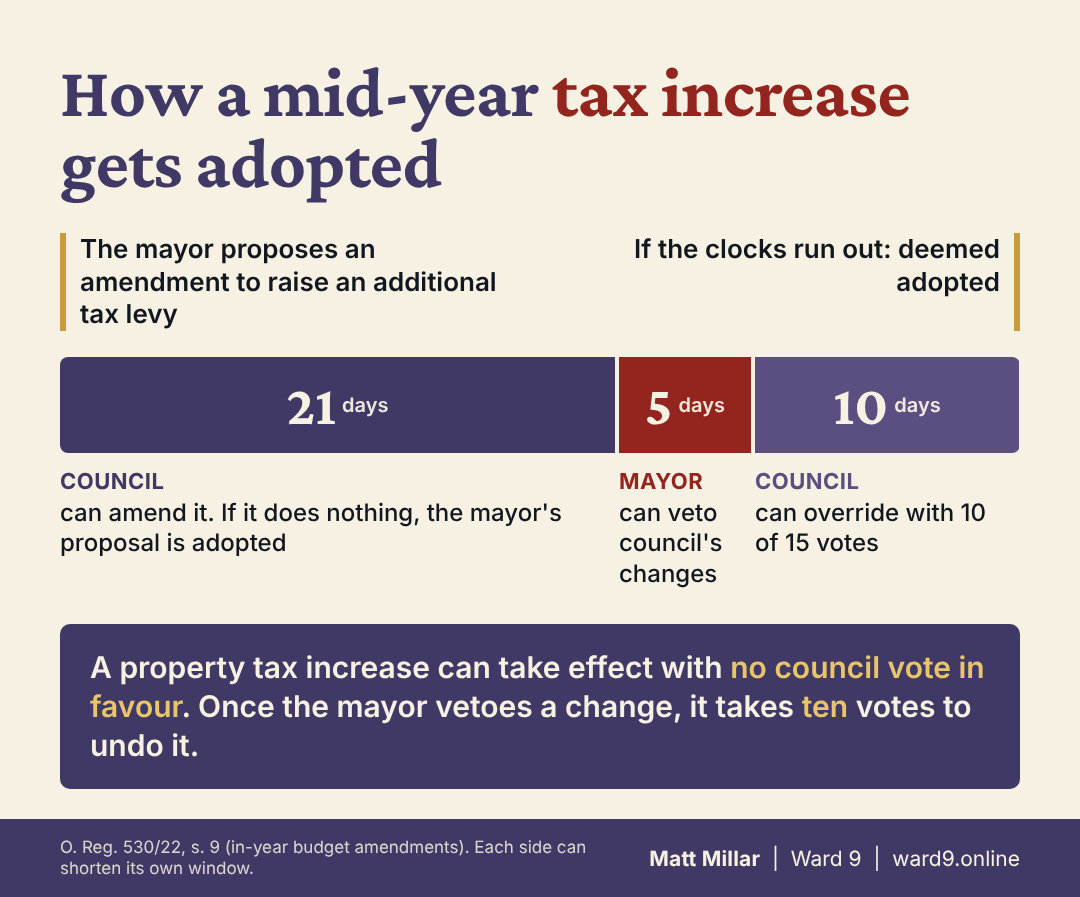
Put plainly, a property tax increase can take effect without a single council vote in favour of it. And once the mayor vetoes a change, a simple majority of council can’t undo the veto. It takes ten.
I’ve said I won’t support a property tax increase, for any reason. Under this process, my vote alone can’t stop one.
Hire the people who run City Hall. The mayor appoints the City Manager, can hire and dismiss most department heads, can reorganize the administration, and can direct City staff in writing on anything connected to these powers.4 That reaches further than it sounds. Council votes on staff reports, and a staff recommendation carries a lot of weight in that chamber, so whoever chooses the people writing those reports has a hand on the outcome.
Run the committees. The mayor can create and dissolve council committees, decide what each one handles, and choose their chairs and vice-chairs.4 Most items are debated at committee before they ever reach a council vote.
Push housing-related by-laws through with a minority. If the mayor believes a by-law could advance one of the two provincial priorities, the mayor can make council vote on it, and it passes with more than one-third of council. In London, that’s the mayor plus five councillors.4
Veto by-laws that get in the way. If the mayor believes a by-law council has passed “could potentially interfere” with a provincial priority, the mayor can veto it. The mayor has to give notice within two days and issue the written veto within 14, and council then has 21 days to override it with ten votes.4
The test in both of those last two powers is the mayor’s own opinion. The Act also says a court can’t overturn a decision made legally and in good faith under these powers on the grounds that it was unreasonable.4
How the powers have been used in London
London’s mayor publishes every decision made under these powers. As of this week, the City’s list holds 28 of them.5 Most of them name committee chairs and vice-chairs or set up committees, including the all-council Budget Committee. In February 2024, Mayor Josh Morgan used the City Manager power to appoint Sandra Datars Bere, after a recruitment committee of the mayor and five councillors ran the search.6 In each budget year of this term, Mayor Morgan issued a written notice that he would not veto council’s amendments, and none of the 28 decisions is a veto.7
London’s experience with strong mayor powers has been a quiet one so far. That’s Mayor Morgan’s record in one term, and nothing in the law requires the next mayor to follow it.
Where the powers stop today
You should know the limits as well as the powers.
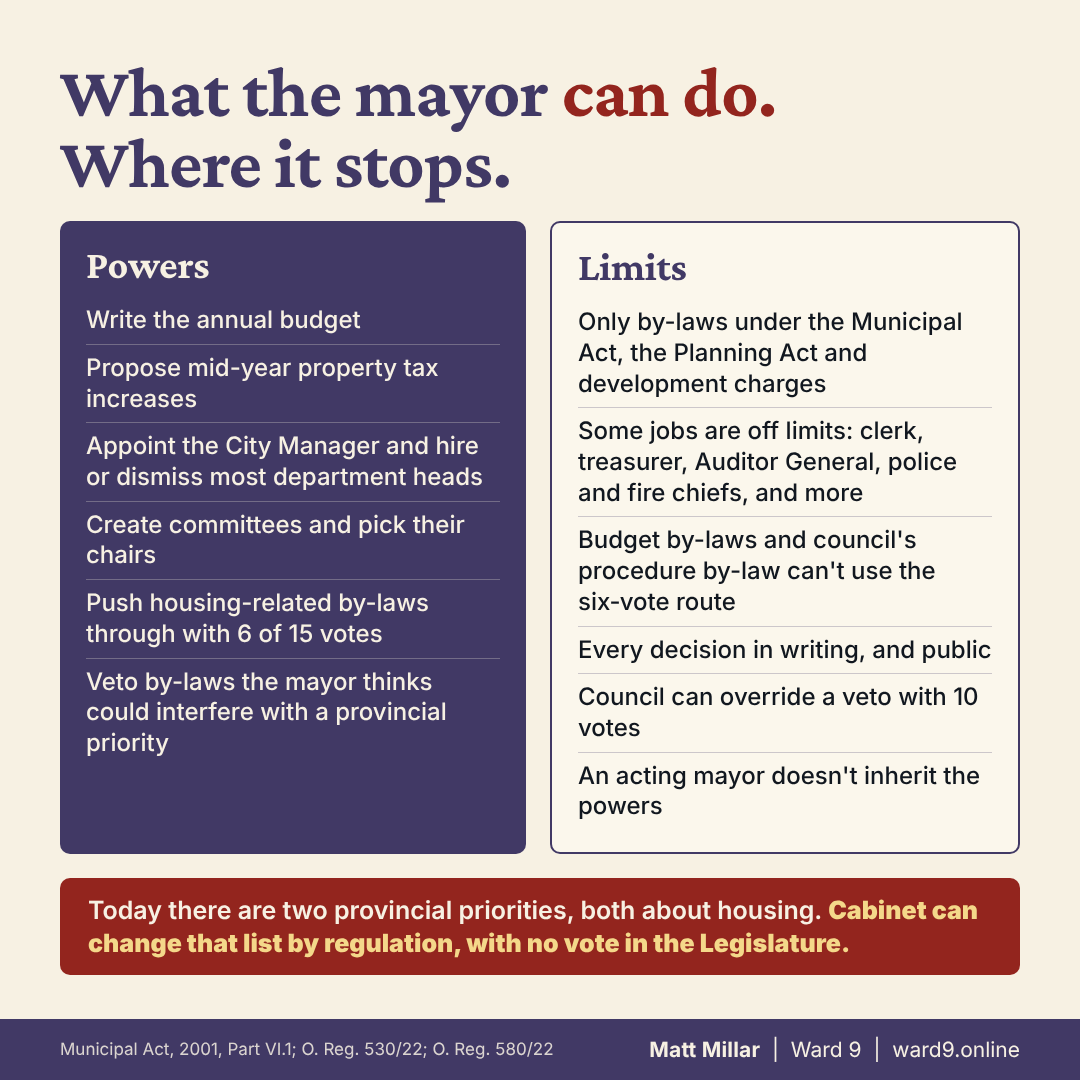
- The veto and the six-vote route only apply to by-laws the mayor ties to the two housing priorities, and only to by-laws under the Municipal Act, the Planning Act and the part of the Development Charges Act that sets the charges.34
- Council’s procedure by-law, budget by-laws and by-laws filling a council vacancy can’t be passed through the six-vote route.3
- The hiring power can’t touch the clerk, the treasurer, the Integrity Commissioner, the Ombudsman, the Auditor General, the chief building official, the police chief, the fire chief or the medical officer of health.4
- A reorganization still has to respect collective agreements and existing contracts.8
- Every decision, staff direction and veto has to be in writing. Decisions go to every member of council by the next business day and are made public, and a veto has to include the mayor’s reasons.34
- If a conflict of interest keeps the mayor out of part of the budget, council can amend that part and the mayor can’t veto the change.3
- In an override vote, the mayor gets one vote like every other member of council. The mayor can vote to keep the veto, so an override in practice takes ten of the fourteen councillors.34
- An acting or interim mayor doesn’t inherit these powers.8
- New rules took effect this June for election time. Once it’s clear, from the certified nominations or the election results, that London is getting a new mayor or that fewer than three-quarters of council will return, the outgoing mayor can’t appoint a City Manager, can’t reorganize City Hall, and can’t use the six-vote route for spending or land sales over $50,000 that weren’t already in the budget. The 2027 budget also can’t be proposed until 2027 begins, so whoever you elect on Monday will put it forward sometime between January 1 and February 1.3
That election-time rule exists because an outgoing mayor with these powers could otherwise lock in a City Manager or a new structure at City Hall that the incoming council never chose.
What the law would allow in the wrong hands
None of what follows has happened in London. All of it is permitted by the rules as they stand today.
Six votes to rezone your street. A zoning by-law is a Planning Act by-law. If a mayor decides a rezoning could help meet the housing target, that by-law can pass with the mayor and five councillors in favour while nine members vote against it, including the councillor elected by the people who live there.4 The public meeting the Planning Act requires still has to happen first. In Lambeth, we’ve already watched applications on Colonel Talbot Road push past what the Southwest Area Secondary Plan allows for our neighbourhood. Under these rules, a mayor set on one of those needs only five allies to carry it.
A veto on council’s guardrails. Say council passes a by-law requiring at least one parking space for every new apartment unit, or one that keeps an established street at the height it was built to. If the mayor thinks either could interfere with housing, the mayor can veto it, and council needs ten votes to put it back.4
The mayor’s number on your tax bill. When council amends the mayor’s budget and the mayor vetoes the amendment, a simple majority of council can’t win that fight. It takes ten. A mayor who wanted to steer more of your property taxes toward a provincial housing push could hold that line with just five councillors on side.3
The people who write the reports. A mayor whose first loyalty ran to Queen’s Park could hire a City Manager and department heads who share it. Council would be voting on that administration’s recommendations for years after that mayor left office.
Rules that can change without a vote in the Legislature. The two provincial priorities sit in a regulation that the provincial cabinet can rewrite on its own, without passing a new law.4 The Minister of Municipal Affairs and Housing can also change, by regulation, how these powers work and which laws they cover, and could extend the mayor’s appointment power to the chairs of local boards. Some of those regulations can even be made retroactive by up to six months.4 The two priorities haven’t changed since 2022,2 but nothing guarantees they’ll stay where they are.
The list itself is open-ended. The Act doesn’t define “provincial priority,” and it puts no limit on how many there can be or what they can be about. Today there are two, both about housing. The mayor’s veto and six-vote powers apply to whatever the list says at the time, and the test is the mayor’s own opinion.4
The real safeguard is the people you elect
Every one of those scenarios needs two ingredients: a mayor willing to put the province’s agenda ahead of London’s, and a council that can’t find ten votes to say no.
The math cuts both ways. A mayor acting in bad faith needs five councillors to go along. A council that agrees on what London needs only has to hold ten together to stop it. That’s why the mayor’s race matters more than it used to, and it’s why the councillors around that mayor matter just as much.
Before Monday, ask every mayoral candidate one question: when the province’s priorities and London’s pull in different directions, whose side will you take? A mayor who answers “London” and means it, with a council that largely agrees on the issues, will rarely need these powers at all.
Here’s my standard. A mayoral override belongs to genuine emergencies. When a mayor uses one, the Act already requires the written reasons to be made public, and council should debate those reasons openly and use the two-thirds override wherever the case holds up. When council needs ten votes to protect a decision Londoners asked for, I’ll be one of them. If council’s judgment ever gets overridden, I’ll tell you the day it happens.
October 26 is election day, and I want you to know exactly what you’re getting when you mark Matt Millar on the ballot: a Ward 9 councillor whose vote stays with Ward 9, whoever sits in the mayor’s chair, regardless of the province’s priorities. Polls are open from 10 a.m. to 8 p.m. You can find your voting place at london.voterservices.ca, and remember to bring your ID.
-
O. Reg. 180/23, amending O. Reg. 530/22 to designate London under Part VI.1 of the Municipal Act, 2001, effective July 1, 2023. https://www.ontario.ca/laws/regulation/r23180. London is item 106 in the current list of designated municipalities. https://www.ontario.ca/laws/regulation/220530 ↩
-
O. Reg. 580/22, Provincial Priorities, under the Municipal Act, 2001. No amendments since December 20, 2022. https://www.ontario.ca/laws/regulation/220580 ↩↩
-
O. Reg. 530/22, Part VI.1 of the Act (current consolidation from June 22, 2026), ss. 3, 5, 7, 8, 9, 10 and 11. https://www.ontario.ca/laws/regulation/220530 ↩↩↩↩↩↩↩↩↩↩
-
Municipal Act, 2001, S.O. 2001, c. 25, Part VI.1 (Special Powers and Duties of the Head of Council), ss. 284.3 to 284.17. https://www.ontario.ca/laws/statute/01m25 ↩↩↩↩↩↩↩↩↩↩↩↩↩↩
-
City of London, Mayor Josh Morgan, published list of mayoral decisions (28 decisions, 2023-001 to 2026-001). https://london.ca/government/council-civic-administration/city-council/mayor-josh-morgan ↩
-
City of London, Mayoral Decision 2024-003, Appointment of City Manager, February 6, 2024. https://london.ca/sites/default/files/2024-02/Mayoral%20Decision%20-%20Appointment%20City%20Manager_.pdf. The recruitment committee was set up by Mayoral Decision 2023-002. https://london.ca/sites/default/files/2023-10/Mayoral%20Decision%20-%202023-002_1.pdf ↩
-
City of London, Mayoral Decisions 2024-004 (March 1, 2024), 2024-013 (November 27, 2024) and 2025-005 (December 1, 2025), each stating “The Mayor will not exercise the power to veto.” https://london.ca/sites/default/files/2026-05/Mayoral%20Decision%202025-005.pdf ↩
-
Government of Ontario, Ontario Municipal Councillor’s Guide, Section 10: Strong mayor powers and duties (updated July 23, 2026). https://www.ontario.ca/document/ontario-municipal-councillors-guide/10-strong-mayor-powers-and-duties ↩↩