Every answer I've given on the record
Here is every answer I've given on the record, word for word, from candidate questionnaires and my replies to residents.
Don't see your question? Search below, or ask me directly and I'll answer it on the record.
ACORN London Municipal Election Candidate Survey on Tenant Protections
Why are you running for Mayor / Ward Councillor in this election? What motivated you to put your name forward at this time?
Year after year, decision after decision, we're left helpless watching our own councillor side with city staff over objections from the community on a variety of issues, but mainly rezoning and development.
Our friendly neighbourhoods are becoming cold and sterile. Cars, yards, and homes get hit overnight, or even in broad daylight. Taxes keep climbing. We're stuck in gridlock and perpetual construction. It's time for a change, and I'm ready to bring a fresh perspective to City Hall.
ACORN London Municipal Election Candidate Survey on Tenant Protections
What are the top 2–3 priorities in your campaign platform? How do these address the needs of low- and moderate-income Londoners?
First, taxes. I won't support a property tax rate increase during my term after the 20% increase over the past 3 years, and my proposed PACT bylaw cuts council's own pay whenever taxes go up beyond inflation. Any increase comes out of a paycheque, and renters pay it too, because a landlord's expenses show up in the rent.
Second, roads that actually move. Every hour a worker sits in gridlock, or detours around what seems like never-ending construction, is an hour taken from home or the job.
Third, safety at home. When a car or a bike gets hit overnight, somebody has to find the deductible, or the money for a new bike, before the next shift. And nobody should feel like a victim in their own neighbourhood.
ACORN London Municipal Election Candidate Survey on Tenant Protections
What experience or background do you bring that distinguishes you from the other candidates running in your race?
I've drafted the proposed Pay Accountable to City Taxpayers bylaw, which cuts city council's pay whenever taxes rise faster than inflation, and I published it open-source for anyone to read and suggest amendments to.
I work in diverse fields, from growing and selling berries and fresh produce, to developing apps and helping people with their computers.
And every promise, and every published statement I've made during this campaign, is public and searchable on my website, so you can hold me to my word.
ACORN London Municipal Election Candidate Survey on Tenant Protections
If elected, what would be your single highest priority in your first year as Mayor / Ward Councillor?
Holding the line on property taxes. I'll vote no on any rate increase, and I'll bring the PACT bylaw forward so council's own pay drops whenever taxes outrun inflation. With their own pay on the line, a tax increase becomes a little less appealing.
ACORN London Municipal Election Candidate Survey on Tenant Protections
What gaps do you see in the current Council’s approach to rental housing maintenance and by-law enforcement? How would you push for improvements if elected?
A homeowner renting out a basement apartment needs a licence and an inspection before the first tenant moves in, while an entire apartment tower down the street doesn’t need a licence at all. That’s backwards. I’d push bylaw enforcement to focus on the large buildings that keep generating complaints, inspect them top to bottom, and follow through with strict enforcement.
ACORN London Municipal Election Candidate Survey on Tenant Protections
Tenants in London often face challenges getting repairs for issues like mould, pests, or lack of heat because enforcement only kicks in after formal complaints. Would you support moving to a proactive system where the City regularly inspects rental properties, especially multi-unit buildings, to catch problems early?
Undecided
I’m leaning against it. Sending inspectors through every rental building on a schedule means a bigger bureaucracy and new fees. Someone has to pay for that, and it's likely to land on taxpayers and tenants.
A complaint-driven system can work if the enforcement behind it is efficient and effective. When a tenant reports mould or a dead furnace, the inspection should happen quickly, and there must be strong consequences for non-compliance. Where a building keeps generating complaints, that’s where I’d send inspectors through top to bottom.
ACORN London Municipal Election Candidate Survey on Tenant Protections
A Landlord Registration Program, modelled after successful approaches elsewhere, would require landlords to register their properties, helping the City identify and address issues more efficiently. Such a program can be self-funded through fees and would not require new taxpayer dollars beyond startup. Do you support exploring and implementing a Landlord Registration Program in London?
Other: Yes for landlords renting out multiple buildings or any medium/high-density building, with lighter rules for homeowners
London’s rental licence already covers the homeowner with a basement apartment, while apartment towers are exempt. I’d flip that around. Any landlord who rents out more than one building they don’t live in, or even a single apartment building or other medium- or high-density rental, should be registered, so the City knows who owns it and who to call when the heat goes out. Where a landlord already holds the current rental licence, the registry should replace it, so nobody pays for two layers of paperwork. Enforcement stays complaint-driven, but once a building crosses a set number of substantiated complaints, it moves onto scheduled inspections until it stays clean through a probationary period. Someone earning a living from rental housing should meet a higher standard than a homeowner renting out a basement apartment to help pay the mortgage. Making it easier for that homeowner to rent means more homes on the market.
ACORN London Municipal Election Candidate Survey on Tenant Protections
As a Ward Councillor, would you actively champion and vote in favour of a strong Landlord Registration Program with proactive enforcement at City Council? Please explain your position.
For any landlord who rents out more than one building they don’t live in, or even a single apartment building or other medium- or high-density rental, I’d vote in favour of a registry so there’s a name and contact info on file when mould starts creeping across a bathroom ceiling or cockroaches start appearing.
For enforcement, I’d keep it responsive: tenant complaints get a fast inspection and strong consequences for non-compliance, and a building that keeps generating substantiated complaints goes onto scheduled inspections until it earns a clean record. That puts the City’s attention on the worst offenders and keeps the homeowner renting out a basement apartment free of new red tape.
ACORN London Municipal Election Candidate Survey on Tenant Protections
How would you address concerns about large property owners who leave key downtown buildings vacant or in disrepair, impacting the local economy and community vitality?
A vacant building costs its owner money every month, so most owners would rather fill it. What keeps a building boarded up is the time and cost of permits, inspections and zoning approvals stacked on top of finding a tenant. I’d cut that friction: fast-track permits, and pre-approved designs for adaptive reuse, so turning an empty building into shops or apartments is quicker and cheaper than leaving it sitting. Where an owner lets a building fall apart, the property standards bylaw already applies to every property in the city, vacant or not, and I’d expect it enforced. And downtown has to feel safe and clean, because nobody signs a lease on a street they don’t want to walk down.
ACORN London Municipal Election Candidate Survey on Tenant Protections
What specific actions would you take in your ward to improve housing quality for low- and moderate-income residents, including renters?
The best protection is being able to walk away from a bad situation, and that goes both ways. A tenant setting a bucket under a leaking ceiling every time it rains should have somewhere better to move, and a homeowner thinking about renting out a basement apartment should feel confident it won’t turn into a costly gamble.
When renting is mutually beneficial, more people open up units, and more quality housing becomes available to the tenants who need it.
I’d push for property standards orders against registered rental buildings to be searchable by address, so a family can check a building’s track record before they sign a lease.
And when a tenant reports a problem, I’ll push bylaw enforcement to deal with it swiftly and effectively.
ACORN London Municipal Election Candidate Survey on Tenant Protections
Do you commit to supporting the implementation of a Landlord Registration Program in London that shifts from a purely complaint-based system to proactive enforcement while being self-funding?
Other: I'd support a self-funded registry covering multi-building and medium/high-density landlords, with proactive inspections only for repeat offenders.
I’d support a registry that pays for itself, covering landlords who rent out more than one building they don’t live in, or any apartment building or other medium- or high-density rental. For those landlords it replaces the current rental licence, so the fee they already pay goes toward it.
Enforcement starts with tenant complaints. Once a building piles up substantiated complaints, it moves onto scheduled inspections, and the owner pays for those return visits until the building earns a clean record.
ACORN London Municipal Election Candidate Survey on Tenant Protections
Would you champion this program at City Council / as Mayor?
Other: I’d vote in favour of a registry built the way I’ve described, but I won’t lead a push for burdening good landlords the same as bad ones.
A big part of my platform is cutting red tape, so every new rule that comes to Council has to show it’s worth the burden it adds. The registry I’ve described can pass that test, because it replaces the current rental licence for the landlords it covers and leaves the homeowner renting out part of their home alone. If it comes to Council built that way, it gets my vote.
ACORN London Municipal Election Candidate Survey on Tenant Protections
Is there anything else you would like to share regarding housing affordability, tenant protections, rental housing quality, homelessness prevention, or other housing-related priorities?
Most of my answers come back to one idea. Renters do best when there’s a For Rent sign on more than one street to choose from and the rent isn’t climbing to cover City Hall’s spending. I’ll hold the line on property taxes and cut the red tape that keeps new rental housing from getting built and rented out.
My goal is for the market to provide every kind of home, from a bedroom rental to a high-rise apartment, to dynamically meet the demand of those seeking them.
Accessible London Coalition candidate questionnaire
What do you feel is the #1 accessibility issue facing the city of London?
I'd guess one of the biggest accessibility issues in this city is that what checks a box on a bureaucrat's scorecard doesn't always translate into anything that actually helps someone. If you've ever dealt with City Hall on anything, you've run into that same issue. LTC's own plan lists dozens of bus stops with a ramp-capable boarding pad and no sidewalk connecting to it. It fills a checklist, but still leaves someone stranded at the curb.
Accessible London Coalition candidate questionnaire
How will you commit to improving accessible housing opportunities in our city?
Most of London's housing was built before today's accessibility standards applied, and those standards only kick in on new construction or a major renovation. That's why people are reporting years-long waits for something as basic as a wheelchair-accessible unit. The one program built to help someone retrofit their own home, Ontario Renovates, is funded by the federal and provincial governments and delivered through the City, and it runs out most years before demand is met. I can't set that funding level from a council seat, but I can make sure residents actually know the program exists and how to apply before the year's funding is gone.
Accessible London Coalition candidate questionnaire
How will you work to improve accessible transportation including conventional transit, Paratransit, taxis and ride sharing?
Paratransit riders report strong on-time performance, at 85% compared with 46% for conventional transit. Their problem is capacity. LTC turns away hundreds of trip requests. More vehicles and scheduling capacity would help, but funding is the constraint.
The taxi issue is economic too, from a different angle. Sixteen of London's 31 accessible-cab licences sit unused, so this isn't a licence shortage. Converting or buying an accessible vehicle runs over $130,000, and it must charge the same fare as a regular cab. The City's bylaw then forces that vehicle off the road at 12 years old, even though every cab already passes an annual City safety inspection regardless of age. I'd replace that flat age limit with the annual safety inspection the City already requires for Vehicles for Hire. And I'd like your opinion: if taxis could charge an increased fare for paratransit in exchange for more accessible cabs on the road, would that be worth exploring? Or off the table?
Ride-sharing isn't filling that gap either. Uber's wheelchair-accessible option only runs in a handful of Canadian cities, and London isn't one of them. The City's Vehicle for Hire bylaw already allows an Accessible Private Vehicle for Hire. Operators aren't putting those vehicles on the road here. I'd like to explore if there's something that London could do to accommodate this.
CCAL (Concerned Citizens Association of London) questionnaire
Londoners have watched elected officials override the clearly expressed will of voters on major projects. Council ignored the public vote against the BRT, and the city is now on the hook for a bus rapid transit system that has ballooned to $454 million — up more than 50% from the original estimate, with the local taxpayer share nearly tripling. The costly bike-lane network followed the same pattern.
Will you commit to following the clearly expressed will of voters on major projects — even when it conflicts with activist pressure — and how will you determine what the majority of your ward actually wants, rather than listening only to the loudest voices?
That is my main goal. I opposed the BRT back in 2018 before it started ballooning past what residents were told to expect. Council voted it through anyway on its own authority, despite widespread public opposition. I've also presented arguments, based on the London Plan, opposing high-density developments that are unsuitable and unwanted in Ward 9.
I built ward9.online with a public concern tracker so residents can write in and see my answer go up publicly. I draft policy the same way: my proposed PACT bylaw has been open on GitHub since day one, allowing anyone to see the entire history and suggest changes.
If elected, I'd like to build an official version of the concern tracker, with verified-resident logins (allowing optional anonymity). Activist groups can organize and lobby all they want, but I represent Ward 9 residents. Not activists.
CCAL (Concerned Citizens Association of London) questionnaire
Londoners have been hit with repeated property tax increases that far outpace inflation — a compounded tax levy increase of roughly 26% over four years — driven by overspending and frivolous spending on non-essential items. Council has shown it will not discipline itself without a hard rule.
Will you support a binding policy that any property tax increase above the rate of inflation requires a public referendum, and what specific spending lines would you cut first to stay under that ceiling?
I would, but my own standard already goes further: I won't support any property tax increase during my term, for any reason, not just increases above inflation.
I've also drafted the Pay Accountable to City Taxpayers bylaw, which permanently cuts council pay for any levy increase at all through this whole coming term, then only for increases above inflation after that.
On specific spending cuts, the Climate Change Reserve Fund already has about $967,000 sitting unallocated, so I'd reject any push to restore its contributions to the old $1 million a year until that backlog clears. The Community Arts Investment Program, about $800,000 a year, ranks below essential services like roads, water, and safety, and it's the kind of discretionary spending that goes first if push comes to shove.
CCAL (Concerned Citizens Association of London) questionnaire
A councillor's sworn duty is to represent citizens and manage their money responsibly. That requires real financial literacy — reading budgets, understanding debt, and prioritizing spending. Too many elected officials arrive with no financial training and treat the job as a platform for grand, top-down social projects that belong in provincial or federal politics.
What is your actual experience reading budgets and financial statements, and will you commit to ongoing financial training as a condition of holding office?
I took a first year Business course at Western University, and I've also kept my books and filed my own taxes since I started Matt Millar Technology Solutions, so I'm used to reading real numbers and acting on them myself.
I've been familiarizing myself with the City's budget documents and procedures too, including the multi-year budget update and the reasoning and calculations behind council's own pay resolution, because you can't hold anyone accountable to numbers you haven't read and understood yourself. If I ever need financial training beyond that, I'm open to it.
CCAL (Concerned Citizens Association of London) questionnaire
Budgets used to be examined line by line, every year. The current model approves a multi-year budget that is difficult to amend, and the promised savings have not materialized — instead, Londoners have seen some of the largest tax increases in the city's history.
Will you vote to reinstate a full annual line-by-line review of the entire budget, rather than the current practice of approving a multi-year plan with only minor amendments?
Yes. A full line-by-line annual review is sorely needed.
While a multi-year budget has a real planning benefit for major capital projects and long-term commitments, approving one and then waving through minor amendments for years skips real oversight, and Londoners have still seen a cumulative tax increase of more than 25% over this multi-year budget.
I'd keep multi-year planning for the parts that actually need multi-year timelines, and require every line of the operating budget to go through genuine annual review and public disclosure again. If a line item can't be defended out loud every year, it shouldn't coast through on the multi-year plan's convenience.
CCAL (Concerned Citizens Association of London) questionnaire
Elected officials have been publicly smeared, subjected to unsubstantiated ethics complaints that would not survive a court of law, and — in the case of the "Whole of Community Response" homelessness planning — told by staff not to attend vital meetings. City staff and outside groups, including non-Canadian-funded organizations, have increasingly attempted to steer council toward decisions that serve their own interests rather than citizens'.
Will you commit to rein in staff members who overstep their boundaries and attempt to steer elected officials, repeatedly re-frame their precise questions in council, or attack them through activist groups — and will you publicly name whoever is doing it?
A major theme of my campaign is the problem of councillors deferring to staff over their constituents. Staff work for council, not the other way around.
I'll push back in public any time a report dodges the actual question asked or steers council toward staff's preferred outcome instead of answering it, and I already support publishing contracts, invoices, and reports proactively so residents can see the pattern themselves rather than take my word for it.
On naming individuals: I'll do it to the extent the law allows, when conduct is actually documented and warrants it, but not as a standing accusation against staff before any facts are established. Naming someone before the facts are in only trades one unfairness for another.
CCAL (Concerned Citizens Association of London) questionnaire
London's budgets have been infiltrated by ideological frameworks with no measurable outcomes — ESG methods that major banks have now largely abandoned, and DEI hiring policies that can pass over the best-qualified candidate because of the wrong skin colour. A city must hire the best people at the best price, not satisfy a fad.
Will you commit to hiring and contracting based on qualifications and merit, and will you publicly oppose any hiring policy that weighs an applicant's race, sex, or ideology over their competence?
Yes. The City should hire and contract with the best person or firm for the job, at the best price and service for taxpayers. I oppose weighing race, sex, or any other identity category over qualifications and results, for anyone, in any direction. Sorting people by group instead of judging them on their own merits is the problem, whichever group ends up favoured. ESG frameworks in procurement and investment get judged by that standard too: if a methodology doesn't produce a measurably better outcome for London taxpayers than the plain merit-based alternative, it doesn't belong in a City contract or budget line. Hire and contract on competence and results, and publish the criteria so residents can see the City is actually following its own rule.
CCAL (Concerned Citizens Association of London) questionnaire
London spent $1.3 million on the Housing Collaborative Initiative — software that was never used — with $933,000 going to a single outside consultant. Council went years without meaningful updates while the bills quietly mounted. The London Economic Development Corporation receives $2.3 million annually under a purchase-of-services agreement that is not put to tender. Other organizations receiving millions for homelessness work resist even basic public reporting. Taxpayers should not need a Freedom of Information request — often answered with redactions — to see their own spending.
Will you ensure all contracts, invoices, and spending details are proactively published and accessible to council without an FOI request — and what reporting frequency will you demand from every funded agency?
I'll push for it. Since it takes a council majority, no single councillor can ensure that outcome outright, but I'll vote for it and keep pushing until it happens. Contracts, invoices, and spending details should be published proactively, and not surrendered one redacted page at a time after a Freedom of Information request.
On the multi-city Housing Collaborative Initiative, London paid a consultant roughly $800,000, and residents only learned the details because reporters kept pulling the thread. I'd require every agency receiving City funding to report quarterly with real numbers attached to real deliverables, published where any resident can find it.
Any vendor contract that requires basic facts like cost, scope, or performance to stay confidential is a contract I'd vote against, and any privacy impact assessment should be public before council votes on it.
CCAL (Concerned Citizens Association of London) questionnaire
Measurable accountability is the difference between a well-run city and a money pit. A lack of clear metrics leads to frivolous spending, possible corruption, decaying core services, and a public that stops trusting — and stops voting for — its elected officials.
Will you require every department to publish clear, measurable performance metrics tied to spending, and what consequence will you impose when a department fails to meet them?
Again, not something I can unilaterally require, but I'd like every department to publish clear metrics tied to what it actually spends. Right now, the pattern runs the other way.
London's Climate Change Reserve Fund held $1.192 million by the end of 2024, with only about $225,000 actually reaching a project and roughly $967,000 sitting unallocated against a real project backlog, and there's still no clear public reporting tying that fund's spending to a measured result.
On consequences: a department that misses its published metrics should have that specific line frozen or cut at the next budget and not quietly carried forward. I won't pretend that a councillor can fire a City manager directly, but I can vote the budget line, and I will vote it down when the numbers don't back up the spending.
CCAL (Concerned Citizens Association of London) questionnaire
London's senior management ranks have expanded faster than the services they deliver, while taxpayers fund salaries, benefits, and pensions that exceed what the private sector earns for comparable work.
How will you reduce the excessive bureaucracy whose compensation goes beyond private-sector earnings — and how many management positions do you believe are redundant, with what specific reductions?
City compensation, pay and benefits together, should match an equivalent private-sector role. A Fraser Institute study from January 2026 found Ontario's public sector already carries roughly a 7.9% wage premium over comparable private-sector work, on top of far better pension and job security odds.
I won't invent a specific headcount number without a real organizational review. That's exactly the kind of unaccountable guess that should invite skepticism. What I can commit to is voting for an independent management-structure audit in year one, with its findings and recommended reductions published in full, then voting the specific reductions that audit actually supports. A number invented without that work behind it wouldn't survive contact with reality, and Londoners deserve better than a guess dressed up as a plan.
CCAL (Concerned Citizens Association of London) questionnaire
While disabled persons must be provided for by taxpayers out of necessity, there is a real risk that increasing local taxation to access provincial and federal housing funding will turn London into a "magnet" for government housing — attracting demand from across the region, while the very taxation used to fund it forces people out of their homes and into the system they are paying for.
How will you help prevent a scenario where rising local taxation to fund social housing expansion turns London into a regional magnet for government housing — and drives working taxpayers out of their homes and into social housing?
I will help prevent rising local taxation through my commitment to oppose any property tax increase, for any reason, including to expand social housing funding, which blocks the exact mechanism this question is worried about.
Beyond that, the City already spends roughly $16 million a year on homelessness, part of about $46 million across all partners, and I want proof that those dollars are producing measured results before any of it grows, regardless of what the province or federal government offers to match.
CCAL (Concerned Citizens Association of London) questionnaire
A city cannot function without public order. Police are increasingly forced to deal with "revolving door" criminals and "free of fear" policies that may hide offenders rather than hold them accountable.
How do you think policing can be made more effective while dealing with "revolving door" criminals and "free of fear" policies that hide offenders?
The revolving door for repeat offenders comes from bail, sentencing, and Crown discretion, which are all provincial and federal matters.
Council does control the City's Free of Fear Services for All Policy, which blocks staff from reporting a resident's immigration status to police or CBSA. I oppose selective enforcement of any law. If there is a problem with a law on the books, the law should be amended. Until that happens, the law must be enforced.
To me, "free of fear" should be the natural state for law-abiding Londoners in their communities. Unfortunately, many don't even feel safe in their own homes. My main law and order concern is ensuring police have the will and capacity to act on pervasive and ongoing crime affecting Ward 9 residents, like frequent overnight break-ins. I will also push our four of seven Police Services Board appointees to make recurring hotspots a stated priority.
CCAL (Concerned Citizens Association of London) questionnaire
"Safer supply" policies have seen taxpayer-funded drugs distributed for unobserved consumption, alongside open drug use, encampments, and a visible decline in public safety. Recovery and treatment must come first, and council must add pressure on the provincial and federal governments.
Do you support an end to "safer supply" being distributed for unobserved consumption by addicts, as well as open drug use — and will you support recovery programs and enforcement against open drug use and encampments that threaten public safety?
My principle is simple: nothing illegal should be permitted in any taxpayer-funded facility, or anywhere in London.
Shelters: this council considered, and in August 2026 pulled back from, a proposal that would have stopped shelters from denying entry over drug possession. I'd have opposed that proposal from the start. Drug use is already banned, at least on paper, in every shelter; I want that made a clear, permanent, city-wide rule, not left to each operator's discretion.
Safer supply is a provincial program, not something council sets, but diversion is real: London pharmacies have been documented dispensing take-home doses that get resold on the street. That's trafficking, already illegal, and I support council's own push for the province to review it.
Open drug use is already illegal, too. I expect it enforced everywhere, rather than tolerated or ignored. Encampments should be cleared; public spaces should stay open for every Londoner.
CCAL (Concerned Citizens Association of London) questionnaire
City procurement must be open and fair. Taxpayers have the right to see every bid, every winning price, and every conflict of interest — before the contract is signed, not after. Too often, contracts favour the recipients while placing an undue burden on taxpayers.
Will you support a full review of procurement policies to ensure contracts are fair and do not unduly burden taxpayers while favouring recipients — and will you commit to publishing all bids, evaluations, and awards proactively, with mandatory conflict disclosure, without requiring an FOI request?
I'll push for both. A single councillor can't rewrite procurement policy alone, but I'll vote for a full review and keep pushing until competitive bidding is the default and the paperwork is public before the money moves.
Right now, staff can approve contracts up to six million dollars without a council vote, and council never even sees a report on anything under $133,800. Below that line, taxpayers only learn what happened if someone files a Freedom of Information request, and even then pages can come back redacted. Bids, evaluations, awards, and conflict disclosures should be published proactively, not dug out after the fact.
Any vendor deal that needs basic facts like cost, scope, or conflicts kept quiet is a deal I'd vote against.
CCAL (Concerned Citizens Association of London) questionnaire
Organizations like the Federation of Canadian Municipalities and the Association of Municipalities of Ontario lobby for agendas — climate mandates, density targets, and social policy — that local voters never asked for, while councils pay membership fees for the privilege of being lobbied.
How familiar are you with the programs pushed by the FCM and AMO, and how will you evaluate their cost/benefit — not just in city taxes, but in the provincial and federal tax dollars they also consume?
I know the Federation of Canadian Municipalities and the Association of Municipalities of Ontario as municipal associations. I haven't worked through every program either one promotes, and I'll be honest about that.
But I will judge the cost and benefit of what they ask of London.
FCM channels large federal climate and housing dollars through funds like the Green Municipal Fund, with project rules and often requiring London taxpayer funds.
AMO lobbies the province on housing supply, growth infrastructure, and homelessness spending, while warning that health and social costs get shifted onto property taxes.
If an agenda brings climate targets, density templates, or social-policy packages decided somewhere else, I will meet it with a heaping dose of skepticism and ask what it costs in city taxes and in provincial and federal dollars, what outcome it claims, and whether Londoners benefit from it.
Association pressure does not shape my decisions.
CCAL (Concerned Citizens Association of London) questionnaire
London has signed onto international frameworks — the Global Covenant of Mayors, UN-aligned "human rights" initiatives, and global NGO agendas — that impose obligations, reporting burdens, and data-sharing commitments on the city without any mandate from local voters. These commitments are made by staff and a handful of councillors, then treated as binding on everyone.
How will you ensure that offshore-funded groups do not exert undue influence over London's budget, the privacy of residents' data, or commitments that conflict with Canadian law — and that they cannot bypass local control through well-organized campaigns such as the highly controversial "Climate Emergency"? And will you support withdrawing from organizations that push agendas contrary to Londoners' expressed wishes?
Londoners decide for London. I will reject outright any attempt by offshore-funded groups, international frameworks, or global NGO campaigns to steer our budget, grab residents' data, or lock the City into commitments that conflict with Canadian law. Labels like a "climate emergency" do not get a free pass on spending or policy. Every dollar and every data share still needs a local case, a cost, and a benefit to Ward 9 residents and all Londoners.
I will also support withdrawing from organizations that push agendas contrary to what Londoners have asked for. If a membership mainly exports decision-making and reporting burdens while importing priorities set somewhere else, it does not belong. Local control is not optional.
Climate Action London questionnaire
It is a priority to improve London Transit service by having 15 minute service frequency during peak weekday hours (maximum headway) on all main arterial routes while maintaining 10 minute service frequency on Rapid Transit routes. 15 minute service frequency is comparable to service in cities like Halifax and Kitchener-Waterloo. Additionally, London Transit should work to eliminate neighbourhood gaps where residents are not within 400m walking distance of a regularly service bus stop.
Neither agree nor disagree. Frequent buses are worth having where people actually ride them. A 15-minute peak standard on every arterial, plus a stop within 400 metres of every home, is a citywide expansion that has to be paid for every year in buses, operators, and subsidy.
London Transit is already adding service hours under its 2024-2027 business plan, and Rapid Transit is being built for buses every five or ten minutes. For 2026, LTC trimmed $700,000 from its City funding request because fuel and insurance costs came in lower than budgeted, without touching a single approved service hour. That is the standard I want applied to any new spending too: match the dollars to the real cost, not to a blanket target.
I will support frequency where the riders are there and the tax bill can carry it, corridor by corridor. I will vote no on a blanket citywide standard that skips that test.
Climate Action London questionnaire
It is a high priority that the City of London meet the goal in the London Plan that 25% of new housing, in aggregate, (and 40% for secondary plans) is affordable to low- and moderate-income households. London has been falling short on this goal therefore it should commit to all means available to the City to increase the number of new affordable units including leverage of public lands, financial incentives to developers by reducing fees, expedited approval timelines and concierge service team for affordable developments and use of the Canada Housing catalogue of pre-approved designs. Additionally, the City should prevent private developers from turning affordable rental units into expensive ones.
Neither agree nor disagree. I support faster, more predictable approvals and reforms, like pre-approved house designs, that cut building costs for every applicant. Both lower the cost of a unit, market or below-market, without a subsidy or a special track for anyone.
New homes are welcome where roads, water, wastewater, drainage, transit, emergency services, and parks can support the added population. Where that capacity is missing, the infrastructure plan has to come first, with a clear funding source. Existing residents should not be left paying the bill or living with worse service. Growth should pay for the infrastructure it requires.
The London Plan already requires 25% of new housing to be affordable for low- and moderate-income households, the City's incentive program already waives development charges for units locked into a 25-year income-restricted agreement, and Council has since assigned a dedicated staff concierge to walk those specific applications through approvals. That's already more interference in the market than I would like to see.
Moving forward, I will support cutting fees and speeding up approvals across the board, and let the market dictate what class of housing needs more supply to meet demand. Developers already agree to a 25-year affordability term in exchange for the City's fee exemption and concierge service. I do not support the City going further and locking those units, or any others, into a permanent rent cap: this drastically lowers incentives to provide rental units, and leads landlords to abandon necessary maintenance once the capped rent stops covering the cost of upkeep.
Climate Action London questionnaire
It is important to restore funding to the Climate Change Reserve Fund to $1m per year, as it was when it was initially created and only use the funds for genuine expenses related to mitigation and adaptation projects designed to increase London's resilience to the increasing impacts of the Climate Emergency.
Strongly disagree. London declared a climate emergency on April 23, 2019. Council's own resolution names the purpose as "naming, framing and deepening our commitment." I do not support using an emergency label to win budget lines.
Six years on, the City's own numbers do not support the label. The City's July 17, 2025 CEAP progress report shows corporate greenhouse gas emissions rose 4 percent year over year, even as Council approved $1 million a year for the Climate Change Reserve Fund for 2023-2027 and then cut planned annual contributions to $192,000. By the end of 2024 the fund held $1.192 million, and only about $225,000 of it had actually reached a project. The other $967,000 sat unallocated, with a backlog of new requests worth $1.21 million to $1.91 million waiting behind it. Money not moving and emissions still rising is not what a real emergency response looks like.
Until someone can articulate the exact criteria that justify declaring a state of emergency, and exactly how the money would be spent to produce a meaningful mitigating effect on the cause of that emergency, I am against spending taxpayer dollars that do nothing more than signal an intention to act. I would oppose putting that million back on the basis of the emergency label alone.
Climate Action London questionnaire
The City of London should establish more aggressive 2050 mode share targets when they are next reviewed in 2028. It is important that the City move toward more daily trips by walking, cycling and transit given an increasing population, London's GHG emissions slightly increasing and drastically missing CEAP targets and an increasing number of High Density and Medium Density residential buildings. It makes life more affordable for all Londoners.
Strongly disagree. In April 2024 the City set a Mobility Master Plan target of 32.5 percent or more of trips by walking, cycling, and transit by 2050, up from about 23 percent. That target is already being used to justify citywide bike-lane programs, lane takeaways, and 20-year mode-share math as a reason to overrule how people actually travel.
Downtown and other short-trip areas can support walking, cycling, and frequent transit. Ward 9 distances, winter, and ordinary trips with groceries or gear do not. London's winters rule out cycling as a serious year-round option for most people making the kind of trips Ward 9 residents actually need to make.
I will judge each project on its own street, its safety record, its effect on arterial flow, and how people actually want to travel, not how the government wants them to travel. I will not vote for a still-higher 2050 target in 2028 as a substitute for that judgment.
Climate Action London questionnaire
Building height maximums as specified in the London Plan should be strictly adhered to as they represent comprehensive plans for the growth of the city taking into account utility demands, emergency services, mobility plans, and preserving neighbourhood character. Recently, council has been approving many developments that exceed both maximum heights and densities as per the London Plan. Given that place types such as downtown, transit villages and corridors and urban corridors already allow significant building heights to meet housing supply demands and intensification targets, individual exceptions should not be allowed but changes to these height and density maximums should only be addressed through official plan amendments.
Strongly agree. The London Plan already allows 45 storeys downtown and 35 in Transit Villages. Urban Corridors go to 15. Neighbourhood Connector streets are capped at 4. Height belongs where the pipes, roads, and emergency services are built for it.
Council has been granting site-specific exceptions that blow past those caps. On June 23, 2026, Council approved six storeys and 100 units per hectare for 3924, 4012 and 4050 Colonel Talbot Road in Lambeth, above the Southwest Area Secondary Plan's own cap of four storeys and 75 units per hectare. I filed a written objection before the vote, citing the specific policies it violated. Council approved the application anyway, and Ward 9's current councillor voted for it. The pattern repeats: Council approved 16 storeys a year earlier at 6309 Pack Road, against a 9-storey cap. That is the kind of exception I will vote against.
If the citywide height table needs to change, change the table through a proper Official Plan amendment, in public. Do not grant exceptions for specific applicants, especially when it has not been proven that the infrastructure is in place to handle such intensification, and when it is not in character with the surrounding neighbourhoods.
Climate Action London questionnaire
The City of London should implement a mandatory lobbyist registry. It would help promote public trust, prevent conflicts of interest and ensure fair access. Over 15 Ontario municipalities have mandatory lobbyist registries, many of which have low cost solutions. For example Guelph has implemented a solution costing less than $25,000 per year.
Strongly agree. Residents should be able to see who is paid to influence City Hall. Guelph's mandatory registry, running since October 2024, was built in-house and is expected to cost $10,000 to $20,000 a year, comfortably under the $25,000 figure cited above. Hamilton has run one since 2015, and Burlington's own City Clerk administers its registry, both without a large new office. London can copy a working model instead of building one from scratch.
I will support a mandatory lobbyist registry so meetings that shape planning files, contracts, and by-laws are on the public record.
Climate Action London questionnaire
The City of London should implement a 1-2 year moratorium on AI Data Centres. There are many harmful aspects to AI Data Centres such as straining local energy grids, constant industrial level noise, heat island impacts over 2 degrees potential up to 10kms away, high water usage or other potential negative environmental impacts from maintaining closed loop cooling systems. AI Data Centres also provide very few jobs after construction. A moratorium would allow proper higher level government regulation and standards to be created before putting London residents at risk.
Slightly disagree. A one or two-year freeze treats every proposal the same. Some sites would pull hard on the local grid, run noisy equipment next to homes, and draw heavily on the municipal water system to cool it. Other sites don't have to. Burlington is currently reviewing a 20-megawatt data centre that is air-cooled (uses no municipal water for cooling) and is going through the same site plan and servicing review as any other large building in the city. That difference is exactly what a blanket freeze ignores.
I will not vote for a moratorium. Hamilton's council rejected a one-year data centre pause in July, 10 to 6. I will vote for conditions instead. A campus that wants City approval should bring power generation that adds capacity to the local grid instead of only serving itself, use cooling that does not negatively impact the municipal water system, and meet noise and setback rules that protect nearby homes.
Construction employment is real, but temporary, and permanent staffing once the site is operating is a small fraction of that construction workforce. The lasting local return is property tax assessment growth and, if the generation condition is enforced, grid capacity the entire city benefits from too. Both depend on the conditions being written into the approval, not assumed after the fact. I will approve a data centre that meets the tests. I will refuse one that does not.
Constituent concerns (ward9.online/concerns/)
Will you support lowering the speed limit on Longwoods Road after the December 2024 tragedy?
As you know, I also live on Longwoods Road, just down from the horrific tragedy that occurred on December 16, 2024. It's not something that any of us will forget.
Our goal here is the same: a road where what happened to an innocent child doesn't happen again. But speed limits are not the cause or the solution here, and I want to walk through my reasoning.
**What happened that day.**
The bus was stopped. The red lights were flashing. The stop arm was extended. A courier in a 2023 Honda Pilot drove straight past it. The child had been told, correctly, that those flashing lights and that extended arm meant every driver on the road would stop. London Police investigated for six months. Two people were charged: the courier, for the bypass, and the bus driver, for letting him off the bus without confirming traffic had stopped.
Two separate, independent failures of an absolute rule. Neither one is a speed-limit question.
**Why a lower limit would not have changed this outcome.**
A posted speed limit sets the upper bound for drivers who intend to obey the rules of the road. It is meaningful for the careful driver. It is not meaningful for a driver willing to pass a stopped school bus with its lights flashing. A driver who commits that violation with a posted 80km/h limit will commit it at any posted speed, and probably won't slow down either. The problem with the courier was not his speed. It was that he blew past a stopped bus with its lights flashing. That's not something a lower speed limit can solve.
Lowering the speed limit of the former Highway 2 corridor would not have changed the outcome on December 16, 2024. That is the hard truth.
More broadly, studies on two-lane roads have found that slower lead vehicles, larger speed differentials, platooning, and restricted passing opportunities can increase driver frustration and overtaking intent. That is especially concerning on our stretch of Longwoods, with its many driveways, curves, and side roads, and it is another reason I am cautious about lowering posted limits as a general policy.
**What would actually move the needle.**
The interventions that target what actually went wrong are real, and most of them are within the scope of city council.
- **Stop-arm cameras on London school buses.** Ontario authorized municipalities to use and prosecute with these in 2020. A petition launched by Charles and Rachel Bakker after the Longwoods tragedy gathered over 2,100 signatures and called for measures including red light cameras. The petition was addressed directly to local politicians and London's police chief. The city installed a speed radar sign in response, but has not acted on the camera proposal. This is the kind of targeted deterrent I would push the city to pursue.
- **The school bus stop relocation.** The school bus service already adjusted the route, and students are no longer crossing Longwoods. This is the type of intervention that actually targets the failure mode: address the root and don't rely on the competence and reliability of drivers.
- **Police enforcement of the rules already on the books.** Monitoring stop-arm violations and corridor speeding are operational decisions a councillor does not direct. What a councillor does have influence over is the police operating budget and four of seven Police Service Board appointments. My goal is enforcement of what is already in place.
**Where I stand.**
Lowering speed limits, especially on major roads and arteries, is contrary to my commitment to improving mobility. Frustrated drivers can become dangerous drivers. My focus is on efficient road travel, proper and complete safety measures for our children, and enforcement of the safety laws we already have. (Answered publicly at ward9.online/concerns/#concern-2.)
Constituent concerns (ward9.online/concerns/)
What would you do about persistent boulevard/weed neglect and unresolved property theft in Ward 9?
You're certainly not the only one to bring these issues up, and I share your concern. The camera case is especially egregious, knowing where the stolen item was but completely dropping it anyway.
A councillor can't explicitly direct the police, but we do have a say in the budget, and council effectively controls four of the seven Police Service Board seats. Board duties under the Community Safety and Policing Act include hiring and firing the chief, running the chief's annual performance review, and approving the operating and capital budget. The board also sets the service's objectives and priorities as part of its strategic plan, and the chief has to run the department within those priorities. I would advocate for strict enforcement. We can't control the courts at the provincial level, but we need to make London as inhospitable for criminals as possible.
The weeds and the boulevards are a different problem with the same shape. The City already budgets for that work, and it isn't getting done. You've called every year and gotten the same promise. That's exactly the kind of documented example I'm building into a public record of City spending priorities, so council has to answer case by case for services taxpayers already pay for and aren't getting. (Answered publicly at ward9.online/concerns/#concern-6.)
Constituent concerns (ward9.online/concerns/)
Will you help restore school bus service on Byron Baseline Road, including for after-school activities?
I get the frustration here, but day-to-day routing is run by Southwestern Ontario Student Transportation Services, the group behind the yellow buses for TVDSB, and a city councillor has no vote on that. Our area's elected trustees are Beth Mai and Sherri Moore, covering wards 7, 8, 9, 10, and 13. One thing worth knowing: TVDSB has been under a provincially appointed supervisor since last year, so trustees aren't currently voting on board policy the way they normally would. The most direct path for a policy gap like the after-practice bus issue right now is TVDSB's own transportation office. It's still worth copying both trustees, since trustees keep hearing from residents and can push things along even without a formal vote. Happy to help you find contact info for all of them. (Answered publicly at ward9.online/concerns/#concern-7.)
Constituent concerns (ward9.online/concerns/)
Why did council approve the Boler Road and Byron Baseline development with only one parking space per unit?
I looked at the actual numbers before replying. The city's report on 415-421 Boler at Byron Baseline lists 62 units and 63 parking spaces, 42 on the surface and 21 built into the first floor. That's barely more than one space per unit, with almost nothing left for visitors. The zoning bylaw does only require 0.5 spaces per unit for a building like this, so on paper the developer cleared the bar easily, but I think that bar is set too low. Housing developments should carry at least one space per unit plus real visitor parking, and 63 spaces for 62 units doesn't cut it. You're also pointing at something bigger than the parking count: council approving a project that residents who already live there don't agree with. The London Plan is supposed to require new buildings to fit the neighbourhood before approval. And the residents are the most important part of every neighbourhood. Housing targets come from the province, not city council, but what I can do is have a say into how London applies its own rules to a corner like Boler and Byron Baseline, and I'd rather see a real parking standard, development the neighbourhood can actually accommodate, and something the people who already live there can feel good about. (Answered publicly at ward9.online/concerns/#concern-8.)
Constituent concerns (ward9.online/concerns/)
The $5-per-night fee for overnight winter parking?
The $5 fee you're asking about is a different rule though, and a different question. Every plate (which is its own issue, with no per-address limit) gets 15 free overnight passes each winter, and only after that do you start paying $5 a night, separate from the snow-event ban. That fee doesn't buy you anything on a plow night, either (and it shouldn't). It only applies on ordinary nights when the streets aren't being cleared. I couldn't find any satisfactory justification from the City for charging a fee once the free nights run out, and I'm not convinced yet that it's worth keeping, at least in its current form. I know past councils have already inquired into this.
I'm not ready to stake a solid position, because I want to find out for sure if there is a proper justification or need for that fee, or the 15-night cap. I don't take my commitments lightly. But I want you to know where I stand right now. With the way neighbourhood planning has gone in London, I understand the need to prevent excessive street parking, which could become a real mess with so many houses in such close proximity. But I do lean against any unnecessary fees and regulations that make daily life more costly and burdensome, across the board, so it would take a good argument to sell me on the fees over and above the free permit. (Answered publicly at ward9.online/concerns/#concern-14.)
Constituent concerns (ward9.online/concerns/)
Evening and weekend transit service for Upperpoint/Riverbend?
What your son goes through, spending six hours of his day getting to and from a math class at Western, is the kind of thing a transit plan should be built to prevent.
I looked into what LTC has already said about your neighbourhood. They've flagged Kains Road and Upperpoint Boulevard as growing with serious gaps in service, and Route 22 is meant to fix that with 30-minute service at weekday and Saturday peaks and 35 to 40 minutes on evenings and Sundays. That's a concrete plan, but plans don't help anyone until they materialize into actual results.
The easy thing to do would be to promise you everything you asked for, but that wouldn't be honest. Council doesn't set LTC's routes or schedules directly, and adding on to 17B means new ongoing operating hours with no funding source attached.
What I can commit to, if elected, is raising this directly with the LTC Commission, with three specific asks: prioritize the Kains/Upperpoint piece of Route 22 (LTC's own numbers put it at one peak bus and about 2,000 service hours a year, a small piece to move up), look at whether a smaller interim shuttle could bridge the gap until Route 22 is running, and pay for either option out of the growth-related revenue that new development in a growing area like yours already generates, rather than the general tax base. Growth should fund the infrastructure it requires, everywhere in the ward.
I've also posted this as a public commitment at https://ward9.online/promises/#ltc-transit-priority, so it's on the record.
This is what I can actually stand behind as a city council candidate, and I'd rather give you that than an empty promise. (Answered publicly at ward9.online/concerns/#concern-15.)
Constituent concerns (ward9.online/concerns/)
Traffic on Colonel Talbot & construction of stack and pack them that will ove...?
You're right to be fed up, and staff running the show is one of my biggest reasons for running. Too many decisions follow a staff recommendation over resident opposition and then get defended as inevitable. I want a council that sides with the people who live here instead of with someone in an office downtown.
I filed a written objection before the June 9 planning committee vote on 3924, 4012 and 4050 Colonel Talbot Road, and laid it out in full here: https://ward9.online/articles/3924-colonel-talbot/. It named missing transportation, servicing and stormwater studies, density and height above the Southwest Area Secondary Plan cap, no secured school site, and no recorded consultation. Council approved it on June 23 anyway, and our current councillor voted for it.
I also objected to the 4402 Colonel Talbot rezoning on the old McEachren school site, which asked for 40 units per hectare against a cap of 30. I first wrote about it in June 2025 (https://millartime.substack.com/p/the-proposed-4402-colonel-talbot), and council approved it unanimously in November 2025. What happened after is here: https://ward9.online/articles/4402-colonel-talbot/. The decisions are final, deaf to the objections of area residents.
As councillor, I would oppose developments of this density in our neighbourhoods, full-stop. And for all developments, I would require necessary infrastructure be in place or guaranteed in writing, with stiff penalties for non-compliance, before any approval.
It's also a travesty what was done on Colonel Talbot Road North. Years of construction, and who knows how many tax dollars, only for traffic to move even slower and get more congested. My aim is not to force Londoners to hit some unrealistic target of bicycles and buses that nobody asked for, but to make London adapt to the way Londoners want to live. (Answered publicly at ward9.online/concerns/#concern-16.)
Constituent concerns (ward9.online/concerns/)
E-scooter safety. Kids riding e-scooters at high speeds without helmets...?
A kid flying down a residential street or a sidewalk on an e-scooter with no helmet is a frightening thing to watch.
Here's where the rules stand. Riders have to be 16 or older, and 16 and 17 year olds must wear a helmet. Scooters are banned from sidewalks and capped at 24 km/h, and they belong in bike lanes, on multi-use pathways or on roads posted at 50 km/h or less. Council extended the pilot in May, and the by-law holds parents responsible when a child under 16 rides on City property. So the rules exist. But, rules without teeth are just a sheet of paper flapping in the wind.
As with many of our problems, the answer isn't more rules. It's enforcement of the rules already on the books. But that's the tricky part. Enforcement is (ideally) targeted based on data like incident reports, so the best course of action is likely to report violations to the City's bylaw enforcement office at 519-661-4660 or [email protected], or to London Police on their non-emergency line at 519-661-5670. (Answered publicly at ward9.online/concerns/#concern-17.)
Constituent concerns (ward9.online/concerns/)
Protecting farmland and agricultural use on Woodhull Road?
We had our own struggle with a zoning change here on Longwoods Road, but it wasn't quite the same situation.
Your case is a tricky one. As a generational farmer, I know how much of a farm family's life is tied up in the land. And I'm also a strong proponent of personal property rights, so when it comes to that time, and a farmer needs to sell to fund their retirement, they need to have that option. But the key here is the zoning. What a city councillor can do is make sure the rules that protect a rural community get followed.
Here's my understanding of the situation: Council adopted the urban growth boundary expansion last December, and Woodhull Road is in it. The Minister of Municipal Affairs and Housing (provincial) gives the final approval, and as of this week, the Ontario registry still showed it before the Minister. The expansion amends the official plan, and zoning is a separate by-law. Nothing can be built that the zoning doesn't allow, so anyone who wants to build something contrary to the zoning has to apply for a rezoning, and council can only approve a rezoning that the official plan permits. The expansion opens the door to those rezoning requests, but each one still needs its own vote at council. That vote is where our voices count now.
But I need to be up-front about the limits. A councillor has one vote on a council of fifteen. I can't approve or refuse a rezoning on my own, and the final approval of the expansion sits with the provincial Minister. And, as you know all too well, once a developer appeals, the odds are against residents. The Auditor General of Ontario found the tribunal allowed about 90% of the proposed developments appealed to it.
According to the tribunal's August 2025 decision on the small-lot house by the Dingman Creek corridor, city staff had recommended approval, council refused it anyway, and the tribunal allowed the developer's appeal after finding it met the provincial and London Plan tests. So, any arguments I'd make would be based on these plans. You can see one such argument I've made here: https://millartime.substack.com/p/the-proposed-4402-colonel-talbot (which was sent to our current councillor and ultimately ignored).
If I'm elected, I'd move a motion asking staff to report on what a rezoning here would do to the properties and farms around it, and I'd push to have that report public before any rezoning request near us goes to a planning meeting, to use as support for keeping prime farmland for agricultural use. Since 2024, neighbours generally can't start an appeal themselves, so I'd be at the planning committee whenever this area is on the agenda, and I'd help get your concerns on the record, in writing and in person, before the vote. And if council refuses a rezoning and the developer appeals, I'd push for council to gather planning and agricultural evidence to defend the decision. (Answered publicly at ward9.online/concerns/#concern-20.)
Constituent concerns (ward9.online/concerns/)
City is too leftist and woke, that's why in decline. You seem sensible enough...?
We're in agreement that we need our local government to focus on the core, common sense issues and cut the nonsense.
That's my goal: show me the hard data, get input from the community, and make the right choice based on all the facts. If it's not worth the cost, taxpayers shouldn't be footing the bill for it. (Answered publicly at ward9.online/concerns/#concern-19.)
Constituent concerns (ward9.online/concerns/)
Making it easier to build more homes and allowing more density?
We both want young people to have a realistic opportunity to afford a home in the communities where they want to build their lives. We also want to make it easier to build homes, and add more density near transit and local shops. And a project that meets clear zoning rules should be able to proceed without a long rezoning fight. That's what the London Plan is meant to deliver: predictability for neighbours and builders alike.
Here are my thoughts. The City is rewriting its zoning by-law right now, with public input this fall and a final version going to the next council. I'd ask staff to report how many ordinary projects can go ahead today without a variance or rezoning, set a target to raise that number so fewer projects need exceptions, and publish the results every year along with approval times. When a rule keeps being overridden, there is either a problem with the system, or with the rule itself. I'd also look at the whole approval pile, because a builder faces site plan and servicing review as well as zoning, and cutting one layer doesn't help if the same question gets asked again at the next. Pre-approved designs for common house types would help a small builder too, so they don't need a paperwork department.
As for increasing density in existing neighbourhoods, picture the day a young family gets the keys to their first home in Byron. What do you want them to see out the front window?
People want to live in communities like Byron and Lambeth because of the tree-lined streets, the grassy yards, and the friendly neighbourhood atmosphere.
Now picture the house next door with four households living on a lot with a smaller yard, cars overflowing driveways onto the streets, constant traffic, and kids being bussed off to distant schools because the ones in their own backyard are over capacity. The City's changes to the London Plan already allow up to four units on a property. Keep adding density to every desirable place and, sooner or later, it stops being the place people wanted to call home.
I support the balance of maintaining the character of existing neighbourhoods, making new development faster and easier where infrastructure supports it, larger buildings along main roads and at key intersections, and intensification closer to the core. Build where the roads, transit, and services are ready for more people. That way we add homes while keeping what drew people here in the first place. (Answered publicly at ward9.online/concerns/#concern-21.)
Constituent concerns (ward9.online/concerns/)
Traffic lights at the Savoy and Wharncliffe intersection?
Turning left out of Savoy at rush hour is no fun, and I understand the concern.
It would be easy to simply agree with you, but one of my main points of focus is improving mobility and getting traffic moving more smoothly, and adding another red light only 400m from the one at Bostwick is just adding to the pile of more stops, fewer lanes, and lower speed limits already inflicted on this route over the past few years.
What I'd push for instead, and what I'd personally like to see if I lived there, is another connection to the main arteries.
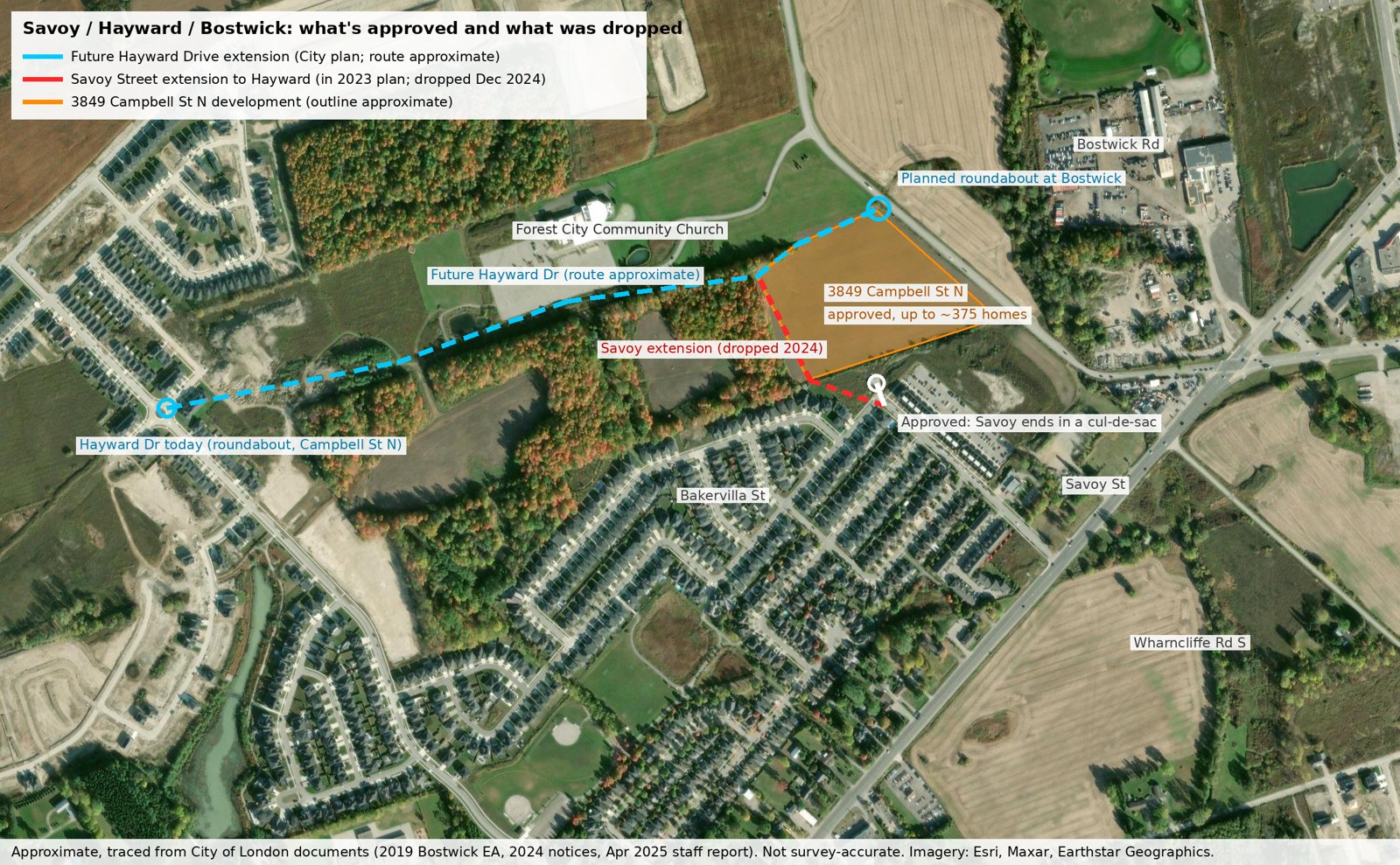
When the development north of Bakervilla was approved last year, City staff recommended extending Savoy north to the future Hayward Drive, which is planned to meet Bostwick at a new roundabout. Several neighbours asked for the same thing. The developer said the road wasn't needed, and City Hall let them drop it, as seems to be the pattern that I am intent on breaking.
If the neighbourhood wants that connection, I'll push to get it put back. Before anything gets built, the City has to approve a site plan, and that’s where the traffic study happens. From what’s publicly available, neither has happened yet, so there should still be time. What are your thoughts? I created a mockup to make it easier to visualize.
!Map of the future Hayward Drive extension, the approved development north of Bakervilla, and the dropped Savoy Street extension (Answered publicly at ward9.online/concerns/#concern-22.)
Constituent concerns (ward9.online/concerns/)
Garbage at the Wonderland Path townhouses?
On the garbage, Wonderland Path is a rental complex owned by Valour Group, so outdoor bins there are their decision and their cost. They can be reached at 1-833-582-5687 or [email protected].
If garbage is piling up, it can be reported to 519-661-4660 or service.london.ca, and the City can, and should, order the owner to clean it up. (Answered publicly at ward9.online/concerns/#concern-23.)
Constituent concerns (ward9.online/concerns/)
Matt, I have a question. If I vote for you, what will you do to keep the home...?
As is my style, I'm not going to sugarcoat it: Any council candidate who claims to have a plan to end homelessness isn’t being honest with you. A councillor making that claim is like a lone farmer trying to sell a solution to end world hunger: he may have the right ideas, but he doesn't have the capacity or the power to deliver it.
But what I can tell you is how my personal position and principles will inform every decision on the topic. My answer to your question is enforcement, plus help for the people who want it, without raising your taxes.
First and foremost, breaking the law shouldn’t get a pass. Open drug use, theft and trespassing are already illegal, and I expect those laws enforced. Parks and sidewalks belong to all of us, so encampments get cleared, with an offer of safe, clean (zero tolerance for illegal activity) shelter for anyone willing to take it. Someone who refuses help, with the attached conditions, doesn’t get to keep a public park or sidewalk.
As for the expense, London already spends about $16 million a year on homelessness, which is part of roughly $46 million across all partners. I’ve committed to voting against any property tax increase, for any reason. I want the money we already spend tied to results you can check every quarter, like how many people move from shelters into housing and stay there. And programs that aren’t delivering should be reimagined or decommissioned.
Treatment is mostly the province’s job. I’d use whatever influence my position has to push for recovery and treatment that gets people clean. Hospitals, CMHA and the province deliver the clinical care.
A vote for me is a vote for strict enforcement, with the opportunity for those who are willing to get back on their feet, without inflating your tax bill. (Answered publicly at ward9.online/concerns/#concern-24.)
Council of Canadians (London Chapter) questionnaire
In 2021 London voted to join more than 120 Blue Communities worldwide. This means we are presently committed to:
• Public ownership and operation of water services
• Recognition of water and sanitation as human right
• Phasing out / banning single-user bottled water in municipal facilities and at municipal events.
Will you commit to protecting London's status as a Blue Community and opposing any attempt to undermine these three commitments?
I reject "human right" as the term, especially for sanitation, since a right can't obligate someone else's labour. But no one should lose water access over genuine inability to pay, and working out arrears instead of cutting people off is the right thing to do.
The bottled water rule doesn't affect most residents day to day, so I'm okay with it.
My priority is public ownership of water under local control: London's water stays with London council, and not a province-run corporation.
Council of Canadians (London Chapter) questionnaire
The Fighting Delays, Building Faster Act, 2025 (Bill 60) gives the provincial municipal affairs and housing minister the power to create a business corporation to take over water and sewage services from municipalities. Although amendments now require such corporations to remain publicly owned, they are not required to operate on a not-for-profit basis. Affected municipalities would have to transfer all their water and wastewater assets, staff, debt, contracts and infrastructure to the new body. The new corporation would set water rates for municipal residents. This model would result in reduced democratic accountability and transparency as decisions about rates, investments, and operations would be made by a corporate board rather than directly by elected council; control will be transferred to the province; and outsourcing to private firms will be enabled. Legally, the Province can impose the model on municipalities it designates. Politically, at least at this stage, the government is seeking voluntary participants before using its broader statutory powers.
Do you support keeping water & sanitation publicly owned through direct control by municipalities?
Will you oppose the provisions of this legislation that threaten to reduce control of water and sanitation by municipalities?
Bill 60 is aimed at exactly this: giving the province more room to take municipal water and sanitation systems out of local hands. I want that decision staying with London council, not shifted to Toronto or handed to a province-run corporation. If Bill 60 provisions move in that direction, I'll oppose them. Direct municipal control means the people using the system and paying for it are the ones deciding how it's run, not a provincial appointee who never has to answer to a London taxpayer.
Council of Canadians (London Chapter) questionnaire
Would you vote in favour of an AI Data Center in our municipality?
If yes, what conditions would you impose? If no, why not?
My answer is only yes WITH STRONG CONDITIONS. No blanket yes or no.
I won't vote for a moratorium, but I won't rubber-stamp projects either. A data centre can earn approval by bringing its own power generation that adds real capacity to the local grid, using cooling that doesn't strain our municipal water system, and meeting noise and setback rules that protect Londoners' homes.
Those are the conditions on which I will base my decision.
Council of Canadians (London Chapter) questionnaire
Bill 5 creates Special Economic Zones where the provincial government has the power to exempt designated projects from provincial laws, regulations, and municipal bylaws. This authority could be used to waive environmental protections, health and safety requirements, labour standards, and other safeguards.
Do you support Bill 5?
Bill 5 significantly limits opportunities for First Nations consultation and consent. The legislation allows the Ontario government to bypass critical processes that safeguard species at risk, cultural heritage, and treaty rights particularly in regions like the Ring of Fire. It concentrates decision-making power in the hands of ministers and the Lieutenant Governor without mandating First Nations involvement, threatening sovereignty, land stewardship, and ongoing reconciliation efforts.
Do you support the Ontario First Nations Chiefs' legal challenge against Bill 5?
Bill 5's Special Economic Zones Act lets the province override local bylaws to fast-track a designated project. I don't find the First Nations legal challenge's theory persuasive as the reason to strike it down. That's a separate legal question from whether Bill 5 itself is good policy. My objection to Bill 5 is mine: it hands the province a tool to override decisions this city's own council makes, and I don't think Toronto should be able to overrule London on what happens in London. That's the same principle behind keeping water under municipal control. If a project needs an exemption from local rules to happen, the community it affects should be the one deciding that, not a provincial cabinet order.
Council of Canadians (London Chapter) questionnaire
What are you prepared to do to address London's opioid/street drug crisis now that funding for safe consumption sites has evaporated?
The City holds three of eleven Board of Health seats, and as councillor I'd use that to push provincial and health-system dollars toward recovery and treatment, not toward managing continued use.
The City doesn't deliver clinical treatment; hospitals, CMHA, and the province do.
Public drug use is already illegal and I want it enforced, not tolerated, with real help offered to anyone who wants it.
Council of Canadians (London Chapter) questionnaire
Affordable housing is a major concern for London voters. What actions do you think City Council should take to address the affordable housing crisis in London?
Faster approvals, not more subsidy. London's Plan already requires 25 to 40 percent of new housing be affordable, and the City already waives fees and assigns concierge staff for those units. That's real interference already. The honest fix is speed: pre-approved designs, like the federal housing catalogue, and faster permits, so supply actually grows.
Council of Canadians (London Chapter) questionnaire
The City of London employs Property Standards Officers to inspect rental properties, document conditions, and enforce municipal property standards by-laws. Would you support expanding their role to document evidence of suspected bad-faith evictions or landlord fraud, preserve that evidence, and refer well-documented cases to London Police or the appropriate provincial authorities for investigation?
This exposes a real problem: two levels of government both claiming the same job.
Property Standards Officers enforce municipal by-laws, property condition, permits, the renovation-eviction licence process. Determining "bad-faith eviction" or "landlord fraud" is a legal finding, and that authority already sits with the Landlord and Tenant Board under the Residential Tenancies Act, backed by the province's own Rental Housing Enforcement Unit and the police for anything criminal.
Layering a City investigation function on top of that doesn't fix the problem, it just gives London two agencies doing the same job with no clearer answer for tenants. Pick one. Either it stays provincial, where the legal authority already exists, or it moves to the municipal level, and if it moves, the funding moves with it. The Province downloading enforcement onto the City without downloading the money to pay for it is how you end up with an unfunded program and the same complaints a year from now.
Ottawa looked at this exact proposal and rejected it for the same reason. I'd rather push the province to actually enforce the powers it already has than build a duplicate program the City can't properly fund.
Council of Canadians (London Chapter) questionnaire
Is keeping property taxes low a priority for you?
Yes. London has a spending problem, not a revenue problem, and every tax dollar taken is a dollar out of a family's or small business's pocket.
I won't vote for any property tax increase, for any reason during my term.
Growth should pay for growth: new development should cover the roads, water, and sewer capacity it demands, so existing taxpayers aren't subsidizing someone else's expansion.
Council of Canadians (London Chapter) questionnaire
Would you prioritize any municipal needs over reducing or limiting increases in municipal property taxes?
Yes, for genuine needs. No, for luxuries.
If a real need comes up, I'd rather find it inside the existing budget by cutting lower-priority spending than reach for a tax increase. I won't vote for a property tax increase, for any reason.
London's problem is how the money already collected gets spent, not how much more we could collect.
Council of Canadians (London Chapter) questionnaire
The Best Defense Conference is an annual Canadian defense industry trade fair held at the city owned RBC Place London.
Do you think hosting a trade fair for arms manufacturers and dealers is consistent with the civic values of our city?
Would you support a request from City Council to the Board of RBC Place to discontinue hosting this event?
London has a real defence manufacturing presence. General Dynamics Land Systems-Canada builds armoured combat vehicles here, employs a significant number of Londoners, and just landed a multi-billion-dollar federal contract for a new armoured vehicle fleet. That's a legitimate local industry we rely on for protecting our sovereignty.
I wouldn't support council asking the RBC Place board to cancel the event either, and the reason goes beyond this one case. The moment government starts making subjective values judgments instead of sticking to objective ones based on law, it's picked up a double-edged sword. That sword doesn't stay pointed at whoever's unpopular today. Councils change, majorities change, and a power used to shut down an industry one council doesn't like gets turned against a different industry, or a different group of people, the next time the politics shift. Once you've established that council can ban a lawful business from a public venue because it disapproves, nobody's safe from that logic being turned on them eventually, including people who cheered it on the first time.
Council of Canadians (London Chapter) questionnaire
The rise of the far right, both internationally and, particularly, in Southwestern Ontario, is a concern for many voters. In 2017, in response to a planned rally by groups promoting racist and hateful views, London City Council passed an emergency motion condemning all forms of racism, bigotry, and hate and prohibiting hate groups from holding rallies on city-owned property. In November 2025, a far-right group hung a banner from the Wortley Road overpass with the message "Remigration Now."
What measures, if any, would you support City Council taking to prevent or respond to similar activities by far-right groups in the future?
Nobody is above the law. And nobody should feel intimidated or targeted in their own city, and I take that seriously. I would go even further. I wouldn't stop at the far-right; I support full enforcement against anyone, of any ideology no matter where they fall on the political spectrum, committing illegal acts. And, in accordance with the law, if speech is lawful, then it must be permitted. The best disinfectant is daylight.
Council of Canadians (London Chapter) questionnaire
The City of London, London Fire Department, and London Police Service are working together to build a new Emergency Services Campus. The campus will support the operational and training needs of first responders, improve regional emergency preparedness and create new spaces for public safety education. A portion of this quarter billion-dollar budget ($200-$270M) will be directed to scenario simulation and indoor and outdoor firing ranges, measures that support more militarized and aggressive policing infrastructure.
Will you commit to demanding transparency about the portion of this Emergency Services Campus budget devoted to policing, as opposed to fire, dispatch, EMS, HAZMAT response?
Will you commit to reducing the budget for the Emergency Services Campus by the amount that would be used for policing?
I'll commit to demanding real transparency on how the Emergency Services Campus budget breaks down between policing, fire, dispatch, EMS, and HAZMAT. Taxpayers funding a $200 to $270 million project are entitled to see exactly where that money goes, line by line, not a single combined number.
I won't commit to cutting the policing portion in advance, and that's regardless of whether it's even legally possible to carve one department's share out of a joint capital project after the fact. Firing ranges and scenario simulation are training infrastructure. That's how officers get and keep the skills to do the job safely, for themselves and for the public they respond to. Wanting transparency on where the money goes and pre-committing to slash a training budget are two different things.
Council of Canadians (London Chapter) questionnaire
Downtown London has many vacant commercial and heritage properties. What actions, if any, would you support to encourage these properties to be occupied, restored, or redeveloped in ways that serve the public interest? Please provide specific examples.
Cut the friction. Fast-track permits and support pre-approved designs for adaptive reuse, like turning vacant buildings into housing or retail, so redevelopment is faster and cheaper than sitting empty. Streamline heritage permitting instead of layering on more review.
A vacant building costs its owner money every month; if we make it easier to fix that, most owners will.
Council of Canadians (London Chapter) questionnaire
Should the City advocate for additional powers from the Province, such as the authority to impose a vacant commercial property tax?
Yes, I'd support the City advocating for more power from the Province generally, including the authority to levy a vacant commercial property tax if council chose to. That's a question about which level of government should have the tool available, not whether I'd personally use it.
If it came to an actual vote on imposing that tax, I'd vote against it. I'm loath to create new taxes, period, and a vacant property tax is still a new tax. My approach to vacant buildings is the one I laid out above: cut the friction. Fast-tracked permits and pre-approved designs for adaptive reuse make it cheap and quick to fix up a vacant building, so owners have a real reason to act. That gets the result a tax is aiming for, without adding another bill for a property owner who's already struggling to fill the space.
Either way, I'd rather London hold the authority to make that call for itself than need permission from Toronto to even consider it.
Hikma Public Affairs Council candidate statement
Hikma Public Affairs Council candidate statement
I'm Matt Millar, a third-generation farmer and an IT specialist, and I've lived in Ward 9 my whole life.
I'm running for council in Ward 9 because City Hall keeps raising property taxes faster than most families' paycheques grow, and I won't vote for another increase during my term, for any reason. And I drafted the proposed Pay Accountable to City Taxpayers (PACT) bylaw to tie City Council pay to our property taxes.
I want to make it faster and cheaper to build housing here, so families aren't priced out of their own neighbourhoods.
I believe every law-abiding Londoner deserves to be safe and protected, especially in the place they call home.
My website ward9.online is where you can learn more about me or ask me questions on the record, and I'm always glad to hear from residents directly.
London Chamber of Commerce questionnaire
What do you see as the principal opportunities and obstacles facing London's economy over the next Council term? What should the City do to support business growth, job creation, entrepreneurship and investment, and how should it work with employers, Western University, Fanshawe College and others to attract and retain the talent London needs?
London's biggest obstacle to growth is City Hall's own cost and approval friction, not a lack of opportunity. I'd cut both: competitive tendering on City contracts, faster and cheaper permitting for every applicant (not a selective fast-track for one favoured category), and a hard look at any fee or process that doesn't clear a real public-interest test.
On talent, the City already funds London Economic Development Corporation's work connecting Western and Fanshawe students directly to local employers, including the Innovation Park land given to both institutions for applied research; I'd measure that partnership by placements and retained graduates, and expand what's already working rather than launch something new.
Business growth follows tax and regulatory restraint. It doesn't need a new municipal incentive fund.
London Chamber of Commerce questionnaire
London now has a new Downtown Plan. Which elements would you prioritize and what results should Londoners expect to see during the next Council term? Please address the downtown business environment, public spaces, housing and office conversions, cultural and civic destinations, safety, transportation and implementation accountability.
Council endorsed a 58-action, 10-year plan called Downtown Reimagined in June 2026, built around four priorities: a river district, better public spaces, building on the UNESCO City of Music designation, and a proposed downtown coordinating authority, sometimes called a Downtown Revitalization Authority.
I'd prioritize two things this term: the public-space upgrades, since that work can start without a new funding structure, and downtown safety, since feeling uneasy or unsafe, along with traffic and parking, is the most common reason I hear for avoiding downtown. Public drug use is already illegal. Residents expect police to actually enforce that, rather than let years of informal tolerance stand in for policy. Enforcement standards don't change block by block, but the evidence right now points to downtown needing strict enforcement, officers responding to public drug use the way they would any other offence, and every public space staying open and usable for everyone.
The proposed authority is where caution is warranted: Council endorsed only the concept; mandate, budget, and funding model are still undefined, and I won't support creating or funding it until the scope and a hard budget cap are made public. Housing and office conversions downtown make sense; that's exactly where the London Plan already allows the height and density this city needs, so long as projects stay inside those designated limits rather than becoming the excuse for one-off exceptions elsewhere in the city.
Changes to downtown parking, curb space, and transit access get judged like any project anywhere: proven effect on how people actually get around, not just what a plan assumes.
London Chamber of Commerce questionnaire
London faces an urgent health and homelessness crisis. Residents, employees and businesses also have concerns about violence, property crime, public disorder and confidence in public spaces. These conditions require related but distinct responses. What actions would you support in each area, and what responsibilities should fall to the City, police, the health system, other orders of government and community partners?
Public disorder and property crime call for enforcement. Public drug use is already illegal; residents expect police to actually enforce that, rather than let years of informal tolerance stand in for policy. Every park and public space should stay open and usable for every Londoner, so encampments get cleared rather than tolerated indefinitely.
London already spends roughly $16 million a year on homelessness and shelter, with tens of millions more from partners. Before adding to that, I want proof the current dollars are producing results, not just a bigger number to point to.
On addiction and health policy, the City has a role too: it holds three of eleven seats on Middlesex-London Health Unit's Board of Health, and its zoning decided where London's supervised consumption site could locate. I'd use that role to push dollars toward recovery and treatment that actually gets people off drugs, rather than facilities built around managing continued use. What the City doesn't do, and shouldn't try to duplicate, is deliver clinical treatment itself; that's hospitals, CMHA, and the province.
London Chamber of Commerce questionnaire
What changes would you support to increase housing supply and affordability and create neighbourhoods with access to employment, services, transportation and public amenities?
The fastest way to add supply without a subsidy is to cut what City Hall charges and how long it takes.
Price is set by both supply and demand. City Hall barely touches demand: population growth, interest rates, and investment flows are out of the realm of council, but the City has a big effect on how much gets built and how fast. That's where affordability actually gets decided. A City-mandated rent cap does the opposite of what it promises: it shrinks the rental supply landlords are willing to add, making the shortage worse. But every dollar and month City Hall cuts from the cost of building is a dollar that doesn't get passed through to the renter or buyer.
Growth belongs where the London Plan already designates density: downtown, transit villages, and corridors, rather than retrofitted into established single-family neighbourhoods through the one-off exceptions Council keeps granting against its own secondary plans.
Complete neighbourhoods need the roads, water, wastewater, and transit capacity in place before approval, paid for by the growth creating the need rather than by existing taxpayers.
London Chamber of Commerce questionnaire
London's cultural facilities, venues and public spaces are essential to the life of the city, and several face age, capacity or funding pressures. What cultural infrastructure should be prioritised during the next Council term, and how should the City decide where to invest?
London's public facilities exist to serve everyone. The City should provide and maintain general-use public spaces and facilities, as economically as possible, for all Londoners. It's up to Londoners themselves to decide how they're used. City Hall's job is upkeep and access, rather than dictating programming or favouring one culture, group, or interest over another.
Where several facilities already show age, capacity, or funding pressure, the priority is maintaining what the city already owns before committing to anything new. Investment decisions should follow documented need and usage inside the existing budget.
Council should decide these priorities using the City's own asset-condition data and actual usage numbers rather than the volume of advocacy behind any one project.
London Chamber of Commerce questionnaire
London's economic success depends on reliable local, regional, national and international connections. How would you improve local transit and service to major employment areas and shift workers, intercity bus and air links, and passenger rail? What should businesses and employees be able to expect in terms of frequency, reliability and access?
I opposed BRT in 2018 and would have built this differently, but it's underway now, and my focus from here is finishing it without further cost or schedule blowouts, and making sure it doesn't come at the expense of arterial capacity for the drivers who still make up most commutes. BRT already covers the corridor a light-rail or in-city passenger line would serve, so I don't support building one. For shift workers and employment areas, service should follow where the jobs and shifts actually are, route by route against ridership.
Intercity connections are already working reasonably well: YXU's Air Canada and WestJet routes, and VIA's Toronto-London corridor running about five trips a day each way. The City's role there is advocacy for keeping and growing that service, rather than new municipal spending.
London Chamber of Commerce questionnaire
What changes would you make to municipal approvals, regulation, procurement and customer service to make it easier to invest, build and operate a business in London?
City Hall keeps adding rules and fees and almost never takes any away, and I can't repeal that pile alone. What I can do is run every regulation that comes to council through one framework: does it prevent specific harm, are the costs worth it, would it survive a four-year defence, and does the regulatory environment net grow or shrink?
I support a one-in-two-out rule so old rules retire as new ones are added, safety and accessibility codes excluded, and compiling and publishing an inventory of every business regulation, its cost, and what it actually enforces.
On approvals and customer service, businesses deserve to know how long a decision will take and who's accountable for it. I'd push for published turnaround standards and a single point of contact per application. That's the transparency I already want applied to every regulation. Procurement should be competitive by default; that saves taxpayers money and gives London businesses a fair shot at contracts they may not even know are available.
London Chamber of Commerce questionnaire
London City Council approved the 2025-2035 ReconciliAction Plan in May 2025, committing the City to 155 actions over ten years. What should the next Council do to translate these commitments into a clear, properly resourced implementation plan developed with Indigenous partners? How would you advance reconciliation through economic development, procurement, planning, cultural investment and municipal services?
Every City program gets judged by a single test in my book: does it serve every Londoner equally, does the benefit justify the cost, and does it actually work. That's the test I'd apply to the ReconciliAction Plan's 155 actions.
Procurement should be competitive by default, which is the standard I hold every City contract to: open bidding, best value, openly available to all who are qualified.
On planning and municipal services, every Londoner deserves an equally efficient process and equally good service. Cultural investment should follow the rule I'd apply to any public facility or program: the City funds general-use spaces and programs as economically as possible for all Londoners, and Londoners decide how they're used, rather than City Hall picking who gets priority.
The real gap is accountability. The Plan's own next-steps section admits an implementation strategy with actual metrics and timelines is still being developed, reviewed only once every two years. A ten-year, 155-action commitment without real metrics is just a longer speech. That's the piece I'd push the next Council to finish first.
London Chamber of Commerce questionnaire
London's growth depends on roads, transit, water and wastewater systems, emergency services and community facilities. How would you determine which investments proceed first, pay for growth fairly and maintain competitive property taxes?
Growth should pay for growth: a subdivision developer covers the roads, water, and servicing capacity a project requires before it's approved, rather than residents living with the shortfall afterward. Existing taxpayers shouldn't backstop growth they didn't ask for.
On sequencing, I'd prioritize water, wastewater, and emergency services capacity already falling behind population growth over new discretionary projects.
Property taxes stay competitive by controlling spending, and I have a specific mechanism for it: my PACT (Pay Accountable to City Taxpayers) bylaw ties councillor and mayoral pay directly to the tax levy, so every point council raises taxes becomes a permanent cut to their own pay. Council just voted itself a next-term raise almost 40% above what they were paid the day they voted for it, while property taxes rose more than 25% over the same multi-year budget. PACT raises the stakes for a council that would burden taxpayers with even higher rates.
London Chamber of Commerce questionnaire
London City Council approved the Climate Emergency Action Plan in 2022. The Plan calls for a 55 per cent reduction in community-wide greenhouse-gas emissions from 2005 levels by 2030. Which elements of the Plan would you prioritise, accelerate or change during the next Council term? How would you ensure that climate action strengthens resilience, affordability and economic competitiveness for residents and businesses?
I'd start by dropping the emergency framing itself. Naming a crisis doesn't change the physics, and it lets spending skip the cost-benefit test every other budget item has to pass. London's own numbers make that case: the City reports 94% of the plan's 200 climate actions on track or complete, while community-wide emissions are 22% below 2005 levels, against a target of 55% by 2030. A deadline is driving the activity, but the results aren't following.
What I'd prioritize and change is this: judge every dollar by what it actually reduces and at what cost, rather than bleed the city dry in the name of an emergency. The Climate Change Reserve Fund's contributions were already cut from $1 million to $192,000 a year, and most of what it's collected still sits unallocated. Money should be allocated where it can return the greatest benefit to Londoners, and I'd hold any other City program to that exact bar. The City's own modelling promises billions in returns from a 25-year investment plan that doesn't break even until the mid-2030s, but that's a projection, and I'd treat it as one until it shows up in real numbers.
Real resilience and affordability come from a strong, well-run local economy: infrastructure kept in good repair, water and stormwater systems sized properly, and emergency response funded before it's needed. Competitiveness means running a city employers can build in, with climate spending measured by results rather than symbolism.
London Chamber of Commerce questionnaire
Ontario's strong-mayor legislation gives the Mayor of London enhanced authority in areas including the municipal budget, senior administration and matters connected to provincial priorities. If you are a candidate for Mayor: How would you use these powers, when would you choose not to use them, and what standards of transparency and accountability would you apply? If you are a candidate for Council: How should Council respond when strong-mayor powers are exercised, and how would you use your role as a councillor to provide effective scrutiny and accountability?
A mayoral override belongs to genuine emergencies.
When a mayor actually uses an override, council's job is to make it cost something politically. The Act already requires the mayor's written reasons be made public; council should hold a real, open debate on that record before it's forgotten, and use the two-thirds override itself where the case for it holds up.
My own standard as a councillor doesn't change based on what the mayor could do. Every vote I cast needs to stand on its own merits, and if council's actual policy judgment ever got overridden, I'd say so publicly the moment it happened. Then it will fall to the voters to determine the consequences.
London Chamber of Commerce questionnaire
What role should arts, culture and the creative industries play in London's economic and community development? How should the City support cultural organisations, artists, venues, festivals and creative businesses while ensuring that municipal investment produces lasting public value?
While arts, culture, and creative industries can add economic and civic value to London, that value ranks below essential services when taxpayer dollars are on the line. Roads, water, police, and fire come first.
The City can promote London's arts scene without funding it directly. Marketing and cutting the red tape around venues and events cost taxpayers far less than grants, and private and philanthropic support grows the sector better than a Council vote does. If it's not actually garnering voluntary support from private individuals, does it really warrant forcing taxpayers to pick up the tab?
London already runs the London Arts Council's Community Arts Investment Program, about $800,000 a year, plus heritage and tourism-tax-funded culture spending. I'm not planning to cut what exists, but if London's budget ever forces real tradeoffs, arts funding is exactly the kind of spending that gets reduced before essential services do.
London Decides 2026 questionnaire
What is the one thing you most want to have changed in London by the end of this term? Tell us what a resident would be able to see in 2030 that shows you did it, and what you would be willing to give up to get it.
Full costing, before every vote, every time. Right now, city staff can approve contracts up to six million dollars without a single council vote, and council never even sees a report on anything under $133,800. Below that line, taxpayer money moves and the people elected to watch it don't find out unless someone files a freedom-of-information request, and even then the documents can come back redacted. By 2030, any Londoner should be able to open any city spending item and see the real cost before the money moves. Getting there means making enemies of whoever likes it this way: staff who'd rather not itemize, and any mayor who'd rather manage the message than open the books. I'm fine being the one who keeps asking the question nobody in that room wants asked.
London Decides 2026 questionnaire
A councillor is one vote of fifteen, and staff write the reports council votes on. Tell us about a time, in any part of your life, when you needed a decision from people who mostly disagreed with you and got it. Who did you have to bring around, what did you change in your ask, and what did you give up?
I'm developing Runnit, a social sports network and league/team management app. Getting anyone to actually switch from what they already use is a fight, even for free. Nobody wants to learn a new system on someone else's word that it's better. I stopped asking people to try it and started removing every reason to say no. I am helping administer a volleyball league and giving them free access. I helped a friend put his softball team on it the same way: I did the setup, waived their fees, and provide ongoing support. What I gave up was money the software could have earned, and hours of my own time. People don't get talked into change. They get walked into it, by someone willing to carry the load until it's proven.
London Decides 2026 questionnaire
Name one thing the people you'd represent will ask you for that city council cannot actually decide. Say plainly what you would tell them, who does hold that decision, and what you would do to move it anyway.
A parent came to me about school bus routes: a stop removed, kids walking a kilometre, and not being able to get a bus home after practice. I told them plainly: a city councillor has no say in that. Day-to-day routing is Southwestern Ontario Student Transportation Services, TVDSB's bus operator. Policy sits with TVDSB's own transportation office. Our elected trustees are Beth Mai and Sherri Moore, covering wards 7, 8, 9, 10, and 13, though TVDSB has been under a provincially appointed supervisor since last year, so trustees aren't currently voting on board policy the way they normally would. What I can do anyway: point residents straight to TVDSB's transportation office, and copy both trustees on it, since trustees still hear from residents and can push things along without a formal vote. I offered to make the introduction myself if needed.
London Decides 2026 questionnaire
Pick the issue you most want to be known for. Where do you feel torn on it, and what is the strongest argument against your own position?
Fiscal responsibility. No wasteful spending, full transparency on every dollar, and no tax hikes. What tears at me is saying no. A resident brings me something worth doing, and the math says the city can't afford it without raising taxes, and I still have to say no.
Here's the case against me. Refusing new revenue can mean deferring maintenance, and deferred infrastructure gets more expensive the longer a city waits. The same taxpayers pay for it eventually, just later, and for a bigger repair bill.
Prioritization is the fix. The full costing that I will be pushing for shows council the real cost of everything, so failing roads and pipes get funded first, and elective extras get delayed or cut.
London Decides 2026 questionnaire
Point us to one thing you have already done for people in London, before this campaign, that a reader could check and that shows how you would do this job. A web address is welcome.
Before I ran, I read the City's own Official Plan and used it. In June 2025, a developer proposed 31 townhouses on Lambeth's old McEachren school site, all its traffic routed through Marianna Drive's single access point, while Lambeth's one remaining public school is already capped and busing new kids out of the village. I wrote directly to Councillor Hopkins asking her to oppose the whole project, then sent a full written case at my Substack, built on the Plan's own commitments to safe, healthy neighbourhoods and real community engagement. She acknowledged the first email and never answered the second. She voted yes four and a half months later.
That's how I'd do the job: research, offer solutions, represent the will of Ward 9, and hold anyone to account who isn't doing what's best for residents.
London Emergency Services Campus candidate questionnaire
What is your understanding of the relationship between the adopted project budgets and the published phase figures? Would you support further financial commitments before a public reconciliation is available? What specific information or Council action would you seek, and when? Please distinguish your interpretation from facts established by records.
The three budget lines you name add up to $186.781 million through 2033 in the 2024-2027 Multi-Year Budget, and Business Case P-57 splits the training campus into three stages of $137.0 million, $8.0 million and $41.7 million, which comes to about $186.7 million. Those are the records. My interpretation is that the City’s $186.8 million is the business-case campus, and the $133 million and $50 million phase figures group the work differently.
The City’s Phase 1 list includes a 911 dispatch centre, an emergency operations centre and a new fire station, and P-57’s Stage 1 description mentions none of them. I won’t support any construction contract or new borrowing until a public reconciliation of the two sets of figures exists. If elected, I would seek a motion directing staff to publish it before the 2027 Class D estimates come to council.
Sources: 2024-2027 Multi-Year Budget, capital detail: PP4481 p. 218 ($79,663K), FS1095 p. 231 ($69,102K), PP4482 p. 232 ($38,016K) · Business Case P-57, Stages 1 to 3 · Phase lists
London Emergency Services Campus candidate questionnaire
Which campus components would you support proceeding with, modifying, deferring, or cancelling, and which remain undecided? Please identify the needs, capacity, safety, cost, or alternatives evidence informing your position, and what could change it. Would you seek a current component-level cost schedule and the supporting assessments before further approvals?
I support proceeding with the core training facilities: the main training building and drill hall, scenario simulation, the indoor and outdoor ranges, and the burn tower. P-57 says the training sites in Hamilton, Mississauga, York and Windsor are at capacity, and so is the Ontario Police College. It also says tactical and K9 officers often get called out of training for high-risk calls. We don't want our London tactical officers on a range in Hamilton when lives are at stake and every moment counts.
I’m undecided on the later items, including the public fire safety village, the driving track and fleet storage, because no cost for any single component exists yet. Before further approvals I’d require the component-level cost schedule along with the consultant’s feasibility study, which CTV reported council never saw when it chose the site. A clear cost per component, or a shared regional option that costs less, could change my position on any piece.
Sources: Business Case P-57 (alternatives, Stage 1 contents) · Phase 2 list · CTV News London, July 2025
London Emergency Services Campus candidate questionnaire
What is your understanding of the amount and purposes of any provincial funding request, and what source supports that understanding? Please distinguish a request from an approved contribution or money received. What should the City publish about the request and its conditions? If provincial funding is smaller than anticipated or unavailable, how should that affect the project and municipal financing?
As far as I can find, no specific provincial request is on the public record. Business Case P-57 books $0 in grants, and the City told you only that it continues to advocate to the provincial and federal governments.
At the July 2025 site approval, the mayor spoke of the “potential to partner regionally, provincially and federally,” which states an intention without an amount. I’ve found nothing showing an approved contribution or money received. The strongest case for provincial money is the space planned for the Provincial HAZMAT response unit, since that serves the province’s own program.
The City should publish the amount it has asked for and when, along with any conditions attached. If provincial money comes in smaller than hoped or never arrives, the later phases should wait, and I won’t support filling that gap with more borrowing or a tax increase.
Sources: Business Case P-57, operating table (Grants: $0) · City of London newsroom, July 22, 2025 (mayor’s quote) · Provincial HAZMAT space
London Emergency Services Campus candidate questionnaire
Would you seek a dated public account of expenditures to date, outstanding contractual commitments, uncommitted budgets, and potential termination liabilities? How would those figures inform a decision to proceed, modify, defer, or cancel work? Please distinguish money already spent from future avoidable costs, and costs arising from a change of course.
Yes. I’d ask staff for a dated public account of four separate numbers: what has been spent, what is under contract, what is budgeted but uncommitted, and what it would cost to terminate each contract.
Concrete that’s already poured is spent whichever way council votes, so it shouldn’t drive the decision. Concrete that hasn’t been ordered is still a choice.
The figures that matter are the future costs council can still avoid and the price of changing course, which includes termination costs and the extra travel and lost training days P-57 says would come with training elsewhere.
I’d judge each component on what’s left to spend against what it delivers, and I’d defer or cancel any piece where that comparison doesn’t hold up.
Source: Business Case P-57 (costs of training in other cities)
London Emergency Services Campus candidate questionnaire
What financing approach would you support across the police and fire project accounts, including debt, reserves, development charges, and other contributions? Would you require a consolidated financing plan before further approvals? Please identify any limits or conditions you would seek to protect municipal finances, distinguishing adopted financing from forecasts and actual receipts.
Business Case P-57 financed all $204.7 million of its additional capital with debt repaid from property taxes, and it booked $0 from reserves, development charges or other governments. That package also covers police headquarters work, and it carries $77.3 million in debt payments from 2028 to 2033, about $12.9 million a year.
The business case put its 2026 tax impact at 0.78 percent, or $30.98 on an average residential property. I won’t vote for a budget that raises property taxes during my term, so I’d require a consolidated financing plan across the police and fire project accounts before any further approvals, showing each source and separating adopted financing from forecasts and actual receipts. My conditions would be no new borrowing beyond what council has already authorized, and any provincial or federal money applied to the debt first.
Source: Business Case P-57, capital budget table and tax levy impact table
London Emergency Services Campus candidate questionnaire
If Ontario contributes funding, what should it change: municipal borrowing, reserve use, other municipal contributions, project scope, timing, or property-tax requirements? What public accounting would you require to show how the contribution was applied and whether any claimed municipal savings occurred?
Provincial money should pay down borrowing first. P-57 finances its additional capital with debt carried on the property tax bill, so every provincial dollar that replaces a dollar of debt also removes years of interest on it.
I wouldn’t let a contribution expand the scope or pull later phases forward, and any change in scope should come back to council as its own decision with its own price. To show how a contribution was applied, I’d want staff to report it in the capital budget, naming the project account it went to, the debt it replaced and the change to the forecast tax levy.
A year later, council should get a check against actual results showing whether borrowing and the tax impact fell by the amount promised. If the savings don’t show up on your tax bill, you deserve to know why.
Source: Business Case P-57, capital budget table (debenture financing)
London Emergency Services Campus candidate questionnaire
You may add up to 150 words identifying a material omission, correcting the premise, or explaining a position not adequately covered by these questions. Evidence supporting particular facilities, or showing that changing course would cost more, is welcome.
Two items are missing from the public record. The first is the consultant’s feasibility study behind the site and the budget, since CTV reported in July 2025 that council approved the Manning Drive site without seeing it. I’d like to see that released.
The second is revenue. P-57 says the consultant projected a net gain of $243,000 by year 12 from renting training space, assuming 75 percent use of the key spaces, and that London Fire could become a regional training centre for surrounding departments. Neighbouring services that train here should pay their share, and council should see that rental plan before it approves Phase 2.
Sources: CTV News London, July 2025 · Business Case P-57 (revenue projection; regional training centre)
London Free Press candidate survey
The base salary for councillors elected in October will be boosted to more than $94,000, with a recommendation that council should be treated as a full-time job as a result. Will council be your sole occupation?
No. I'm not giving up the family farm to become a full-time politician, and I'm opposed to pinning council salary to more than what 70% of full-time working Londoners earn. That's why I drafted the Pay Accountable to City Taxpayers (PACT) bylaw. Making council a career discourages the kind of people this job actually needs: those who understand what it's like to run a business, meet a payroll, or work a trade, because they're still doing it. Staff already do the day-to-day work of the City. Council's job is to set direction and represent the will of their constituents.
London Free Press candidate survey
What are your top three priorities, if elected?
1. Making sure every single tax dollar extracted from hard-working Londoners is treated with the respect it deserves.
2. Getting traffic flowing efficiently through the city and planning for construction intelligently.
3. Rein in the ever-expanding government tentacles and redirect that energy into the core functions that Londoners really care about.
London Free Press candidate survey
Which city politician, past or present, do you best identify with?
None, really. That's the reason I'm running. I'm not here to become part of the status quo. I'm here because we need something different at City Hall.
London Free Press candidate survey
What is your vision for London?
My ideal London spends every dollar in the budget like it belongs to a taxpayer, because it does. It's a city where crossing town doesn't mean fighting red lights and rerouting around construction on every alternate route. Families don't have to worry about strangers prowling their neighbourhoods for vehicles and yards to loot. City Hall does its core job well, and then it gets out of the way and lets residents prosper, along with the entire city.
London Free Press candidate survey
What is the biggest challenge facing London right now?
Getting City Hall to listen to what Londoners actually want instead of trying to coerce Londoners into what City Hall thinks we should want.
London Free Press candidate survey
What sets you apart from other candidates?
I've lived on the same Ward 9 property my whole life, as a family farmer and tech professional.
Specific to this election, I've actually drafted a bylaw that I intend to introduce if elected. The PACT bylaw is on GitHub for anyone to read, version by version, before they decide whether to support it. I also built a public tracker at ward9.online asking every council and mayoral candidate in London, not just Ward 9, to put their position on PACT on the record.
London Muslims Vote candidate questions
Will you support, and vote to fund, the City of London's Action Plan to Disrupt Islamophobia?
No. Every Londoner should be able to walk to their place of worship or the grocery store without being threatened, and anyone who attacks or threatens someone for their faith, or any other reason, should face the full force of the law.
But any City program gets judged by the same test in my book: does it serve all Londoners equally, does the benefit justify the cost, and does it actually work? A plan built around one specific group doesn’t pass the first test, and I’d give the same answer to a plan built around any other specific group.
London Muslims Vote candidate questions
Should employers, starting with the City and school boards, give staff time for Friday (Jumu'ah) prayer and religious holidays?
No. I wouldn’t expect employers to make special exceptions for any group, and I’m an advocate for personal responsibility: each individual should choose a job that fits their lifestyle. The City has to follow Ontario’s Human Rights Code like every employer, and I wouldn’t push it beyond what the law requires.
School boards set their own staff policies, which is outside council’s authority.
London Muslims Vote candidate questions
Should the City of London adopt the IHRA working definition of antisemitism?
No. The City shouldn’t adopt any definition that turns speech into a category for enforcement, whoever it’s meant to protect. My bar is the criminal law: threats, violence and harassment get enforced against anyone, of any background or belief.
London Muslims Vote candidate questions
Do you support the right to protest peacefully for Palestine, including on university and college campuses?
Yes. Peaceful, lawful protest is a right for every cause, on every side, and the City should treat every cause the same on its public property. Illegal acts get prosecuted no matter the cause.
Campus rules are set by the universities and colleges themselves, which is outside council’s authority.
London Muslims Vote candidate questions
Should the City limit the number of new cannabis stores?
No. The province’s AGCO licenses cannabis stores and already keeps them at least 150 metres from schools. Council’s formal role is a written comment during a 15-day public notice. I won’t ask the province to cap a lawful business because of how anyone feels about the product.
Where a specific location doesn’t fit a neighbourhood and faces opposition, I’ll stand with the residents.
London Muslims Vote candidate questions
Should drinking alcohol be allowed in City parks?
No. Ontario law bars drinking in public places unless a council designates them, and I wouldn’t vote to designate London’s parks.
London Muslims Vote candidate questions
Should the City further restrict payday lenders?
No. While their practices seem predatory, adults should have the option. Ontario already regulates what they can charge, and beyond that I’d leave it to the market.
London Professional Fire Fighters Association Election Survey
How familiar are you with current operational/staffing/infrastructure/labour-relations issues facing LFD?
Not very familiar
London Professional Fire Fighters Association Election Survey
What do you believe are the most significant challenges currently facing the London Fire Department?
In my view, the biggest challenge facing London Fire right now is probably keeping pace with growth. Ward 9, and London as a whole, is adding new structures fast, and I think call volume and response-times are going to keep climbing before the city's capital planning catches up with your needs.
I'd also suspect recruitment and retention. The job is tough, you're competing for skilled people in a tight labour market, and I think that pressure is only going to grow.
London Professional Fire Fighters Association Election Survey
Would you like to visit a station or do a ride along?
Yes
London Professional Fire Fighters Association Election Survey
Maintaining appropriate staffing/apparatus/station coverage is a core municipal public-safety responsibility (1-5 scale)
5, Strongly Agree
London Professional Fire Fighters Association Election Survey
Do you support regularly reviewing staffing/deployment as population/growth/call volume increase?
Yes
London Professional Fire Fighters Association Election Survey
Do you support long-term investments in staffing/stations/apparatus where growth/operational need shows they're needed?
Yes
London Professional Fire Fighters Association Election Survey
When Council considers investments in fire protection, what factors should determine appropriate firefighter staffing, apparatus and station infrastructure?
I think the biggest factor should be actual demand. That means looking at population growth, call volume, and response-time data by area, instead of relying on historical allocation or whichever part of the city has always gotten attention. If Ward 9 and other growing areas are seeing more calls and slower response coverage, that should show up directly in where new stations, apparatus, and staffing get prioritized.
I also think council needs to look at whether a dollar spent gets the most protection for the community, which means being open to shared-facility or co-located models where it makes sense. And staffing decisions should be driven by actual workload and safe response levels.
I don't think fire protection is a place to cut corners to save money, but I also think every dollar needs to be justified by what it actually buys in coverage and safety, not by tradition or politics.
*Section 4 — Labour Relations & Accountability*
London Professional Fire Fighters Association Election Survey
Would you support meaningful consultation with frontline firefighters/LPFFA on decisions affecting safety/staffing/equipment/working conditions?
Yes
London Professional Fire Fighters Association Election Survey
Do you believe a firefighter whose death is legally recognized as resulting from an occupational injury or disease arising from their firefighting career should receive appropriate line-of-duty recognition regardless of whether the firefighter was active or retired at the time of death?
Need more information (no comment field existed on this question)
London Professional Fire Fighters Association Election Survey
Should families of work-related deaths receive established line-of-duty benefits?
Yes
London Professional Fire Fighters Association Election Survey
Would you commit to open dialogue with LPFFA, station visits, Fire Ops 101?
Yes
London Professional Fire Fighters Association Election Survey
Anything else you'd like LPFFA/families to know?
I'll approach every budget and staffing decision for the fire department by looking at the actual data and the actual need. I don't think public safety is a place for shortcuts, and I don't think your professional judgment about what the job requires should be overridden by people who've never done it. If I'm elected, you'll find me straightforward to work with, even when we don't agree on every detail.
London and District Labour Council questionnaire
Do you pledge to run an ethical and principled campaign? Is there anyone that you would not accept campaign contributions from?
Of course I pledge to run an ethical and principled campaign. Every contribution to this campaign is tracked and reported under the rules that govern municipal campaign finance, and I will stay well within those bounds. There are other candidates with big money behind them. I am grateful for every dollar that comes in from my grassroots supporters.
Further, my principles and priorities are already public, on the record before a single dollar came in. Anyone who gives to my campaign should give with that knowledge: my position was set based on my own principles and what I believe is best for Ward 9, and it won't move because of any contribution. I'll put every dollar to work getting my message out to voters for the benefit of Ward 9, and London as a whole.
London and District Labour Council questionnaire
What do you consider to be the most important priorities for the City of London?
Two things come before everything else for me: Does council actually listen to the residents it represents, and is the City delivering real value for the tax dollars it already collects.
On the first, too many decisions get made by following a staff recommendation over resident opposition, then defended afterward as inevitable. I want a council that weighs a resident's objection when it reviews a file.
On the second, property taxes have gone up well above inflation three years running. I will not stand for them to increase any more under my watch. I want every dollar the City takes from a hard working Londoner justified against a measurable result: transit that runs where the riders actually are, roads that keep moving, core services delivered efficiently and on budget. Everything else I'm running on, from how the City handles growth to how it spends, comes back to those two questions.
London and District Labour Council questionnaire
Provide your views on the status of public services and unionized workers for our city. What are your plans for a just economy that supports working people?
Transit operators, water and wastewater crews, and everyone else who keeps this city running in a unionized role do real, skilled work residents depend on every day. I don't doubt that for a second.
Government, at any level, isn't built to engineer a "just" economy. Every serious attempt at it ends up picking winners and creating losers. What actually supports working people is a City that does its own job well: deliver core services efficiently, and keep property taxes and the cost of doing business in London as low as possible. That does more for a working family's paycheque than any citywide economic-justice program could.
I'll judge every City service and every City contract on whether it's delivered efficiently and priced competitively, because that's what keeps taxes from climbing faster than paycheques do. That's the standard I'd apply to how the City treats the people who work for it too: compensation and benefits benchmarked to equivalent private-sector roles, reviewed in the open every term.
London and District Labour Council questionnaire
Do you agree with a raise to the minimum wage and ten paid sick days for all workers? Should the City be a living wage employer?
My opinion on minimum wage is moot since it's set by the provincial government. Where I do have a vote is over what the City itself pays.
Council's own November 2025 vote disgusts me. Councillors voted 9 to 6 to peg their pay to the 70th percentile of London full-time income, which sets next-term pay at over $94,000. That is almost 40% above the $67,420 they were being paid when they cast that vote, and signals that they believe they deserve to earn more than 70% of full-time working Londoners. I definitely would have opposed that, and I've drafted the PACT bylaw that cuts councillor pay whenever council raises the tax levy.
On the employment side, I want City compensation, for staff and for the contractors the City hires, measured against private-sector equivalents, taking both pay and benefits into consideration. Public sector workers should be well compensated, but it should not be more lucrative than a private-sector equivalent. On sick leave specifically, City of London unionized staff already accrue 1 sick day per month up to a cap of 85 days under CUPE Local 101's current agreement. Ontario law only guarantees private-sector workers 3 unpaid days a year, nothing paid, and, nationally, only 64% of employees have access to any paid sick leave at all. That gap is worth being honest about.
London and District Labour Council questionnaire
What would you do to promote local public services and good union jobs in our community? Do you support door-to-door mail delivery? Explain your view.
If a City service is worth having, London residents already know about it and use it. Needing an active promotion campaign to justify its existence is itself a sign the service deserves a harder question: is it worth the tax dollars funding it?
Job creation belongs to the private sector. The City does need to employ people directly for essential services like London Transit, London Water, and City Hall itself, and the people doing that work should be compensated on par with a private-sector equivalent.
In a perfect world, door-to-door mail delivery beats a community mailbox for every household. That's a federal Canada Post decision though, outside what a City Councillor can control.
For local jobs more broadly, my focus is on what council controls: the cost and speed of getting a business open or expanded here. Every month a permit or request sits waiting, or a fee gets added to a project, is a month a local employer isn't hiring or a dollar that isn't going towards providing jobs. Removing that friction is the most direct way council can get out of a local employer's way.
London and District Labour Council questionnaire
What are your ideas about addressing the affordability and housing crisis in London? What is your position on a renoviction bylaw?
London's rental unit repair licence requires a landlord issuing an N13 renovation notice to apply for a City licence within seven days, backed by a building permit and a qualified professional's report confirming the unit genuinely needs to be empty. It's been in force since March 2025. The City's own review found only seven applications for the special licence so far, which tells me it's catching bad-faith cases without choking off legitimate repairs. I support keeping it. The problem it targets is a landlord using a fake renovation to end-run an eviction the Landlord and Tenant Board would never approve. That's exactly the kind of narrow, provable harm that justifies a rule.
On affordability more broadly, my read is that London's own approvals process is a real part of the cost problem. Every month a housing application sits waiting for a decision adds carrying costs that get passed straight into the price of the unit. I want faster, more predictable approvals and fewer site-specific exceptions granted off-plan, so a builder can price a project accurately. A subsidy program only stretches to cover a handful of units, while faster approvals lower the cost of every unit that gets built. On the other side of supply and demand is demand itself, which council can only move secondarily. Making London a place fewer people want to live, just to bring prices down, would be treating a symptom of failure as if it were a policy win. My focus stays on supply, where council actually has the tools to help.
London and District Labour Council questionnaire
What will you do to further embed equity and social justice in London? How will you commit to the Indigenous Truth and Reconciliation process with concrete actions?
Every Londoner should get equal weight and equal treatment from City Hall. Period. That's the standard I'll hold every City program and every City decision to, and it's the one I'd want applied to me too.
On reconciliation specifically, Council approved a ten-year ReconciliAction Plan in May 2025, built from direct input from Indigenous community members through focus groups and a survey, guided by the Truth and Reconciliation Commission's Calls to Action. My job, if elected, is to carry through the commitments already in motion, and examine anything still open to change against that same equal-treatment standard, with real metrics tracked and reported publicly.
London and District Labour Council questionnaire
Explain your plan for addressing the climate crisis and comment on specific details to date on how London City Council has worked on environmental issues.
London declared a climate emergency in 2019. The City's own 2025 progress report shows corporate greenhouse gas emissions rose 4 percent the previous year, even as Council approved a million dollars annually for the Climate Change Reserve Fund and then cut that down to $192,000. By the end of 2024 the fund held $1.19 million, but only about $225,000 of it had reached an actual project, while a backlog of requests worth well over a million dollars sat waiting behind it. Money sitting unused and emissions still climbing is not the record of a plan that's working.
Where I'll support spending is on projects with a plan, a cost, and a real measurable benefit attached before council approves the money: stormwater capacity, tree canopy, and energy retrofits on City buildings that pay for themselves in avoided utility costs or provide a real tangible benefit to Londoners. Those are projects I can defend to a taxpayer because the return is provable. Before any new dollar goes toward the reserve fund, I want a plan that names the result it buys and how we'll know it worked.
London and District Labour Council questionnaire
How would you approach applications to build data centres for use with A.I. in London?
I won't support a blanket freeze on data centre applications. It treats every site the same when the sites aren't. Some proposals would pull hard on the local power grid, run noisy equipment near homes, and lean on the municipal water system to cool it. Others don't. Burlington is reviewing a data centre application that's built air-cooled, drawing no municipal water for cooling, going through ordinary site plan review like any other large building in the city.
I'll vote for conditions on approval. A project has to bring its own power generation that adds real capacity to the local grid, use cooling that doesn't strain the municipal water system, and meet noise and setback rules that protect the homes nearby. Construction on a project like this employs real people, but that work is temporary. Permanent staffing once a facility is operating is a small fraction of the construction workforce. I want the approval to lock in the lasting return too: local property tax assessment growth, and grid capacity the whole city benefits from when the generation condition is actually enforced. Approve the ones that meet the tests. Refuse the ones that don't.
London and District Labour Council questionnaire
Do you support a change in provincial law that would allow London to charge a vacancy tax for commercial buildings? How will you approach downtown landlords to revitalize economic activity and build a livable city?
My focus for downtown is on what actually gets a vacant storefront filled: cutting the cost and time it takes a small business to open in the first place. A landlord leaves a unit empty when the return on finding a new tenant doesn't clear the cost and delay of permits, inspections, and zoning approvals stacked on top of the lease itself. That's the first cost I'd go after.
Beyond that, downtown revitalization comes back to the basics every other part of the city needs too: reliable transit that actually gets people downtown, streets that are easy to park on or walk to, and predictable approvals for the businesses and housing that bring foot traffic back. Feeling unsafe downtown, from open drug use, disorder, and streets that don't get cleaned, keeps people and customers away as much as any permit delay does. Public drug use is already illegal. I expect the law enforced downtown, as it should be everywhere else in this city. An empty storefront is a signal that opening a business downtown currently costs too much, in dollars and in safety. Fixing both is what fills the space.
London and District Labour Council questionnaire
Would you support the City of London divesting from municipal water / hydro resources by way of a Municipal Services Corporation?
London Hydro already operates at arm's length from City Hall. It's a corporation with its own board, and the City is its sole shareholder, receiving an annual dividend. Any further change to how these services are structured needs to clear one bar for me: does it actually improve service and value for the ratepayer, without quietly moving costs or debt off one column of the City's books and onto another.
Water and wastewater are different. The City runs those directly today, and I'm cautious about moving an essential service Londoners can't choose an alternative for further from direct public accountability. If a restructuring proposal ever comes to council, I'd want to see the real financial case and exactly what oversight ratepayers keep before I'd support it.
London and District Labour Council questionnaire
If elected, what steps will you take to stay in communication with the London and District Labour Council?
I'll make myself equally and readily available to every constituent I represent, with no special treatment and no exceptions, including LDLC. If a decision in front of council affects the people you represent, I want to hear about it before the vote, exactly as I would from any other group or resident raising a concern. My website at ward9.online is a pilot project for receiving and responding to feedback, and I'm always open to new ideas for more effective communication.
Luis Claro (CLARO) Regulatory Journey Ledger candidate review
Should London provide applicants with a consolidated early view of the known regulatory constraints affecting a property or project?
Definitely.
Luis Claro (CLARO) Regulatory Journey Ledger candidate review
Should repeated variances, duplicate reviews, late-discovered requirements and sequential handoffs be reviewed to determine whether they can be simplified or coordinated?
Of course
Luis Claro (CLARO) Regulatory Journey Ledger candidate review
If elected, would you support formally reviewing mechanisms such as a Cumulative Development Constraint Test, One Property/Site Regulatory Pre-Check, Regulatory Handoff Ledger, Duplicate Review Test and Consolidated Property Status Record?
If it eases the regulatory burden on citizens and streamlines processes, I am all for it.
Nature London 2026 candidate questionnaire
In terms of your enjoyment of nature in London, what do you see as the difference between a park and an environmentally significant area?
I'm blessed to live and work on my family farm, so I get to enjoy nature in London daily. I see a park as a maintained space designed for public use, while an Environmentally Significant Area is land left alone on purpose because of what naturally exists there.
Nature London 2026 candidate questionnaire
For new developments adjacent to the city's Natural Heritage System, an Environmental Management Plan is a requirement for the developer. Has this proven to be a useful process? What improvements would you recommend?
I can't tell you if the Environmental Management Plan process has proven useful, and that's the real problem. A developer writes the plan, the City approves it, and the developer funds monitoring for years afterward, checked at set intervals after construction. All of that data goes to the City. None of it gets published anywhere a resident or a councillor could check whether a development actually followed through. A process nobody outside city hall bureaucracy can verify hasn't proven anything either way.
My improvement: publish EMP compliance details and outcomes, plan by plan, so council and residents can see whether the monitoring milestones were actually met, not just that a plan was filed on paper.
Nature London 2026 candidate questionnaire
Have the Environmental Management Guidelines served their purpose? What improvements would you recommend?
I can't give you a real answer on whether the Guidelines are too strict, not strict enough, or right where they should be. That takes seeing years of outcomes: how many Environmental Impact Studies got rejected or scaled back, how many Environmentally Significant Areas came close to losing protection, how many projects were stalled or abandoned, or how monitoring actually played out. None of that gets published in a form residents or council can review, so nobody outside city hall can make that call either.
I'd push for the same improvement as the last question: full transparency. Publish outcomes so residents and council can eventually judge whether they're working.
Neighbourhoods London "Building London Survey"
What housing types do you think our policies and incentives should prioritize?
- One bedroom units: Low priority
- Two bedroom units: High priority
- Three bedroom units: Medium priority
- Townhouses: Low priority
- Small detached houses: High priority
- Medium detached houses: High priority
- Student housing: Low priority
Neighbourhoods London "Building London Survey"
Optional: How will your initiatives and policies help to increase the supply of your highest priority selections?
Faster approvals and pre-approved designs cut the time and cost between an idea and a building, so builders can respond to what people need. Growth should pay for growth, so the roads, water and sewers are in place before approval.
Neighbourhoods London "Building London Survey"
What will your primary strategy be for making housing more affordable for low income earners?
Other: Cut red tape and make approvals faster and easier, so builders can respond to what the market actually needs. I don't want City Hall directing the housing market from the top down.
Neighbourhoods London "Building London Survey"
Describe your strategy for improving housing affordability for the middle class.
The same approach. Faster permits and pre-approved designs lower what it costs to build, and that matters most in the middle of the market, where there are no subsidies to lean on. I'd rather lower the City's costs on builders than add programs that cost taxpayers money.
Neighbourhoods London "Building London Survey"
How likely are you to support motions designed to protect our urban tree canopy if it holds developers to stricter standards and limits site coverage?
3 (scale 1 Totally unlikely to 5 Extremely likely)
Neighbourhoods London "Building London Survey"
What height limit should we put on buildings that share a property line with established neighbourhoods (Neighbourhood Place Type)?
Other: I'm not as concerned with height as I am with density and type. A taller detached house among detached houses is fine. A walk-up apartment or multi-unit building is not.
Neighbourhoods London "Building London Survey"
How important are the following factors when evaluating infill construction?
- Height: Somewhat important
- Density: Priority factor
- Setbacks: Priority factor
- Site coverage: Somewhat important
- Traffic volumes and safety: Priority factor
- Appearance: Not important
- Housing type: Somewhat important
- Greenspace/tree removal: Somewhat important
- Neighbourhood need for housing type: Priority factor
- City need for housing type: Not important
Neighbourhoods London "Building London Survey"
How well do you think we're doing at keeping neighbourhood roads safe as we add new infill development (and cars)?
3 (scale 1 We're not doing well to 5 We're nailing it)
Neighbourhoods London "Building London Survey"
How will your development policies and decisions better support local businesses?
Faster, simpler approvals help local builders and contractors most, because small companies can't afford staff to chase paperwork.
Making growth pay for its own roads and sewers also keeps that cost off existing local businesses.
And a developed neighbourhood with happy families is good for business.
Neighbourhoods London "Building London Survey"
Which of the following concerns do you share with Londoners?
- Staff planners are recommending projects with too many special provisions: Very concerned
- Developers are using increased density limits as a stepping stone to even higher density approvals: Very concerned
- Infrastructure isn't keeping up with development: Very concerned
- We're not investing enough into community ammenities: Somewhat concerned
- Housing needs and what we're building are not aligned: Very concerned
- Developers' applications often include misrepresentations in order to skirt the rules: Don't know
- There is too much land banking and land speculation: Somewhat concerned
Neighbourhoods London "Building London Survey"
The Ontario Land Tribunal approves 97% of the applications that come in front of them even though they were locally rejected. Will you advocate for London to regain control over decision-making? If so, how?
Yes. I'd ask the Province to restore local decision-making. In the meantime, council can make its decisions harder to overturn by following the London Plan and refusing one-off site-specific exceptions, so an appeal has less to pick apart.
Neighbourhoods London "Building London Survey"
Tell us anything about your housing and development platform that you want Londoners to know that this survey doesn't capture.
My opinions on housing aren't set in stone, and good input from the community could easily change them. What I do want is to make building easier, faster, and cheaper for builders, because that gets more affordable homes built sooner. The types of homes we build should be dictated by market demand, and not by what someone downtown wants to have built.
No More Noise Municipal Candidate Promise survey
Do you agree to push the province for automated enforcement?
We are asking municipalities to pass formal council resolutions urging the Province of Ontario to amend the Highway Traffic Act so it can allow for automated noise enforcement pilots in our cities.
No. I'm against fixed cameras surveilling London’s citizens on principle, and a noise camera is another fixed camera reading licence plates, so I will oppose them.
No More Noise Municipal Candidate Promise survey
Do you agree to modernize the Operating Definition of Noise within your city?
The current operating definition of most noise in municipal bylaws is 'unwanted sound'. This definition requires for residents to complain about noise before city government action can be taken. 'Unwanted and/or harmful sound' allows for municipal governments to take proactive, health-focused enforcement action, reducing the need for people to report noise issues.
Not sure. I could support updating the City’s definition of noise if the new one is objectively measurable and backed by solid evidence. “Harmful” on its own is too vague to enforce fairly.
No More Noise Municipal Candidate Promise survey
Do you support the implementation of Traffic-Calming Design for existing and new roads in your city/ward?
Speeding, aggressive driving and high motor traffic volume all create unnecessary and unhealthy noise. Traffic-Calming designs that reduce vehicle speed, volume, and aggressive driving also reduce noise.
No. My mobility plan rests on one idea: when the arterials flow, your neighbourhood stays quiet. Traffic forced off a backed-up main road brings its noise right to people’s front doors, so I won’t support calming that pushes cars onto side streets, but calming may be warranted on a residential street when measurable data shows a clear problem.
Panopti.ca ALPR questionnaire
Do you support or oppose the deployment of fixed ALPR cameras in your municipality? Please explain your reasoning.
London Police Service already operates mobile ALPR on about 50 cruisers, with a completed privacy impact assessment and a stated policy of deleting non-hit data immediately. An officer is behind the wheel deciding where and when to drive, and, most importantly, non-hit data is deleted and not stored in a database. I can live with that system on the condition that the stated policy is actually followed and independently verified, not simply assumed.
A fixed camera network is different. It runs continuously with no officer making a judgment call, and it builds a permanent, searchable record of where every vehicle in the city has been. Waterloo activated exactly this kind of fixed CCTV and ALPR network in June, with more communities expected to follow. I oppose it for London.
My objection is not only that government would hold this data. I do not trust a private company to compile mass surveillance data on citizens either, whether the customer is a government or anyone else. A fixed network built and hosted by a vendor does not solve the problem by moving it outside City Hall. It adds a second party with access to the same compiled record. A permanent, always-on database creates its own risk regardless of who holds it or how careful today's policy looks: it invites expansion, becomes a target for a breach, and creates pressure to widen its use over time.
Panopti.ca ALPR questionnaire
If ALPR procurement, renewal, or expansion (e.g. contracts with vendors such as Flock Safety, Genetec, or Motorola Solutions) came before council or the police services board, how would you vote?
I would vote against any fixed ALPR network and against any procurement or contract, including with Flock Safety, Genetec, or Motorola Solutions, that expands London toward one. Flock Safety in particular has a documented pattern in the United States: agencies outside a customer's own department gained access to its cross-jurisdictional lookup network despite the company's own policies saying otherwise. A vendor's privacy promises are not a substitute for a hard limit written into the contract, the bylaw, and the system's own code. Any contract has to make the code source-available to the City, either under a non-disclosure agreement or through a forensic audit by a third party of the City's choosing, paid for by the vendor. That floor is non-negotiable: a vendor unwilling to meet it doesn't get the contract.
Renewal of the existing mobile program is a separate question, but it's still a contract. The same code-access floor applies, plus independent proof that the current retention and access rules are actually being followed, not just restated.
Panopti.ca ALPR questionnaire
What limits, if any, would you require on ALPR data: retention periods, access controls, independent audits, public reporting?
Ontario's own Information and Privacy Commissioner published detailed guidance on police ALPR use in December 2024: delete non-hit data immediately, log every manual search with the officer's name and reason, run periodic independent audits, and publish the retention period, camera locations, and policy publicly. I would hold London to that standard rather than to something weaker.
For non-hit data, the Commissioner's standard is immediate deletion: a scan that doesn't match a stolen vehicle, wanted plate, or similar alert must be purged the moment that's confirmed. Toronto's public policy instead keeps all scans, hits and non-hits alike, for 365 days before purging. That is a real gap between what the province's own privacy watchdog recommends and what a major Ontario police service actually does, and it is exactly why I want an independent audit confirming what London actually retains and deletes, reported publicly on a fixed schedule. The cost of that audit belongs to the vendor selling the system, not to taxpayers.
Panopti.ca ALPR questionnaire
Would you permit ALPR data collected in your municipality to be shared with other police services, federal agencies, or entities outside Canada?
No, not by default, and not through a standing agreement with any vendor or police service. Data collected here should stay with the department that collected it unless a specific request, with its own legal basis, says otherwise.
"The data will only be used for its stated purpose" has already failed in Canada without anyone acting in bad faith. In 2012, British Columbia's privacy commissioner found that Victoria police's ALPR data, run on an RCMP-shared system, was being passed to the RCMP and kept past the point its stated purpose, checking plates against a stolen-vehicle and violation list, was served; the province forced the RCMP to reconfigure the system to delete that data instead. A federal contractor's network was separately breached in 2019, exposing more than a million licence-plate images collected under a different federal program; over ten thousand were confirmed leaked, some more than a decade old, and a 2022 federal privacy finding held the government responsible even though the contractor's own network was the actual point of failure. This survey names Flock Safety as one vendor selling this kind of system, and reporting in the United States has documented tens of thousands of its cameras searched directly by outside agencies, on exactly the kind of shared network this question is asking about.
I will not approve a program, or a vendor contract, that lets data leave the department that collected it except through a specific request tied to an active investigation or a court order. No standing agreement hands data to another police service. No federal agency gets default access. And nothing crosses the border to any entity outside Canada: once it does, it's outside the reach of Canadian courts and Canadian privacy law entirely. That distrust runs both directions. Government should not get to misuse this kind of data, and government should not get to hand a private company permission to compile it either, for its own use or anyone else's.
Panopti.ca ALPR questionnaire
What role should public consultation play before surveillance technology is acquired? Would you commit to a public privacy impact assessment?
Yes. A privacy impact assessment should be public before council votes, not filed away after, and residents should get a real comment period long enough to actually respond, not a notice posted the week of the vote.
London Police Service's existing mobile ALPR program already went through a privacy impact assessment before deployment. That is the right bar. I would apply the same bar publicly, in advance, to anything new: the specific problem the system is meant to solve, what was tried instead, and why this tool and this scale are proportionate to that problem, not just proportionate to what a vendor is selling.
The City having source-available access under contract doesn't mean the public has it. On top of that floor, I would push for the source code to be published outright before any contract is signed, so independent experts and any resident who wants to can review it while a vote can still be changed by what they find. Most vendors will refuse that. Where full public release can't be negotiated, I would still want an independent expert to examine the code and publish their findings before the vote.
I oppose a fixed ALPR system outright. No privacy impact assessment or public process changes that. For the mobile program already in place, renewal carries the same conditions as any new contract: the code-access floor already described, a public privacy impact assessment, and a genuine public comment period, all in advance and all on the record before the vote. Skip any of those steps on a renewal, and I vote no regardless of what the system itself does.
Panopti.ca ALPR questionnaire
Where would you direct the money an ALPR program would cost, if not to ALPRs?
Not every dollar not spent on fixed cameras has to go somewhere else. If a program doesn't clear the bar on its own merits, the money goes back to taxpayers, not into a different program by default.
But where I would send it is neighbourhood patrol, because the crime I care about here, vehicle break-ins, shed and garage theft, things taken off porches, is significantly undercounted. Only about half of break-ins and vehicle-related thefts ever get reported to police, and 57% of people who skip reporting say it's because they don't believe police can recover the property anyway. London's theft-from-vehicle count rose nearly 46% in 2025, and the national clearance rate for motor vehicle theft sits under 10%. That gap means official crime statistics understate this problem by design, so I would not have London rely on police-report maps alone to decide where officers go; resident associations, insurance claims, and non-emergency call volume pick up patterns that never make it into a report, and those should count too.
The research favours visibility over volume: officers deployed to known problem locations cut property crime by roughly a third in controlled studies, while patrol spread thin and randomly across a whole area showed no effect. I would fund that: consistent, visible patrol in the neighbourhoods this combined picture, formal reports and informal ones, actually points to, not a camera network.
Panopti.ca ALPR questionnaire
Would you commit to timely, complete responses to freedom-of-information requests about surveillance technology?
Yes, and it needs enforcement given the record. In 2017, London Police Service completed only 56.2% of FOI requests within the province's deadline at the time, well below the 81% municipal average that year. Under the current 45-business-day standard, missing that deadline outright counts as a deemed refusal, appealable to Ontario's Information and Privacy Commissioner. I would hold LPS to that standard publicly.
That commitment covers the technology itself: contracts, the privacy impact assessment, audit results, and deployment policy should all be releasable in full, and a vendor's confidentiality clause should never be the reason a resident can't see what the City is buying, what it costs, or what an audit found. Any contract that requires those basic facts to stay secret is a contract I would vote against before it ever creates an FOI problem.
Panopti.ca ALPR questionnaire
Anything else you would like voters concerned about mass surveillance to know?
I support policing, and I support London's existing mobile ALPR program under strict conditions: a human operating it, immediate deletion of anything that isn't a hit, and an audit trail that's actually checked. I want more officers visible in neighbourhoods too. Fixed, always-on cameras are a different category of tool: infrastructure that watches everyone who passes, all the time, whether or not there's ever a reason to.
The test I apply to any new government power is the same one I'd apply to a tax or a bylaw: does it solve a real, demonstrated problem, is the burden on residents proportionate to what it actually buys them, and would it still hold up in four years once the initial promises get checked against results. Fixed ALPR fails that test because it inverts the normal order: police are supposed to build a reason to look at someone specific, and a network of cameras logs everyone first and looks for a reason afterward.
That same standard applies to private companies, not just government. A vendor holding this data on the City's behalf is the same problem in different hands. A single, justified look at a single plate is a power police can earn, case by case, with a reason on record. An always-on network that watches everyone by default is not that kind of power at all, and no audit or vendor safeguard changes that. This is something I vehemently oppose.
Pillar Nonprofit Network 2026 Candidate Survey
What do you see as the biggest challenges currently facing nonprofits and charities in London, and what actions would you support at City Council to address them?
I would assume that the biggest challenges are likely the same as for most everything: funding and support. If my constituents are receiving a concrete benefit from a nonprofit, then it would warrant possibly taking a look at funding, but it would need to be on a case by case basis, and provide real results.
Pillar Nonprofit Network 2026 Candidate Survey
As a City Councillor, would you support a formal, ongoing mechanism for dialogue and collaboration between the City and the nonprofit sector (e.g., a standing committee, liaison role, or advisory table)?
No.
I'm uneasy about granting special access. Every citizen should have equal standing.
Pillar Nonprofit Network 2026 Candidate Survey
Do you support multi-year funding and longer-term partnerships for community organizations?
No.
I don't believe it's healthy for any organization to be reliant on taxpayer dollars, and I'm hesitant to commit taxpayer dollars to something without being able to show a strong return on investment in some form or another. Committing to something years in advance isn't prudent.
Pillar Nonprofit Network 2026 Candidate Survey
How would you ensure nonprofits - as partners in achieving community outcomes, not just recipients of grants- are included in decisions affecting community wellbeing, economic growth, and city planning?
I would not give non-profits, or any other group, special privileges over the voices of my constituents, who are the reason I am running for office, and my chief concern.
Pillar Nonprofit Network 2026 Candidate Survey
What is your view on the City's role in supporting the infrastructure that helps the nonprofit sector succeed, such as shared spaces, capacity-building, and cross-sector collaboration?
The city has a responsibility to maintain its infrastructure for all of its citizens.
Pillar Nonprofit Network 2026 Candidate Survey
What role do you see the nonprofit sector playing in London's economic vitality and community wellbeing over the next four years, and what would success look like over your term?
Success looks like addressing the concerns of my constituents, keeping their tax bills from rising, and providing the services that the city is obligated to provide for them. If nonprofits can play a role, that's great, but it's not something I can control.
Pillar Nonprofit Network 2026 Candidate Survey
Is there anything else you would like the nonprofit sector to know about your priorities? (Optional)
My priority is, first and foremost, the taxpayer. I will do my utmost to advance whatever is in the best interest of tax-paying Londoners, while keeping the size and scope of the government as focused and narrow as possible.
Platform (ward9.online homepage)
Taxpayer focused. Compensate accordingly.
In November 2025, council voted 9 to 6 to set their next-term pay at $94,222, almost 40% above what they were paid when they cast that vote. The City's share of your tax bill went up about 20% over the same three years. The fix: a direct-democracy bylaw that cuts councillor pay when the municipal tax on your home rises faster than inflation. Drafted in public. Read it, suggest changes, watch the audit trail.
Platform (ward9.online homepage)
Roads that actually move
When the arterials flow, your neighbourhood stays quiet. Wonderland, Wharncliffe, Commissioners, Colonel Talbot. The way Lambeth, Byron, and Riverbend get their streets back is by making sure those roads move vehicles quickly and efficiently, as designed. Every mobility vote gets the same test from me: does it get you where you need to go faster, or jam up traffic and push the spillover into someone’s neighbourhood?
Platform (ward9.online homepage)
Safe at home
Overnight break-ins keep happening in Ward 9. But a councillor can’t assign patrol cars. What a councillor can do, though, is two real things: fight for police resources that match the documented break-in pattern, and push council’s Police Service Board appointees to make recurring hotspots a strategic priority for the Service.
Platform (ward9.online homepage)
Your life. Your call.
City Hall keeps adding rules and fees and almost never takes any away. I can’t repeal the pile alone. What I can do is make decisions based on a framework on every regulation that comes to council: does it prevent specific harm, are the costs worth it, would it survive a four-year defence, and does the regulatory environment net grow or shrink? And I’ll keep pushing for a council that subtracts as often as it adds. Let me know about red tape that needs cutting.
TREA (Thames Region Ecological Association) environmental questionnaire
Environmental Responsibility
London declared a climate emergency on April 23, 2019. Council's own resolution names the purpose: "naming, framing, and deepening our commitment to protecting our economy, our eco systems, and our community from climate change." That's a framing exercise, and I don't support scare tactics like calling something a climate emergency to win support for a position. Real environmental protection matters, but it has to come at a cost taxpayers can afford.
The City's own July 2025 CEAP progress report shows the gap between promise and delivery. Corporate emissions rose 4 percent year over year. Council approved $1 million a year for the Climate Change Reserve Fund and then cut that to $192,000. The City allocated $1.19 million for projects and spent $225,000 of it, while project requests totaled $1.2 to $1.9 million. The plan lacks the funding to match its own commitments. If elected, I would oppose spending justified by the "emergency" label alone. Genuine environmental spending should clear the same bar as every other line item in the budget: what result did it produce for the cost?
TREA (Thames Region Ecological Association) environmental questionnaire
Sustainable Growth
Growth needs to go in the right place. It shouldn't get crammed onto neighbourhoods and natural areas that never asked for it. I hold new development to the London Plan's own test: is it sensitive to, compatible with, and a good fit within its surroundings. That test applies to agricultural land and significant natural areas as much as it applies to built-up neighbourhoods. Infrastructure needs to be in place before development begins, for roads and sewers as much as for the natural systems a growing city depends on. Fix capacity first, then build.
TREA (Thames Region Ecological Association) environmental questionnaire
Circular Economy and Waste Reduction
London already has real programs working here: weekly Green Bin collection, four year-round EnviroDepots, and Blue Box recycling's shift to full producer responsibility, completed province-wide at the end of 2025. That shift puts the cost on the companies that make the packaging instead of on municipal budgets, although taxpayers are likely footing the bill one way or the other (either directly through municipal taxes or indirectly via passed-through costs on goods).
London's landfill, W12A, was expected to hit capacity in 2024. The City won approval to expand it, buying time to 2049, but every tonne of waste that gets reused or repaired instead of landfilled stretches that runway further. Diverting waste is fiscal prudence: landfill capacity is a finite, expensive asset, and W12A's expansion won't be the last one taxpayers pay for if the City doesn't also reduce what goes in.
London doesn't need any new bureaucracy. Any expansion in this area should come from volunteers, like with the London Repair Café, now hosted at library branches. And the city could lead by example by buying refurbished and repairable goods, and salvaging materials instead of demolishing in its own projects.
TREA (Thames Region Ecological Association) environmental questionnaire
Air Pollution
Wildfire smoke has hit London hard in recent years, most recently in July 2026, when the AQHI reached Very High Risk, the City suspended open-air burning, and outdoor recreation programs closed until the smoke cleared. That's the right response. London Council can't manage forests in Northern Ontario or control smoke carried here on the wind.
What the City can do is make sure Londoners are protected when the smoke arrives: a fast, clear alert with the AQHI forecast, health guidance, and word on which outdoor programs and City operations are pausing. Community centres should open as indoor clean-air spaces too, and the City should publicize them clearly, especially for seniors, children, and people with respiratory conditions. London already did this in July 2026, when centres across the city opened for indoor relief while outdoor pools, sports fields, and recreation programs closed.
The City should also keep its own operations from making a bad-air day worse: suspend discretionary open-air burning and reschedule non-urgent outdoor work. That gives residents timely information and a safe place to go, without adding a new department or an expensive new program to do it.
TREA (Thames Region Ecological Association) environmental questionnaire
Open-Air Burning
No, I wouldn't support a ban on open-air burning. London already has a framework that handles this: By-law F-9 requires a permit above a certain size and restricts burning hours, and the City can shut burning down entirely when air quality turns dangerous, which is exactly what happened automatically in July 2026 during the wildfire smoke event. That's the right tool for a real hazard. A backyard fire on a normal night is a different situation. A blanket ban is like closing every stove in the city because one kitchen caught fire. Your question comes down to two different things: neighbours disagreeing over an occasional fire, and smoke reaching dangerous levels citywide. The bylaw already draws that line, and I'd keep it there.
Urban League Ward 9 debate questions (2026-09-17 debate)
You're asking Londoners to vote you into a significant leadership role that will shape our community. What have you done to earn that job?
Being a city councillor isn't something you earn by jumping through the right hoops and checking the right boxes. It's up to voters to decide who has the wisdom needed to guide the city along the correct path, the skills and determination to execute, and the principles necessary to stay on course. We candidates are all here to help guide that decision.
I've lived my entire life on the farm, so I'm no stranger to dealing with variables completely out of my control, knowing that nobody will be coming to bail me out. When a farmer does something wrong, we feel the consequences immediately, and we're the ones that will be cleaning up the mess. We're also used to working on a shoestring budget, and stretching every dollar.
That is the mindset I'll bring to council, along with my background in tech. I've used my website, ward9.online, as a pilot project for novel ideas to keep Londoners connected with the political process, including a concern tracker to let me know about important issues and get my response, a promise tracker to hold me accountable, and an open-source proposed bylaw tying council pay to property tax rates that anyone can provide input to help shape. I've also provided researched, sourced arguments, based on the London Plan, against developments in the Lambeth area when residents were organizing in opposition. Unfortunately, they fell on deaf ears.
But you can be sure that a vote for me is a vote for someone ready to dig in and read the reports, ask the hard questions, account for every dollar, and stand with voters over the recommendations of City Staff, or special interests.
Urban League Ward 9 debate questions (2026-09-17 debate)
Past members of London City Council have described the position of councillor as extremely demanding and requiring significant personal sacrifice. The most recent Resourcing Review Task Force found councillors work an average of more than 50 hours per week, including constituent correspondence, extensive meeting preparation, council and committee work, and frequent evening and weekend community events. With this in mind, why do you want to serve as a city councillor?
A 50 hour week would be a nice relaxing pace compared to a hectic harvest season. But it's not so much that I want to inject myself straight into the vipers' nest, where the status quo is designed to stifle people like me, who aren't out to make friends, and aren't there to go along to get along. I feel duty-bound to give Ward 9 a representative who will speak loudly on their behalf, look out for their best interests, and give them a clear window into what's really happening behind the scenes. No more folding to city staff. No more approving of projects because that's what City Hall wants. No more voting for a pay raise and raising taxes at the same time. If the community has an objection, it's my job to make it known.
Urban League Ward 9 debate questions (2026-09-17 debate)
Voter turnout in municipal elections remains low, and many Londoners appear increasingly disengaged from municipal politics. What do you think is driving that disengagement, and what would you do as a councillor to help rebuild public interest and trust in City Hall?
People lose interest when their input disappears into a murky void, or when they feel that the outcome was already decided before the process ever began.
Trust and engagement comes back when residents can see what was proposed, what staff recommended, what changed, how each councillor voted, and that their input had a real impact. I would publish plain-language ward updates, build a system for residents to voice their concerns and see my responses, and hold me to my word. I might try, but I can't make everyone agree with me. What I can do is make the process clear enough that people know that their participation matters.
Urban League Ward 9 debate questions (2026-09-17 debate)
What should London be doing now to prepare for the city it will be 20 years from now?
London shouldn't just use its own long-range plan as a slogan, but as discipline.
Growth should be directed where infrastructure can support it, with roads, transit, water, sewers, schools, and emergency capacity considered before approvals are finalized. We should renew the infrastructure we already own, close critical transportation gaps, and require clear costing for new commitments.
One of those gaps has been open for decades. London still doesn't have a real ring road, and every year we don't build one, we push more raging drivers through neighbourhoods where children play. Council finally voted in April 2025 to open talks on it, but in that same meeting admitted a ring road runs completely counter to their mobility plan, which is built around forcing 32.5 percent of all trips onto bikes, sidewalks, and buses. And this is the problem we face: City Hall constantly trying to make Londoners fit their plans, instead of making their plans fit Londoners. This needs to change.
Along the same thread, we need to ensure London doesn't become a city that taxes itself out of being livable. Every new commitment, be it a ring road or a mess of bike and bus lanes, has to come with a real number attached, because the same growth that builds a bigger city can just as easily build a permanently bigger tax bill if nobody's counting the pennies.
The London Plan's inward-and-upward direction can help control the cost of growth, but only if council follows it consistently, costs its commitments honestly, and reports the results publicly.
Urban League Ward 9 debate questions (2026-09-17 debate)
Each term, London city council approves a 4-year multi-year budget. This past council approved a record setting 23.5% increase. This means that if a resident was paying $4000 in taxes in 2023, they will be paying just under $5000 today. Do you think that this was an appropriate level of tax increase and what level of levy increase do you think is appropriate over the course of this next 4-year term of council?
No. A multi-year tax levy increase of this scale is not something residents should be expected to accept. By the City's own numbers, this multi-year budget works out to a cumulative increase of around 25 percent on your tax bill, 8.7 percent in 2024 alone. And to add insult to injury, council voted itself a raise of almost 40 percent for the next term at the same time.
To make up for this egregious abuse of taxpayers, I won't support any levy hike that will increase an individual's tax bill over the next 4 years. On top of that, I've drafted a proposed Pay Accountable to City Taxpayers bylaw that would tie council's pay to the City's portion of Londoners' tax bill; for every percentage point it rises above inflation, council pay goes down by the same percentage. If leadership expects Londoners to sacrifice more, they can lead by example. I've invited every candidate city-wide to read and either support, oppose, or propose amendments to PACT, and it's all open source and tracked on ward9.online and GitHub.
Aside from that, growth from new homes should pay for growth. It shouldn't be an excuse to raise the rate on the people already here.
Urban League Ward 9 debate questions (2026-09-17 debate)
What is one thing the City currently spends money on that you believe should receive less funding, and where would you redirect that money?
I wouldn't name a program for a cut without first seeing its service results, legal obligations, and alternatives.
I would reduce funding for activities that can't show a clear public benefit or measurable outcome, beginning with discretionary initiatives rather than core safety, roads, water, transit, libraries, or emergency services.
Any redirected money should be aimed first at renewal of existing infrastructure, and relief from the tax levy for taxpayers. The principle is simple: fund necessities, measure discretionary spending, and stop paying for work that can't show what residents received. The difficult part is forcing the necessary transparency at City Hall to make the correct decisions, but I believe it can be done, with the right leadership.
Urban League Ward 9 debate questions (2026-09-17 debate)
What do you think London City Council needs to do differently over the next term to improve public awareness of how decisions are made at City Hall?
Council should publish a plain-language decision brief before every major vote. It should state the problem, the options, the full cost, who has authority, what staff recommended, and how residents can provide input before the decision.
After the vote, the same page should show the final decision and each councillor's comments and vote. Residents shouldn't need to watch hours of council video or decode a staff report to understand a decision that affects their home or neighbourhood.
Urban League Ward 9 debate questions (2026-09-17 debate)
How would you make it easier for Londoners to understand what council is deciding, why those decisions are being made, and how residents can meaningfully influence them before a final vote? How do we cut through procedure and jargon and be clear?
Put the explanation where residents already look, use ordinary language, and give them enough notice to act.
Every major proposal should have a one-page summary, a clear deadline, an accessible online comment path, and an in-person option for people who can't use the online system.
Public input should be summarized for council, including the concerns that were not adopted. Engagement is meaningful when residents can see both how their input changed a proposal, and why it did not.
I've already built a simple concern tracker for Ward 9 on my own website, where residents can write in and see my response posted publicly. What I'd like to build as councillor goes further: an official city platform with verified, and optionally anonymized, resident accounts, closer to a dedicated Ward 9 forum, eventually citywide, where residents can engage directly with council and each other on what's actually being decided.
Urban League Ward 9 debate questions (2026-09-17 debate)
Council is regularly required to balance competing priorities and limited municipal resources. What principles would guide your decisions about what the City of London should fund, what it should reduce, and what it should stop doing? What does fiscal prudence mean to you?
First, protect life, safety, and the services people cannot reasonably provide for themselves.
Second, maintain assets the City already owns before adding new commitments.
Third, require a clear public benefit, full lifecycle cost, and measurable result.
Fourth, identify who has jurisdiction and use outside funding only when it doesn't create an unfunded municipal obligation.
If a program can't meet those tests, council should reduce it, redesign it, or stop it altogether.
Fiscal prudence, to me, is being a good steward of the fruits of Londoners' labour. Never ask taxpayers for more before proving you've made the most of what they already gave you. And never ask residents to sacrifice unless you're willing to sacrifice more yourself, and that's exactly what my PACT bylaw makes unavoidable.
Urban League Ward 9 debate questions (2026-09-17 debate)
Residents expect reliable municipal services while facing increasing household costs. How would you balance maintaining services and infrastructure with keeping property-tax increases affordable? Are there areas where London should spend more, or spend less?
Start with the service level residents actually need, then fund it honestly over the asset's full life. Roads, bridges, water, sewers, fire, police, waste collection, and transit reliability deserve priority. New amenities and expansion should wait when the City cannot maintain what it already has without repeated tax pressure. Affordability isn't achieved by deferring maintenance until the bill is larger. It's achieved by prioritizing early, publishing the trade-offs, and refusing commitments without a durable funding plan.
Urban League Ward 9 debate questions (2026-09-17 debate)
London must maintain roads, bridges, water and wastewater systems and other municipal assets. What infrastructure investments should be Council's highest priorities over the next four years, and how would you decide what gets funded now, what can wait, and how it should be paid for?
The first priority is renewal of existing roads, bridges, water, sewer, and drainage infrastructure, with projects ranked by condition and risk.
The second is transportation capacity and safety on the arterial network, especially where traffic is pushed into neighbourhood streets.
Finally, we should look seriously at a ring road, or some other solution to get drivers from one end of the city faster. With all of the new development in the West end, Westdel Bourne seems like a prime candidate for improvement. And not to put in fancy curbs, wide boulevards, and drop the speed limit.
I would decide now, on projects with clear safety, condition, or capacity evidence. Projects that depend on uncertain growth or lack full lifecycle costing should wait until the evidence and funding are ready.
Urban League Ward 9 debate questions (2026-09-17 debate)
Beyond elections and formal public meetings, how should City Hall engage with London residents, particularly people who do not normally participate in municipal processes?
People who don't normally participate mostly assume the decision's already made and their input won't have any effect.
The way to change that is to make the connection between input and outcome visible and specific. My Ward 9 concern tracker already does this: residents write in, and my response goes up publicly, so nobody's left wondering whether it landed.
But not everyone will use an online option no matter how well it's built, so we still need a real in-person option too, accessible to those who need it, like a library or community centre, and at times that actually work for people.
Whichever method someone chooses, they should be able to point to the result and say, "that happened because I got involved."
Urban League Ward 9 debate questions (2026-09-17 debate)
As of 2024, one in three households in London face some form of food insecurity. Many families must choose between paying rent and getting enough groceries to meet their nutritional needs. What city-level actions do you think could be taken to address food insecurity in London?
Food insecurity is primarily an income problem, though the City still has real tools available. The health unit's own primer to every candidate this September puts Middlesex-London household food insecurity at 31.3 percent in 2024, up from about 17 percent in 2019.
The London Food Bank is privately run, not a City department, but the City partners with it directly, promoting donations and running food-rescue programs that get fresh produce that would otherwise be thrown out to people who need it. That's a real, working piece of infrastructure, and I'd keep London leaning into it.
Beyond that, the City funds anti-poverty and food-related non-profits through its Community Grants Program. I'd want those dollars judged the same way I judge every other City dollar: a real accounting of what the money actually bought, with grant agreements that tie the funding to food-insecurity outcomes specifically, not just a general mission fit.
No city councillor can honestly claim to fix household income. That's a whole-of-government and economy-wide problem, well beyond what any one level of government controls, let alone one seat on council. What the City can do is not waste money pretending otherwise, and make sure what it does spend actually gets food to people who need it.
Urban League Ward 9 debate questions (2026-09-17 debate)
How do you balance the needs of people experiencing homelessness with the concerns of residents and businesses?
Everyone deserves dignity.
Residents and businesses deserve safe, usable public spaces too, and those two things aren't in conflict when the system actually works.
London already runs a Coordinated Informed Response team, made up of City staff, London Police, and London Cares, that's on the street every day. The City calls this a caring, compassionate approach, but homelessness and related issues are still one of the biggest concerns Londoners have.
Council also endorsed a full Community Encampment Plan back in June 2024, including a rapid forced closure protocol for situations that need one, but as of the City's own documents, it still hasn't been fully operationalized. That gap between the vote and the follow-through is a serious problem.
The City runs monthly dashboards tracking shelters, encampments, and its Highly Supportive Housing program. I'd hold the city to actually using that data, and changing course where the current approach clearly isn't working.
Supported housing has to come with real conditions. If the City is putting people into housing, that housing needs to stay safe and free of drugs and other illegal activity, for the well-being of both the people living there and for the neighbours around it.
Urban League Ward 9 debate questions (2026-09-17 debate)
What is your plan to reduce homelessness in London over the next four years?
Asking a city councillor for a plan to end homelessness is like asking a farmer for a plan to end world hunger. It's bigger than any one plan, any one seat, or even an entire city.
What a councillor can actually do is make sure London's own effort is honest. And that starts with real targets: shelter exits, supportive housing placements, and repeat homelessness, tracked and published every quarter so residents can see whether the number is moving or not.
It means directing resources where they actually work: prevention, rapid connections to permanent housing, and coordinated health and outreach services.
And it means council actually using the money as leverage: tie funding to results, and correct course or pull it when something isn't working.
That has to include holding supported housing itself to a standard. If the City is putting people into housing, that housing has to stay safe and free of drugs and other illegal activity, for the people living there and for their neighbours.
I can't tell you a councillor ends homelessness in four years, but I can tell you what an honest four years of trying actually looks like: targets you can check, results you can see, and a councillor willing to say when something isn't working instead of throwing more money at it.
Urban League Ward 9 debate questions (2026-09-17 debate)
What specific actions would you support to increase affordable and supportive housing in our city?
By the City's own numbers, council endorsed 600 new highly supportive housing units, over three years, back in April 2024. As of the City's own most recent report, 169 of those units are actually built and occupied.
I'd use City land first, the way our own Official Plan already says surplus land should be evaluated for affordable housing before anything else.
And I want to be clear about what I'm not proposing. Turning single-family streets into rental complexes, three, four, five units crammed onto one lot, run by a landlord who doesn't live there and doesn't answer to the neighbours, isn't the kind of housing policy I'll support.
What I do support is family taking care of family. London and the province both already allow a homeowner to add a basement suite or a small backyard suite on their own property, so a parent or an adult child can live right there with the family instead of getting shipped off to a facility they don't want to be in. I'd protect and expand that option specifically, while keeping the line clear against turning ordinary neighbourhoods into rental blocks.
And supportive housing has to come with the services that make it actually work: health supports, case management, security. Without that, it's just a different kind of failure in a nicer building.
Both council and the public need to see the numbers. Units approved, units built, units occupied, and units still safe and stable a year later.
Urban League Ward 9 debate questions (2026-09-17 debate)
If a new supportive housing project was proposed in a neighbourhood where many residents opposed it, how would you respond? What commitments are you prepared to make tonight that voters can hold you accountable for?
I don't believe a developer or a bureaucrat downtown should get to decide what a neighbourhood has to live with. If a supportive housing project came to a neighbourhood that didn't want it, it's my job to be the voice of the people living there and represent their will.
But the truth is that provincial law limits how far a council can go to block a housing project just because a neighbourhood opposes it. I won't tell any neighbourhood that I can hand them a guaranteed veto, because that would be a promise I couldn't keep, and I don't make those.
What I can promise is that before a project like this comes anywhere near a vote, residents get the actual plan on the table: who runs it, what security looks like, what happens when something goes wrong, and how they can hold someone accountable after it opens. I'll use every real tool a councillor has, like site conditions, servicing requirements, and a public record that actually reflects what residents said, to make sure a project that goes forward reflects what the neighbourhood raised. And if I think a project is being forced through without honestly addressing what residents brought forward, I'll vote against it and say so publicly, regardless of the final outcome.
Urban League Ward 9 debate questions (2026-09-17 debate)
How can London improve public safety while also supporting people experiencing homelessness?
Public safety is the most important thing a city government does. Everything else council debates matters less if people don't feel safe walking through their own neighbourhood.
That starts with a simple line I won't blur: breaking the law shouldn't get a pass. Period. Theft, violence, trespassing, open drug use in public spaces, none of that is acceptable, no matter the circumstances of the perpetrator. I expect that to be enforced consistently.
At the same time, help should go to people who actually want and need it. Outreach and health teams should be there for someone ready to take housing, treatment, or support, and council's job is to fund that system and make sure it works. But help isn't a blank cheque, and it isn't a substitute for consequences when someone breaks the law.
Urban League Ward 9 debate questions (2026-09-17 debate)
In a 2025 survey, Londoners identified homelessness as their top issue. In spite of significant investments, the city's level of homelessness is continuing to grow. What do you believe council has done well in dealing with this critical issue? What would you do differently?
Council has made progress worth noting. It built 24/7 Hubs that have moved dozens of people into stable housing, a Highly Supportive Housing Plan with actual staffing and intake standards behind it, and London was the first city in Canada approved for federal Housing Accelerator Fund money, over 80 million dollars now, tied to real unit targets the City has actually beaten on permits issued.
But there are problems, straight from the City's own numbers. The City keeps a real, active count of every person known to be homeless in London. In 2021, that count was just over a thousand people. By the end of last year, it was nearly twenty-three hundred. That's a core measure of this crisis, and it more than doubled while the City was building all of that infrastructure.
Council endorsed a full Community Encampment Plan back in 2024. The City's own website says it still hasn't been fully put into practice. That lack of follow-through on the plans already voted on is a real gap. And in 2024, the share of people successfully diverted away from homelessness actually dropped, well below the City's own five-year average.
I don't want to keep funding programs that return no or negative results. I'd rather run smaller pilot projects, test them against real outcomes, and get behind whatever actually works instead of pouring more into something the City's own numbers say hasn't been effective.
Urban League Ward 9 debate questions (2026-09-17 debate)
What will you do to respond to the businesses and residents impacted by homelessness in their neighbourhoods?
Communication is the easy part. A contact number and a follow-up email don't fix anything on their own, and residents and business owners in this city have had enough studies and plans thrown at them. They're right to expect more than that. They expect the problem in their backyard or in front of their store to actually get resolved.
So here's what that means in practice. Every resident report should get a clear contact path and a real response time, as the bare minimum starting point. Behind that has to be actual outreach and enforcement, whichever the situation calls for, and a public record of whether the problem was resolved or not. If the same corner shows up on a list month after month with nothing changing, that's a process failure.
The success metric Londoners care about is whether a person got help and whether the sidewalk in front of that business is actually safe and usable again.
Urban League Ward 9 debate questions (2026-09-17 debate)
Bad faith renovictions by landlords have resulted in tenants being evicted from their rental homes. In 2025 council approved a Rental Unit Repair Bylaw. Is it enough? What else can London do to address this issue?
London already has a tool for renovictions. The Rental Unit Repair Licence has been in force since March 1, 2025. A landlord serving an N13 for renovations needs a building permit first, and has to apply for that licence within seven days.
But here's what people miss on evictions generally. The bigger risk to tenants isn't a landlord adjusting rent to cover rising costs, insurance, taxes, maintenance. It's a landlord who can't afford to keep the unit on the market at all, or a unit that falls apart because there's no money left to maintain it. Block every legitimate path to a workable rent, and there will be no more units left for renters to live in. That helps no one.
Same logic applies to safety enforcement; nobody should be trapped in a home that's genuinely unsafe. But push too hard over minor, fixable issues, and landlords pull units off the market instead of fixing them. That only shrinks the supply, and there is no avoiding the laws of supply and demand.
The law has to work for both sides. Tenants need stability. Landlords need viability. Enforce the licence, and apply safety standards with reasonable judgment.
Urban League Ward 9 debate questions (2026-09-17 debate)
London City Council has just adopted a new 10-year Downtown Plan and a new Economic Development Strategy. Both identify downtown as an important component of London's economic future. At the same time, downtown investment is likely to be a significant issue in this election, with some Londoners calling for continued investment and others questioning whether downtown receives too much of the City's attention and resources. What role should downtown play in London's future, and how would you rank downtown revitalization among your priorities as an elected official?
Downtown should be a thriving part of the city where people can do business, live, and enjoy entertainment while feeling safe and secure. Downtown matters the way every part of London does.
But I'm running to represent Ward 9, and when downtown's priorities compete with Ward 9's roads, parks, and services for the same attention and the same dollars, I'll always lean the same direction. While every area matters in this city, a councillor's job is to prioritize their own ward.
Urban League Ward 9 debate questions (2026-09-17 debate)
The Downtown Plan contains 58 actions, some of which will require new or additional municipal investment. If elected, would you support allocating additional City resources to implement the Downtown Plan? If YES: What types of investments would you prioritize? If NO: Which elements of the Plan would you not support?
I'm not comfortable giving a blanket yes or no answer to a question with so many unknown variables. It depends on the action, and the cost.
I'd prioritize the investments with a direct, measurable public benefit: safety and enforcement in the core, and cleaning and beautification that keeps the area inviting and enjoyable. Those pay for themselves in results people can experience.
What I wouldn't support is open-ended spending on things like programming and promotion, projection art, self-guided tours, late-night bus pilots, more branding for the City of Music designation, that are competing for the same dollars as core services with no way to measure what they bought.
The Downtown Plan is a roadmap, but that doesn't warrant a blank check. Every dollar allocated should be done based on merit.
Urban League Ward 9 debate questions (2026-09-17 debate)
Implementing the Downtown Plan will require Council to make choices about future municipal investment. When downtown investment competes with other priorities across London, do you believe downtown should continue to be a City-wide investment priority? Why or why not? If YES: What would you be prepared to prioritize or fund? If NO: What should take priority instead? If IT DEPENDS: What would your decision depend on?
I won't prioritize downtown to the detriment of the rest of the city, but we shouldn't neglect it either.
Council endorsed a roadmap: a new downtown office, upgrades to Victoria Park, Ivey Park, and Covent Garden Market, a river district at the Forks of the Thames, and more branding around the City of Music title. But endorsing that roadmap isn't the same as funding it. The City's own account says the roughly $48 million it would take gets decided later, through the next strategic plan and the next multi-year budget.
A park upgrade, a new office, or self-promotion shouldn't take priority over essential infrastructure or emergency services.
Downtown definitely needs attention, but my priority will always be Ward 9, and essential services and infrastructure come first.
Urban League Ward 9 debate questions (2026-09-17 debate)
Arts and culture contribute to London's economy, downtown vitality, tourism, and civic identity. What specific policies or investments would you support to strengthen the cultural sector as a driver of economic development, talent attraction, and placemaking?
Culture can mean jobs, busy downtown nights, and a reason people stay in London. If it's a net benefit, and we can afford it, it would be worth considering. But I'd treat culture the same way I treat every other line in the budget: show me the objective, the cost, and the result.
It's important to keep grant programs arm's-length and transparent, so residents can see who gets funded and why, and we can support affordable venues and creative space through planning rules the City already controls.
Placemaking works when it's tied to a downtown or neighbourhood plan with a cost attached. It fails when it runs on the assumption that culture pays for itself. A cultural sector that attracts talent and visitors is worth supporting when we can see tangible results for the taxpayer dollars spent on it.
Urban League Ward 9 debate questions (2026-09-17 debate)
How would you ensure that municipal cultural investments, programs, and decision-making processes are inclusive and accessible for Indigenous, Black, newcomer, disabled, and other equity-deserving artists and communities? What role should reconciliation play in London's cultural development?
Public venues and programs should be equally accessible to every member of the public. That means fixing barriers anyone can hit: inaccessible buildings, tangled applications, and grant information people can't find. One standard, applied the same way.
On reconciliation, London should comply with the obligations it has already committed to. Finish the metrics and timeline on the ReconciliAction Plan, and report progress in public.
Urban League Ward 9 debate questions (2026-09-17 debate)
Many of London's cultural facilities, creative spaces, and heritage assets face aging infrastructure, affordability pressures, or capacity challenges. What are your priorities for maintaining, improving, and expanding cultural infrastructure across the city?
Start with a condition and lifecycle-cost inventory of every cultural facility the City owns or funds. Rank them by safety, how much the public uses them, heritage value, and what it actually costs to keep the doors open. If a building has a public purpose and a plan London can sustain, keep it. If it can't be maintained, council should say so early instead of letting a structural failure decide years later, and look at shared, adaptive, or partnership models before it becomes a crisis. Waiting on a hard decision almost always makes the bill bigger.
Urban League Ward 9 debate questions (2026-09-17 debate)
Affordable space for creating, rehearsing, performing and exhibiting remains a significant issue for artists and cultural organizations. What role, if any, should the City play in making affordable cultural spaces available?
Public space should be available to Londoners for the uses they need, at a price the City can sustain without overburdening taxpayers.
That can mean identifying underused City space, clear lease terms, and planning rules that make adaptive reuse easier. It doesn't mean the City becomes the landlord for every group that wants a room, or locking in subsidies with no review date.
Urban League Ward 9 debate questions (2026-09-17 debate)
London is a UNESCO City of Music. Do you think the city has taken full advantage of that designation? If not, what would you like to see London do with it over the next four years?
A UNESCO title on letterhead doesn't build a music scene. The people who write, play, book, and fill the rooms do that.
London can facilitate and assist where it's sustainable and not a burden on taxpayers: clearer rules, faster permits for venues and events, and a light touch that gets out of the way. If a partnership has an honest cost up front and doesn't grow bureaucracy, I'll look at it. If it's mainly a way to wave the designation around, I won't.
Over the next four years I want that title tied to what artists and venues get done, with results residents can see.
Urban League Ward 9 debate questions (2026-09-17 debate)
At a time when municipalities face significant pressures around housing, homelessness, infrastructure and affordability, why should, or shouldn't, the City continue investing public money in arts and culture?
I'd support investing public money in arts and culture when it earns its place. Housing, homelessness, infrastructure, and affordability come first.
A city needs more than emergency response, but every cultural dollar still has to face an honest public test.
Cultural spending can support local jobs and downtown activity when the benefit is measurable, but no line item gets automatic protection just because it makes a good sound-bite.
I'd require a public-purpose test and a measurable return for every cultural dollar. When those are transparent, a focused cultural investment can still clear the bar without jumping the line ahead of housing, and without burdening the taxpayer.
Urban League Ward 9 debate questions (2026-09-17 debate)
Cycling infrastructure is currently patchy or incomplete in places. What would you prioritize to make active transportation (cycling, walking, mobility devices) safer and more connected, and how would you balance that against concerns from residents and businesses about parking and traffic flow?
We need to plan around how Londoners actually travel. Council's Mobility Master Plan targets walking, cycling, and transit rising from about 23% of trips to 32.5% or more by 2050, with personal-vehicle driving falling from 61% to 52.5%. Most trips today still rely on cars, so I'd judge every project against how people move now and want to move in the future, not against some dreamed up target.
I want to get the arterials moving, protect neighbourhood streets, and put the investment where people will use it. I'd advocate for cycling infrastructure that's safe and connected, and focused where cycling is already a practical way to get around.
Londoners are tired of staring at empty bike and bus lanes while they're stuck in gridlock and can't find a place to park.
Urban League Ward 9 debate questions (2026-09-17 debate)
Many residents say they'd like to cycle or walk more but don't feel safe doing so on our streets. What specific steps would you take in your first term to improve safety for people getting around without a car?
Everything has a price tag, so the benefit has to at least match the cost.
I'd start with a ward-wide gap and hazard list built from collision data, school and transit connections, accessibility concerns, and what residents themselves report.
I'd fix the highest-risk areas and the missing links first, keep them maintained, and inspect the result once construction is done.
A route people can't safely reach or safely cross isn't connected, so the first dollars go where the risk and the daily trips already are. Success would show visible, ranked improvements on the ground.
Writing more lines on a plan without that work doesn't make anyone safer.
Urban League Ward 9 debate questions (2026-09-17 debate)
As the city grows, how do you see active transportation (cycling networks, sidewalks, transit connections) fitting into your broader vision for the ward, including its role in reducing congestion and supporting the environment and downtown vibrancy?
Active transportation should give residents practical choices without pretending every trip in Ward 9 looks the same, or works the same for everyone.
For most, that's a reliable arterial for getting across the city, and for others it's a safe sidewalk to school or a cycling link that connects to somewhere useful, and Ward 9 needs all of it working at once.
Dense short-trip areas can support walking, cycling, and frequent transit more easily than longer winter trips with groceries or gear, or more rural or outlying areas.
I'd support projects that close existing gaps and keep cut-through traffic off neighbourhood streets, because a network only works if people can trust it to get them where they're going safely and practically.
Urban League Ward 9 debate questions (2026-09-17 debate)
Some residents feel cycling infrastructure gets built at the expense of other priorities, while others feel it's chronically underfunded. How would you approach funding decisions around transportation relative to other infrastructure needs?
Some people say active transportation crowds out other priorities; others say it's starved. Both of those complaints can be true at once.
Transportation should sit among the City's highest infrastructure priorities, because if people can't move, nothing else works. But the dollars still have to compete in public with water, sewers, bridges, and the rest of the capital plan.
That fight should run on evidence, lifecycle cost, and a published ranked list.
I'd fund what matches how Londoners actually travel and how they want to travel.
Urban League Ward 9 debate questions (2026-09-17 debate)
London's Mobility Master Plan commits the City to delivering a safe and connected cycling network suitable for all ages and abilities, including closing critical gaps, adding new facilities, and integrating cycling infrastructure into major road projects. The MMP is based on evidence indicating cities that increase walking, cycling, and transit as viable alternatives to the personal automobile consistently see reduced road congestion, stronger local business activity, and significant cost savings for both residents and government. If you are elected, what specific actions will you take in the next four years to accelerate implementation of London's cycling network, particularly closing critical gaps, ensuring cycling facilities are included in all major road projects, and making active transportation a preferred daily travel option across the city?
I wouldn't accelerate it. I'd aim to make it smarter.
I'd request a four-year schedule that closes gaps where people already travel, and put the priority on links to schools, transit, and jobs where walking and cycling are already practical.
That means safe crossings at danger points where people are currently at risk, and coordinating with planned road renewals so a street isn't torn up twice.
I'd review every major road project for what it does for people walking, cycling, and using mobility devices, whether the arterials move more efficiently, and whether neighbourhood streets stay protected.
I'd publish the safety and usage results so residents can see if the benefit outweighed the cost.
A citywide mode-share target on paper isn't the project. I won't use 32.5% by 2050 to justify a build that fails on its own street.
I'd judge each project on safety, usage, and whether it matches how Londoners get around.
Urban League Ward 9 debate questions (2026-09-17 debate)
On May 13, 2025, The City of London approved the ReconciliAction Plan intended to guide the City's actions over the next decade towards truth, justice, and reconciliation by supporting the implementation of the Calls to Action. What specific action(s) will you prioritize to move forward? How will you do this?
London should comply with the obligations it has already committed to, and I won't push for more on top of that.
Council approved a ten-year, 155-action plan in May 2025, and the metrics and timeline for those commitments are still being developed.
Finish that accountability work so the public can see what's complete or delayed, and what the true cost is.
Anything still open to change gets examined against an equal-treatment and taxpayer burden standard, with results reported in public.
Urban League Ward 9 debate questions (2026-09-17 debate)
We have seen more incidents of flooding, extreme heat and wildfire smoke in London in the last few years, and the need to adapt to a changing climate. What do you see as the most important climate-related action that you would support if you were elected and how do you envision funding it?
Protect people from the risks that are already here: flooding, extreme heat, and wildfire smoke.
The City's own 2024 progress report puts community emissions 22 percent below 2005 levels, with the 2030 target at 55 percent below.
I'm not willing to subject Londoners to undue financial hardship to hit an arbitrary target.
I won't put more money into climate programs on the strength of an emergency label alone.
The Climate Change Reserve Fund held about $1.19 million at the end of 2024, with only about $225,000 reaching a project and the rest sitting unallocated.
Keep core infrastructure reliable through the capital plan and partnerships where they're available, with the full cost published before any vote. All spending has to pass the same evidence, lifecycle-cost, and result test.
Vote Compass candidate questionnaire
London should do more to combat climate change.
Strongly disagree. A recent audit found London is off track for its 2030 climate target despite what has already been spent, and says catching up will take still more funding. No more throwing good money after bad. I want real results and accountability for tax dollars. A CBC survey of Londoners this election found homelessness, drugs, roads, and taxes topping resident concerns, while climate did not crack the top ten. Let's focus city hall on what residents are actually asking for.
Vote Compass candidate questionnaire
Municipal workers are paid too much.
Somewhat agree. I'm not against fair pay for good work. But total compensation, wages, pensions, benefits, job security, should be comparable to the private sector, not richer than it. A January 2026 Fraser Institute study found Ontario government workers earn a 7.9% wage premium, are 3.5 times more likely to have a pension, and are almost 6 times less likely to lose their job than private sector workers. Fair means comparable. And whatever we pay, we should demand real results for it.
Vote Compass candidate questionnaire
Private contractors are more efficient than municipal workers at delivering most municipal services.
Somewhat agree. What actually saves taxpayers money is competition, by exposing services to real competitive bids, whether the winner is a private contractor or the city's own crew. A C.D. Howe Institute analysis found fully-contracted municipal waste services cost about a third less per household than city-run ones; separate research found privatized garbage collection running roughly 20% cheaper. London should put more services out to competitive tender and let residents see the real price tag either way.
Vote Compass candidate questionnaire
The mayor should never overturn council decisions.
Somewhat agree. City councilors, elected ward by ward, should carry more weight than one office overturning them. Even Mayor Morgan has said he doesn't intend to use his veto power, preferring council to reach its own decisions, and that's the right instinct. I'd only want an override on the table for a genuine emergency, not as a routine tool. Council's collective judgment, accountable to every ward, should set the course for London.
Vote Compass candidate questionnaire
Municipal buildings in London should fly the Pride flag during Pride month.
Strongly disagree. Official city flags should represent every resident equally, so our flagpoles should fly only the standard Canada, Ontario, or London flags, the banners that belong to all of us without exception. Once the city starts choosing which causes or groups get a flag and which don't, city hall is picking sides among its own residents. A consistent, neutral flag policy protects that equal standing for all Londoners, with no exceptions and no favourites.
Vote Compass candidate questionnaire
Every municipal council meeting should begin with an acknowledgement of Indigenous peoples' ties to the land.
Strongly disagree. London is stronger when every resident looks forward together as a cohesive whole. Reconciliation should be judged by real outcomes, not by whether the right words were read aloud at the start of a meeting. Repeated at every single meeting, mechanically rehearsed lines become background noise that change nothing on their own. That same time and energy would be better spent on work that produces real results instead of performative recitation from a cue card. Say less, deliver more.
Vote Compass candidate questionnaire
London should keep historic street names and statues, even if they commemorate people who some would consider racist by today's standards.
Somewhat agree. History should be judged in the context of its own time, not erased to fit today's shifting standards. We can't rewrite the past by tearing down every name and statue that fails a modern test. The better path is to keep them, add honest context where it's warranted, and learn from where we fell short. Erasing a name doesn't undo what happened. Understanding it does.
Vote Compass candidate questionnaire
London should try to keep property taxes low, even if it means fewer services for residents.
Somewhat agree. Low taxes and good services don't have to sit on opposite ends of a seesaw. London's own budget shows an 8.7% property tax levy increase in a single year, while residents haven't seen services keep pace. The money isn't the problem. City Hall's use of our tax dollars is. I want accountability and efficiency looked at first, cutting frivolities and ensuring our dollars are paying for things Londoners actually need, before anyone is told the only choice is higher taxes or fewer services. Keep taxes low by spending smarter, not by cutting what residents rely on.
Vote Compass candidate questionnaire
London should rely more on fees for specific services rather than raising taxes to pay for them.
Somewhat agree. Essential services like roads, water, and safety belong on the tax base; that's what taxes are for. Fees make sense for optional extras like recreation programs, not core services everyone relies on. And even where a fee-for-service model would work, if a private business already does it well, City Hall shouldn't be running it at all. One line I won't cross: I will not support raising tax rates, full stop.
Vote Compass candidate questionnaire
London should apply an additional tax to vacant homes.
Somewhat disagree. Our infrastructure, like roads and schools, is already buckling under the population pressure we have. A vacant home tax might push a few more units into occupancy, but it adds zero infrastructure capacity, not a single road, pipe, or classroom seat. It just squeezes more people onto systems already at their limit, grows the bureaucracy, and puts extra strain on citizens. I'm loath to create new taxes, period. Dead-set against it, regardless of any potential justification. Fix capacity first, then talk about how homes get used.
Vote Compass candidate questionnaire
London should encourage more multi-unit housing in neighbourhoods that are currently made up mostly of single-family homes.
Strongly disagree. Many of London's neighbourhoods, Lambeth being a prime example, built their appeal over decades: quiet streets, small-town feel, and the kind of trust where people know each other. That character is worth protecting. London has areas suited to high-density, multi-unit housing. Established single-family neighbourhoods aren't them. Pushing high density where residents expect the opposite, in the name of growth targets, is an assault on their home and sense of belonging. This isn't anti-growth. It's growth in the right place, not growth crammed onto people who never asked for it.
Vote Compass candidate questionnaire
London should protect existing green space, even if doing so limits new housing development.
Somewhat agree. I'm a staunch defender of property rights, and that includes the right to build on land that's simply sitting vacant. But green space isn't a vacant lot. Parks and natural areas serve everyone in a neighbourhood, and that value doesn't disappear when someone decides they want to chase growth and profits at the expense of something irreplaceable. Protecting genuine green space isn't a property rights violation. It's stewardship of something that belongs to the whole community. London can grow without paving over the green space residents actually use.
Vote Compass candidate questionnaire
London should build new housing in existing neighbourhoods rather than create new subdivisions.
Somewhat disagree. Both approaches can work. Infill in existing neighbourhoods is fine when it genuinely fits the area, and that's already city policy: the London Plan requires new intensification to be "sensitive to, compatible with, and a good fit within" the existing neighbourhood before it gets approved. New subdivisions are equally legitimate, provided the infrastructure to support them is in place first, not promised for later. What matters is judging each proposal on its own merits, not forcing every project through one blanket approach.
Vote Compass candidate questionnaire
London should cover the cost of programs for low-income residents, even if this means other residents pay more.
Strongly disagree. Canadians are charitable by nature. But it's not charity to forcibly extract wealth, filter it through a bureaucracy, and then dole it out to whoever has the favour of the government of the day. Leave more in Londoners' pockets, and let us decide how it is best used.
Vote Compass candidate questionnaire
London should install more bike lanes.
Strongly disagree. Canada's weather rules out cycling as a serious option for most of the year, and only the most committed cyclists brave it outside a few good months. Downtown, with higher density and short trips, lends itself more to cycling infrastructure. In the outskirts, with longer distances, cycling is impractical for grocery runs, hauling gear to a kid's game, or daily travel needs. Building more bike lanes citywide won't get people out of their cars no matter how much city hall wants it to. We should plan infrastructure around how citizens actually live, not as a tool to control their behaviour.
Vote Compass candidate questionnaire
London should increase the presence of police officers downtown.
Somewhat agree. Downtown deserves more police presence, but the risk doesn't stop at the core. London's vehicle theft alone jumped nearly 46 percent in a single year, and residential neighbourhoods face real overnight risk too, not just downtown. A downtown-only approach leaves those neighbourhoods exposed exactly when they're least watched. Police presence should follow where Londoners and their property actually need protecting, day or night, downtown or not.
Vote Compass candidate questionnaire
How much should London spend on policing?
About the same as now. Police do hard and important work and need to stay well-supported. But that doesn't mean forking over more money every year without asking what it buys. Before any increase, I want proof the money already committed is going toward what actually works: evidence-based methods with results to show for them. Keep funding steady, and hold every dollar to that standard.
Vote Compass candidate questionnaire
Police should have the authority to require people using illegal drugs in public spaces to leave, even if they are not committing other crimes.
Strongly agree. Public spaces belong to everyone: families, kids, seniors, all of us. When the law says something is illegal, it shouldn't quietly stop applying just because someone using drugs in a park or on a sidewalk isn't also breaking another law at the same moment. Consistent enforcement is what makes a rule mean anything. Police need the authority to keep our shared public spaces safe and welcoming for everyone who uses them.
Vote Compass candidate questionnaire
London should respond to public drug use with support services rather than police enforcement.
Strongly disagree. Public drug use is illegal, and services don't change that. Support services should exist for anyone who wants help, but asking police to step back and let the law go unenforced is where I draw the line. When someone is using drugs in a park, on a sidewalk, or near a school, police need to be able to act, not wait for a caseworker with a different mandate. Offer help to those who want it. Don't replace the law with a suggestion.
Vote Compass candidate questionnaire
London should spend more money to provide shelter spaces for people experiencing homelessness.
Somewhat disagree. London already puts real money into this: the city alone contributes roughly $16 million a year toward homelessness response, part of a broader $46 million effort across all funding partners. That's a serious commitment, not an underfunded afterthought. The next dollar should go toward making that money work harder through effective, results-driven programs, not toward a bigger budget line. And whatever we do, it can't come with a tax increase.
Vote Compass candidate questionnaire
People experiencing homelessness should be prevented from setting up encampments in public spaces.
Strongly agree. Public parks and spaces exist for every resident to use and enjoy, and an encampment effectively takes that space away from everyone else. Families can't picnic, kids can't play, and neighbours can't walk through safely when a park becomes a permanent camp. That's not a fair trade-off for the rest of the community to bear. Support services should be there for anyone who wants them, but public property has to stay open and safe for the public it belongs to.
Vote Compass candidate questionnaire
London should do more to prevent landlords from evicting tenants in order to raise rents.
Somewhat disagree. Landlords facing rising costs, insurance, taxes, maintenance, etc., need a legitimate way to bring rent to a workable level. Block that path entirely, and eviction becomes their only option left, which helps no one. The bigger risk to tenants isn't landlords adjusting rent. It's landlords who can no longer afford to keep units on the market at all, or units that deteriorate because there's no money left to maintain them. The law needs to work for both sides. Tenants need stability, landlords need viability, and the bills still have to get paid either way.
Vote Compass candidate questionnaire
London should strictly enforce safety rules for rental housing, even if this means some units can no longer be rented out.
Somewhat disagree. Safety rules exist for good reason. No one should be trapped in a home that's genuinely unsafe, and I support enforcing a real floor on that. But strict enforcement with no judgment can backfire: push too hard over minor, fixable issues, and some landlords will simply pull units off the market rather than fix them, shrinking supply when London needs more housing, not less. The goal is safe housing and available housing. Enforce real safety standards, but apply them with reasonable judgment, not a rigid rulebook that empties the rental market.
Vote Compass candidate questionnaire
Property developers should pay a greater share of the cost of road, water, and energy infrastructure needed to support new housing construction.
Somewhat agree. There's a real difference between an individual building a single home on their own lot and a large developer laying out an entire new subdivision. An individual shouldn't be treated like a corporate developer building hundreds of units. But a developer creating brand new demand for roads, water, and energy capacity should cover a fair share of what that growth requires. Existing taxpayers who already paid for their own infrastructure shouldn't be stuck subsidizing someone else's profit-driven expansion. Growth should pay for growth, at the scale that's actually creating it.
Vote Compass candidate questionnaire
London should have strong protections for trees on private property, even if this limits what homeowners can do on their land.
Strongly disagree. London already has rules for genuinely significant trees, and that's a reasonable line. Going further to strong protections that reach into an ordinary homeowner's backyard crosses into micromanaging what people do with their own land. A resident should be able to manage their own trees without a permit fight over every branch. Large-scale forest clearing by a developer building a subdivision is a different matter, and the London Plan already requires an environmental study before those trees come down. We don't need a new blanket bylaw. We need to trust homeowners with their own property.
Vote Compass candidate questionnaire
London should spend more on public libraries.
Strongly disagree. London already increased library funding by over 5 percent this year, and libraries remain a valued public service. But an open-ended commitment to spend more, without a plan or a cap, isn't the answer. If there's a real gap, like building maintenance falling behind, the fix is targeting that specific need inside the existing budget, not writing a blank cheque that pushes taxes higher. Spend smart on what libraries actually need, not just spend more because more sounds good (to some people).
Vote Compass candidate questionnaire
London should spend more on social housing, even if it means tax increases or cuts to other services.
Strongly disagree. Social housing matters, and the city already puts meaningful money toward it. But this question ties new spending directly to higher taxes or cuts to other core services, and that's not a trade worth making automatically. Before committing to more, the existing budget needs to be spent effectively; results matter more than the size of the number. Raising taxes or gutting other services to hit an arbitrary spending target isn't good governance. Make the current dollars work harder first.
Vote Compass candidate questionnaire
London should spend more to improve its public transit service, even if doing so leads to higher fares.
Somewhat agree. Fares are different from taxes. Riders choose to pay for a service they use, and that's a fair way to fund it. If keeping transit viable means adjusting fares, so be it. That's not the same as saying City Hall needs a bigger transit budget. Before committing to more spending, London needs to show current transit dollars are being used well. Fund transit through the people who ride it, not through higher taxes on everyone else, and only grow the budget when the case for it is actually made.
Vote Compass candidate questionnaire
London should allocate more of its budget to improving roads, even if it means less funding for other core services.
Somewhat agree. When people picture what government is actually for, roads are usually the first thing that comes to mind. Safe, well-maintained, easily navigable and efficient streets are one of the clearest ways Londoners judge whether their city hall is doing its job. If prioritizing that means fewer dollars for vanity projects and pet initiatives, that is a trade worth making. Roads move people to work, school, and each other. That is core infrastructure, not a nice-to-have, and it deserves to be treated that way in the budget.
Vote Compass candidate questionnaire
London should build more rail underpasses to reduce traffic congestion, even if construction disrupts roads and businesses.
Somewhat disagree. I'd put an underpass at every rail crossing in London, if I could, and end train delays for good. But they carry real costs. One of the biggest complaints I hear about London construction generally is poor planning jamming up main routes and alternate routes at the same time, with idle time stretching projects out even longer. The Adelaide St. underpass alone ran about $29 million over budget and years behind schedule, and nearby businesses pay the price when customers can't reach them. Underpasses deserve serious consideration, but only with accountability for cost, timeline, and businesses.
Water fluoridation candidate question (from a resident)
Do you agree that a plebiscite can determine public policy but cannot establish scientific safety or effectiveness?
Plebiscites. I agree a vote can tell you what people want, and it can't tell you what's safe. The Fluoridation Act lets council pass a by-law to discontinue fluoridation on its own, and a vote of the electors is optional. So council can make this decision.
Water fluoridation candidate question (from a resident)
Will you investigate what safety testing, regulatory oversight and manufacturing standards apply to the actual fluoridating chemical London uses?
The chemical itself. London's 2025 drinking water report lists fluorosilicic acid (hydrofluorosilicic acid) as the fluoride chemical. What I'd press staff on is what you asked: what regulatory approval and testing standard it's held to for lifelong ingestion, and what the supplier's certificates of analysis show for arsenic and lead. I'd want those answers in writing and in public.
Water fluoridation candidate question (from a resident)
Will you investigate how an “optimal” individual dose can be assured when the City controls concentration but not individual consumption, body weight or total fluoride exposure?
Dose. Yes. The City controls concentration and has no say over how much anyone drinks, their body weight, or what they get from toothpaste and food. That's a fair point and it needs an answer on the record.
Water fluoridation candidate question (from a resident)
In light of the newer evidence concerning neurodevelopment, will you support an independent and transparent reassessment of London's water-fluoridation policy?
Reassessment. Yes, an independent and transparent one, with everything published so residents can read it for themselves, and the strongest arguments presented fairly from both sides.
Water fluoridation candidate question (from a resident)
If an adequate margin of safety cannot be demonstrated—particularly for pregnant women, infants and children—will you support ending fluoridation?
Ending fluoridation. If an adequate margin of safety can't be shown, yes. And I'd go further: I'd bring forward a motion to discontinue it. If the decision ended up hinging on depriving people of fluoride for their teeth, I'd propose that the money previously spent on fluoridation be allocated to supplying fluoride toothpaste to low-income Londoners who want it.