Where I stand on growth, development and farmland
Here is every answer I've given on the record about growth, development and farmland, word for word, from candidate questionnaires and my replies to residents.
Don't see your question? Search below, or ask me directly and I'll answer it on the record.
Constituent concerns (ward9.online/concerns/)
Protecting farmland and agricultural use on Woodhull Road?
We had our own struggle with a zoning change here on Longwoods Road, but it wasn't quite the same situation.
Your case is a tricky one. As a generational farmer, I know how much of a farm family's life is tied up in the land. And I'm also a strong proponent of personal property rights, so when it comes to that time, and a farmer needs to sell to fund their retirement, they need to have that option. But the key here is the zoning. What a city councillor can do is make sure the rules that protect a rural community get followed.
Here's my understanding of the situation: Council adopted the urban growth boundary expansion last December, and Woodhull Road is in it. The Minister of Municipal Affairs and Housing (provincial) gives the final approval, and as of this week, the Ontario registry still showed it before the Minister. The expansion amends the official plan, and zoning is a separate by-law. Nothing can be built that the zoning doesn't allow, so anyone who wants to build something contrary to the zoning has to apply for a rezoning, and council can only approve a rezoning that the official plan permits. The expansion opens the door to those rezoning requests, but each one still needs its own vote at council. That vote is where our voices count now.
But I need to be up-front about the limits. A councillor has one vote on a council of fifteen. I can't approve or refuse a rezoning on my own, and the final approval of the expansion sits with the provincial Minister. And, as you know all too well, once a developer appeals, the odds are against residents. The Auditor General of Ontario found the tribunal allowed about 90% of the proposed developments appealed to it.
According to the tribunal's August 2025 decision on the small-lot house by the Dingman Creek corridor, city staff had recommended approval, council refused it anyway, and the tribunal allowed the developer's appeal after finding it met the provincial and London Plan tests. So, any arguments I'd make would be based on these plans. You can see one such argument I've made here: https://millartime.substack.com/p/the-proposed-4402-colonel-talbot (which was sent to our current councillor and ultimately ignored).
If I'm elected, I'd move a motion asking staff to report on what a rezoning here would do to the properties and farms around it, and I'd push to have that report public before any rezoning request near us goes to a planning meeting, to use as support for keeping prime farmland for agricultural use. Since 2024, neighbours generally can't start an appeal themselves, so I'd be at the planning committee whenever this area is on the agenda, and I'd help get your concerns on the record, in writing and in person, before the vote. And if council refuses a rezoning and the developer appeals, I'd push for council to gather planning and agricultural evidence to defend the decision. (Answered publicly at ward9.online/concerns/#concern-20.)
Vote Compass candidate questionnaire
Property developers should pay a greater share of the cost of road, water, and energy infrastructure needed to support new housing construction.
Somewhat agree. There's a real difference between an individual building a single home on their own lot and a large developer laying out an entire new subdivision. An individual shouldn't be treated like a corporate developer building hundreds of units. But a developer creating brand new demand for roads, water, and energy capacity should cover a fair share of what that growth requires. Existing taxpayers who already paid for their own infrastructure shouldn't be stuck subsidizing someone else's profit-driven expansion. Growth should pay for growth, at the scale that's actually creating it.
Vote Compass candidate questionnaire
London should have strong protections for trees on private property, even if this limits what homeowners can do on their land.
Strongly disagree. London already has rules for genuinely significant trees, and that's a reasonable line. Going further to strong protections that reach into an ordinary homeowner's backyard crosses into micromanaging what people do with their own land. A resident should be able to manage their own trees without a permit fight over every branch. Large-scale forest clearing by a developer building a subdivision is a different matter, and the London Plan already requires an environmental study before those trees come down. We don't need a new blanket bylaw. We need to trust homeowners with their own property.
Nature London 2026 candidate questionnaire
For new developments adjacent to the city's Natural Heritage System, an Environmental Management Plan is a requirement for the developer. Has this proven to be a useful process? What improvements would you recommend?
I can't tell you if the Environmental Management Plan process has proven useful, and that's the real problem. A developer writes the plan, the City approves it, and the developer funds monitoring for years afterward, checked at set intervals after construction. All of that data goes to the City. None of it gets published anywhere a resident or a councillor could check whether a development actually followed through. A process nobody outside city hall bureaucracy can verify hasn't proven anything either way.
My improvement: publish EMP compliance details and outcomes, plan by plan, so council and residents can see whether the monitoring milestones were actually met, not just that a plan was filed on paper.
Neighbourhoods London "Building London Survey"
Which of the following concerns do you share with Londoners?
- Staff planners are recommending projects with too many special provisions: Very concerned
- Developers are using increased density limits as a stepping stone to even higher density approvals: Very concerned
- Infrastructure isn't keeping up with development: Very concerned
- We're not investing enough into community ammenities: Somewhat concerned
- Housing needs and what we're building are not aligned: Very concerned
- Developers' applications often include misrepresentations in order to skirt the rules: Don't know
- There is too much land banking and land speculation: Somewhat concerned
London Chamber of Commerce questionnaire
London's growth depends on roads, transit, water and wastewater systems, emergency services and community facilities. How would you determine which investments proceed first, pay for growth fairly and maintain competitive property taxes?
Growth should pay for growth: a subdivision developer covers the roads, water, and servicing capacity a project requires before it's approved, rather than residents living with the shortfall afterward. Existing taxpayers shouldn't backstop growth they didn't ask for.
On sequencing, I'd prioritize water, wastewater, and emergency services capacity already falling behind population growth over new discretionary projects.
Property taxes stay competitive by controlling spending, and I have a specific mechanism for it: my PACT (Pay Accountable to City Taxpayers) bylaw ties councillor and mayoral pay directly to the tax levy, so every point council raises taxes becomes a permanent cut to their own pay. Council just voted itself a next-term raise almost 40% above what they were paid the day they voted for it, while property taxes rose more than 25% over the same multi-year budget. PACT raises the stakes for a council that would burden taxpayers with even higher rates.
Vote Compass candidate questionnaire
London should build new housing in existing neighbourhoods rather than create new subdivisions.
Somewhat disagree. Both approaches can work. Infill in existing neighbourhoods is fine when it genuinely fits the area, and that's already city policy: the London Plan requires new intensification to be "sensitive to, compatible with, and a good fit within" the existing neighbourhood before it gets approved. New subdivisions are equally legitimate, provided the infrastructure to support them is in place first, not promised for later. What matters is judging each proposal on its own merits, not forcing every project through one blanket approach.
Climate Action London questionnaire
It is a high priority that the City of London meet the goal in the London Plan that 25% of new housing, in aggregate, (and 40% for secondary plans) is affordable to low- and moderate-income households. London has been falling short on this goal therefore it should commit to all means available to the City to increase the number of new affordable units including leverage of public lands, financial incentives to developers by reducing fees, expedited approval timelines and concierge service team for affordable developments and use of the Canada Housing catalogue of pre-approved designs. Additionally, the City should prevent private developers from turning affordable rental units into expensive ones.
Neither agree nor disagree. I support faster, more predictable approvals and reforms, like pre-approved house designs, that cut building costs for every applicant. Both lower the cost of a unit, market or below-market, without a subsidy or a special track for anyone.
New homes are welcome where roads, water, wastewater, drainage, transit, emergency services, and parks can support the added population. Where that capacity is missing, the infrastructure plan has to come first, with a clear funding source. Existing residents should not be left paying the bill or living with worse service. Growth should pay for the infrastructure it requires.
The London Plan already requires 25% of new housing to be affordable for low- and moderate-income households, the City's incentive program already waives development charges for units locked into a 25-year income-restricted agreement, and Council has since assigned a dedicated staff concierge to walk those specific applications through approvals. That's already more interference in the market than I would like to see.
Moving forward, I will support cutting fees and speeding up approvals across the board, and let the market dictate what class of housing needs more supply to meet demand. Developers already agree to a 25-year affordability term in exchange for the City's fee exemption and concierge service. I do not support the City going further and locking those units, or any others, into a permanent rent cap: this drastically lowers incentives to provide rental units, and leads landlords to abandon necessary maintenance once the capped rent stops covering the cost of upkeep.
Constituent concerns (ward9.online/concerns/)
Why did council approve the Boler Road and Byron Baseline development with only one parking space per unit?
I looked at the actual numbers before replying. The city's report on 415-421 Boler at Byron Baseline lists 62 units and 63 parking spaces, 42 on the surface and 21 built into the first floor. That's barely more than one space per unit, with almost nothing left for visitors. The zoning bylaw does only require 0.5 spaces per unit for a building like this, so on paper the developer cleared the bar easily, but I think that bar is set too low. Housing developments should carry at least one space per unit plus real visitor parking, and 63 spaces for 62 units doesn't cut it. You're also pointing at something bigger than the parking count: council approving a project that residents who already live there don't agree with. The London Plan is supposed to require new buildings to fit the neighbourhood before approval. And the residents are the most important part of every neighbourhood. Housing targets come from the province, not city council, but what I can do is have a say into how London applies its own rules to a corner like Boler and Byron Baseline, and I'd rather see a real parking standard, development the neighbourhood can actually accommodate, and something the people who already live there can feel good about. (Answered publicly at ward9.online/concerns/#concern-8.)
Constituent concerns (ward9.online/concerns/)
Traffic lights at the Savoy and Wharncliffe intersection?
Turning left out of Savoy at rush hour is no fun, and I understand the concern.
It would be easy to simply agree with you, but one of my main points of focus is improving mobility and getting traffic moving more smoothly, and adding another red light only 400m from the one at Bostwick is just adding to the pile of more stops, fewer lanes, and lower speed limits already inflicted on this route over the past few years.
What I'd push for instead, and what I'd personally like to see if I lived there, is another connection to the main arteries.
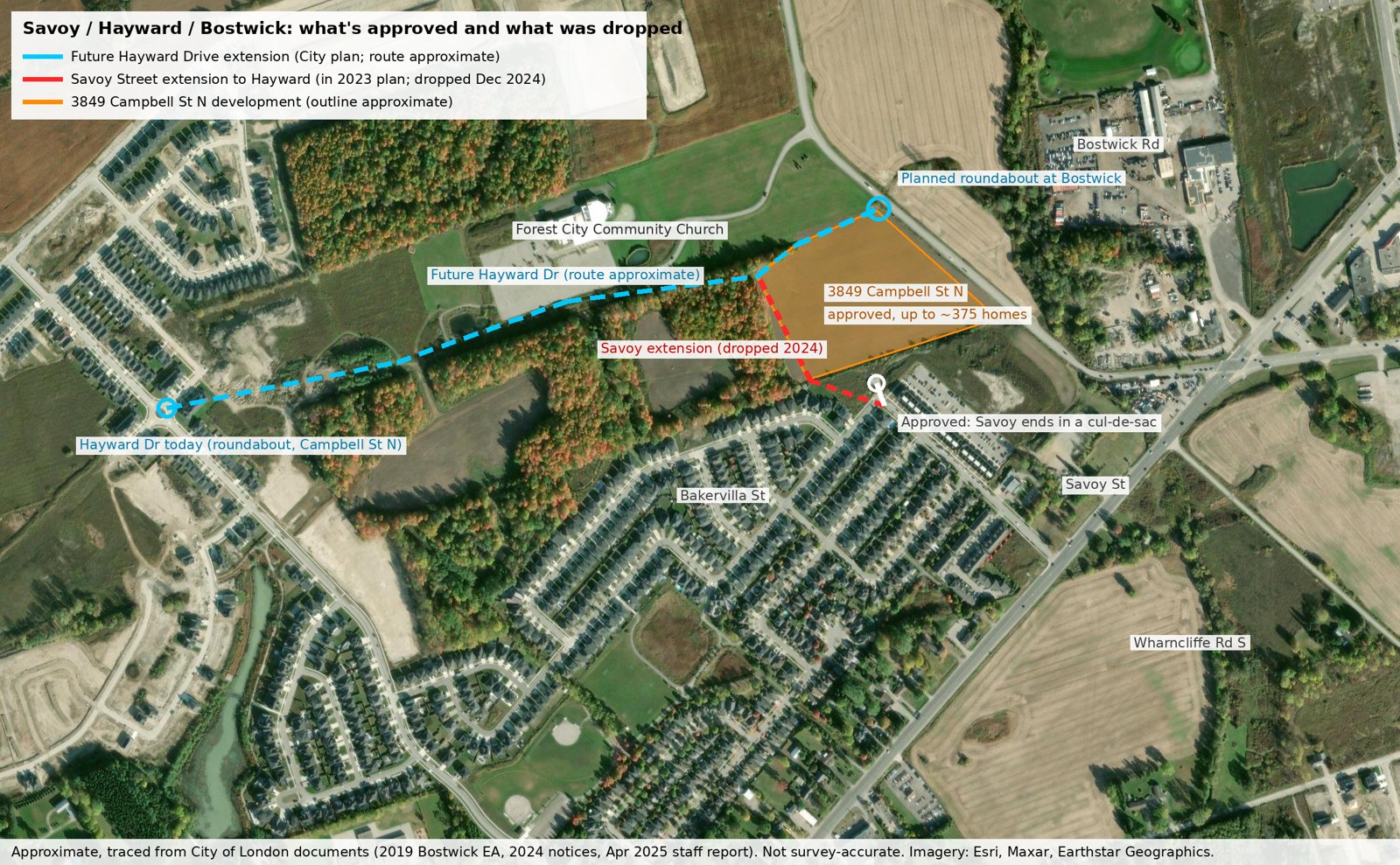
When the development north of Bakervilla was approved last year, City staff recommended extending Savoy north to the future Hayward Drive, which is planned to meet Bostwick at a new roundabout. Several neighbours asked for the same thing. The developer said the road wasn't needed, and City Hall let them drop it, as seems to be the pattern that I am intent on breaking.
If the neighbourhood wants that connection, I'll push to get it put back. Before anything gets built, the City has to approve a site plan, and that’s where the traffic study happens. From what’s publicly available, neither has happened yet, so there should still be time. What are your thoughts? I created a mockup to make it easier to visualize.
!Map of the future Hayward Drive extension, the approved development north of Bakervilla, and the dropped Savoy Street extension (Answered publicly at ward9.online/concerns/#concern-22.)
Neighbourhoods London "Building London Survey"
How likely are you to support motions designed to protect our urban tree canopy if it holds developers to stricter standards and limits site coverage?
3 (scale 1 Totally unlikely to 5 Extremely likely)
TREA (Thames Region Ecological Association) environmental questionnaire
Sustainable Growth
Growth needs to go in the right place. It shouldn't get crammed onto neighbourhoods and natural areas that never asked for it. I hold new development to the London Plan's own test: is it sensitive to, compatible with, and a good fit within its surroundings. That test applies to agricultural land and significant natural areas as much as it applies to built-up neighbourhoods. Infrastructure needs to be in place before development begins, for roads and sewers as much as for the natural systems a growing city depends on. Fix capacity first, then build.
Neighbourhoods London "Building London Survey"
How well do you think we're doing at keeping neighbourhood roads safe as we add new infill development (and cars)?
3 (scale 1 We're not doing well to 5 We're nailing it)
London Decides 2026 questionnaire
Point us to one thing you have already done for people in London, before this campaign, that a reader could check and that shows how you would do this job. A web address is welcome.
Before I ran, I read the City's own Official Plan and used it. In June 2025, a developer proposed 31 townhouses on Lambeth's old McEachren school site, all its traffic routed through Marianna Drive's single access point, while Lambeth's one remaining public school is already capped and busing new kids out of the village. I wrote directly to Councillor Hopkins asking her to oppose the whole project, then sent a full written case at my Substack, built on the Plan's own commitments to safe, healthy neighbourhoods and real community engagement. She acknowledged the first email and never answered the second. She voted yes four and a half months later.
That's how I'd do the job: research, offer solutions, represent the will of Ward 9, and hold anyone to account who isn't doing what's best for residents.
Luis Claro (CLARO) Regulatory Journey Ledger candidate review
If elected, would you support formally reviewing mechanisms such as a Cumulative Development Constraint Test, One Property/Site Regulatory Pre-Check, Regulatory Handoff Ledger, Duplicate Review Test and Consolidated Property Status Record?
If it eases the regulatory burden on citizens and streamlines processes, I am all for it.
Neighbourhoods London "Building London Survey"
How will your development policies and decisions better support local businesses?
Faster, simpler approvals help local builders and contractors most, because small companies can't afford staff to chase paperwork.
Making growth pay for its own roads and sewers also keeps that cost off existing local businesses.
And a developed neighbourhood with happy families is good for business.
London Emergency Services Campus candidate questionnaire
What financing approach would you support across the police and fire project accounts, including debt, reserves, development charges, and other contributions? Would you require a consolidated financing plan before further approvals? Please identify any limits or conditions you would seek to protect municipal finances, distinguishing adopted financing from forecasts and actual receipts.
Business Case P-57 financed all $204.7 million of its additional capital with debt repaid from property taxes, and it booked $0 from reserves, development charges or other governments. That package also covers police headquarters work, and it carries $77.3 million in debt payments from 2028 to 2033, about $12.9 million a year.
The business case put its 2026 tax impact at 0.78 percent, or $30.98 on an average residential property. I won’t vote for a budget that raises property taxes during my term, so I’d require a consolidated financing plan across the police and fire project accounts before any further approvals, showing each source and separating adopted financing from forecasts and actual receipts. My conditions would be no new borrowing beyond what council has already authorized, and any provincial or federal money applied to the debt first.
Source: Business Case P-57, capital budget table and tax levy impact table
Council of Canadians (London Chapter) questionnaire
Is keeping property taxes low a priority for you?
Yes. London has a spending problem, not a revenue problem, and every tax dollar taken is a dollar out of a family's or small business's pocket.
I won't vote for any property tax increase, for any reason during my term.
Growth should pay for growth: new development should cover the roads, water, and sewer capacity it demands, so existing taxpayers aren't subsidizing someone else's expansion.
Neighbourhoods London "Building London Survey"
Tell us anything about your housing and development platform that you want Londoners to know that this survey doesn't capture.
My opinions on housing aren't set in stone, and good input from the community could easily change them. What I do want is to make building easier, faster, and cheaper for builders, because that gets more affordable homes built sooner. The types of homes we build should be dictated by market demand, and not by what someone downtown wants to have built.
Urban League Ward 9 debate questions (2026-09-17 debate)
If a new supportive housing project was proposed in a neighbourhood where many residents opposed it, how would you respond? What commitments are you prepared to make tonight that voters can hold you accountable for?
I don't believe a developer or a bureaucrat downtown should get to decide what a neighbourhood has to live with. If a supportive housing project came to a neighbourhood that didn't want it, it's my job to be the voice of the people living there and represent their will.
But the truth is that provincial law limits how far a council can go to block a housing project just because a neighbourhood opposes it. I won't tell any neighbourhood that I can hand them a guaranteed veto, because that would be a promise I couldn't keep, and I don't make those.
What I can promise is that before a project like this comes anywhere near a vote, residents get the actual plan on the table: who runs it, what security looks like, what happens when something goes wrong, and how they can hold someone accountable after it opens. I'll use every real tool a councillor has, like site conditions, servicing requirements, and a public record that actually reflects what residents said, to make sure a project that goes forward reflects what the neighbourhood raised. And if I think a project is being forced through without honestly addressing what residents brought forward, I'll vote against it and say so publicly, regardless of the final outcome.
ACORN London Municipal Election Candidate Survey on Tenant Protections
Why are you running for Mayor / Ward Councillor in this election? What motivated you to put your name forward at this time?
Year after year, decision after decision, we're left helpless watching our own councillor side with city staff over objections from the community on a variety of issues, but mainly rezoning and development.
Our friendly neighbourhoods are becoming cold and sterile. Cars, yards, and homes get hit overnight, or even in broad daylight. Taxes keep climbing. We're stuck in gridlock and perpetual construction. It's time for a change, and I'm ready to bring a fresh perspective to City Hall.
Vote Compass candidate questionnaire
London should protect existing green space, even if doing so limits new housing development.
Somewhat agree. I'm a staunch defender of property rights, and that includes the right to build on land that's simply sitting vacant. But green space isn't a vacant lot. Parks and natural areas serve everyone in a neighbourhood, and that value doesn't disappear when someone decides they want to chase growth and profits at the expense of something irreplaceable. Protecting genuine green space isn't a property rights violation. It's stewardship of something that belongs to the whole community. London can grow without paving over the green space residents actually use.
Urban League Ward 9 debate questions (2026-09-17 debate)
How would you ensure that municipal cultural investments, programs, and decision-making processes are inclusive and accessible for Indigenous, Black, newcomer, disabled, and other equity-deserving artists and communities? What role should reconciliation play in London's cultural development?
Public venues and programs should be equally accessible to every member of the public. That means fixing barriers anyone can hit: inaccessible buildings, tangled applications, and grant information people can't find. One standard, applied the same way.
On reconciliation, London should comply with the obligations it has already committed to. Finish the metrics and timeline on the ReconciliAction Plan, and report progress in public.
Constituent concerns (ward9.online/concerns/)
Traffic on Colonel Talbot & construction of stack and pack them that will ove...?
You're right to be fed up, and staff running the show is one of my biggest reasons for running. Too many decisions follow a staff recommendation over resident opposition and then get defended as inevitable. I want a council that sides with the people who live here instead of with someone in an office downtown.
I filed a written objection before the June 9 planning committee vote on 3924, 4012 and 4050 Colonel Talbot Road, and laid it out in full here: https://ward9.online/articles/3924-colonel-talbot/. It named missing transportation, servicing and stormwater studies, density and height above the Southwest Area Secondary Plan cap, no secured school site, and no recorded consultation. Council approved it on June 23 anyway, and our current councillor voted for it.
I also objected to the 4402 Colonel Talbot rezoning on the old McEachren school site, which asked for 40 units per hectare against a cap of 30. I first wrote about it in June 2025 (https://millartime.substack.com/p/the-proposed-4402-colonel-talbot), and council approved it unanimously in November 2025. What happened after is here: https://ward9.online/articles/4402-colonel-talbot/. The decisions are final, deaf to the objections of area residents.
As councillor, I would oppose developments of this density in our neighbourhoods, full-stop. And for all developments, I would require necessary infrastructure be in place or guaranteed in writing, with stiff penalties for non-compliance, before any approval.
It's also a travesty what was done on Colonel Talbot Road North. Years of construction, and who knows how many tax dollars, only for traffic to move even slower and get more congested. My aim is not to force Londoners to hit some unrealistic target of bicycles and buses that nobody asked for, but to make London adapt to the way Londoners want to live. (Answered publicly at ward9.online/concerns/#concern-16.)
Urban League Ward 9 debate questions (2026-09-17 debate)
London must maintain roads, bridges, water and wastewater systems and other municipal assets. What infrastructure investments should be Council's highest priorities over the next four years, and how would you decide what gets funded now, what can wait, and how it should be paid for?
The first priority is renewal of existing roads, bridges, water, sewer, and drainage infrastructure, with projects ranked by condition and risk.
The second is transportation capacity and safety on the arterial network, especially where traffic is pushed into neighbourhood streets.
Finally, we should look seriously at a ring road, or some other solution to get drivers from one end of the city faster. With all of the new development in the West end, Westdel Bourne seems like a prime candidate for improvement. And not to put in fancy curbs, wide boulevards, and drop the speed limit.
I would decide now, on projects with clear safety, condition, or capacity evidence. Projects that depend on uncertain growth or lack full lifecycle costing should wait until the evidence and funding are ready.
Urban League Ward 9 debate questions (2026-09-17 debate)
London City Council has just adopted a new 10-year Downtown Plan and a new Economic Development Strategy. Both identify downtown as an important component of London's economic future. At the same time, downtown investment is likely to be a significant issue in this election, with some Londoners calling for continued investment and others questioning whether downtown receives too much of the City's attention and resources. What role should downtown play in London's future, and how would you rank downtown revitalization among your priorities as an elected official?
Downtown should be a thriving part of the city where people can do business, live, and enjoy entertainment while feeling safe and secure. Downtown matters the way every part of London does.
But I'm running to represent Ward 9, and when downtown's priorities compete with Ward 9's roads, parks, and services for the same attention and the same dollars, I'll always lean the same direction. While every area matters in this city, a councillor's job is to prioritize their own ward.
London Chamber of Commerce questionnaire
What do you see as the principal opportunities and obstacles facing London's economy over the next Council term? What should the City do to support business growth, job creation, entrepreneurship and investment, and how should it work with employers, Western University, Fanshawe College and others to attract and retain the talent London needs?
London's biggest obstacle to growth is City Hall's own cost and approval friction, not a lack of opportunity. I'd cut both: competitive tendering on City contracts, faster and cheaper permitting for every applicant (not a selective fast-track for one favoured category), and a hard look at any fee or process that doesn't clear a real public-interest test.
On talent, the City already funds London Economic Development Corporation's work connecting Western and Fanshawe students directly to local employers, including the Innovation Park land given to both institutions for applied research; I'd measure that partnership by placements and retained graduates, and expand what's already working rather than launch something new.
Business growth follows tax and regulatory restraint. It doesn't need a new municipal incentive fund.
Urban League Ward 9 debate questions (2026-09-17 debate)
Arts and culture contribute to London's economy, downtown vitality, tourism, and civic identity. What specific policies or investments would you support to strengthen the cultural sector as a driver of economic development, talent attraction, and placemaking?
Culture can mean jobs, busy downtown nights, and a reason people stay in London. If it's a net benefit, and we can afford it, it would be worth considering. But I'd treat culture the same way I treat every other line in the budget: show me the objective, the cost, and the result.
It's important to keep grant programs arm's-length and transparent, so residents can see who gets funded and why, and we can support affordable venues and creative space through planning rules the City already controls.
Placemaking works when it's tied to a downtown or neighbourhood plan with a cost attached. It fails when it runs on the assumption that culture pays for itself. A cultural sector that attracts talent and visitors is worth supporting when we can see tangible results for the taxpayer dollars spent on it.
London Chamber of Commerce questionnaire
What role should arts, culture and the creative industries play in London's economic and community development? How should the City support cultural organisations, artists, venues, festivals and creative businesses while ensuring that municipal investment produces lasting public value?
While arts, culture, and creative industries can add economic and civic value to London, that value ranks below essential services when taxpayer dollars are on the line. Roads, water, police, and fire come first.
The City can promote London's arts scene without funding it directly. Marketing and cutting the red tape around venues and events cost taxpayers far less than grants, and private and philanthropic support grows the sector better than a Council vote does. If it's not actually garnering voluntary support from private individuals, does it really warrant forcing taxpayers to pick up the tab?
London already runs the London Arts Council's Community Arts Investment Program, about $800,000 a year, plus heritage and tourism-tax-funded culture spending. I'm not planning to cut what exists, but if London's budget ever forces real tradeoffs, arts funding is exactly the kind of spending that gets reduced before essential services do.
London Chamber of Commerce questionnaire
London City Council approved the 2025-2035 ReconciliAction Plan in May 2025, committing the City to 155 actions over ten years. What should the next Council do to translate these commitments into a clear, properly resourced implementation plan developed with Indigenous partners? How would you advance reconciliation through economic development, procurement, planning, cultural investment and municipal services?
Every City program gets judged by a single test in my book: does it serve every Londoner equally, does the benefit justify the cost, and does it actually work. That's the test I'd apply to the ReconciliAction Plan's 155 actions.
Procurement should be competitive by default, which is the standard I hold every City contract to: open bidding, best value, openly available to all who are qualified.
On planning and municipal services, every Londoner deserves an equally efficient process and equally good service. Cultural investment should follow the rule I'd apply to any public facility or program: the City funds general-use spaces and programs as economically as possible for all Londoners, and Londoners decide how they're used, rather than City Hall picking who gets priority.
The real gap is accountability. The Plan's own next-steps section admits an implementation strategy with actual metrics and timelines is still being developed, reviewed only once every two years. A ten-year, 155-action commitment without real metrics is just a longer speech. That's the piece I'd push the next Council to finish first.
CCAL (Concerned Citizens Association of London) questionnaire
Londoners have watched elected officials override the clearly expressed will of voters on major projects. Council ignored the public vote against the BRT, and the city is now on the hook for a bus rapid transit system that has ballooned to $454 million — up more than 50% from the original estimate, with the local taxpayer share nearly tripling. The costly bike-lane network followed the same pattern.
Will you commit to following the clearly expressed will of voters on major projects — even when it conflicts with activist pressure — and how will you determine what the majority of your ward actually wants, rather than listening only to the loudest voices?
That is my main goal. I opposed the BRT back in 2018 before it started ballooning past what residents were told to expect. Council voted it through anyway on its own authority, despite widespread public opposition. I've also presented arguments, based on the London Plan, opposing high-density developments that are unsuitable and unwanted in Ward 9.
I built ward9.online with a public concern tracker so residents can write in and see my answer go up publicly. I draft policy the same way: my proposed PACT bylaw has been open on GitHub since day one, allowing anyone to see the entire history and suggest changes.
If elected, I'd like to build an official version of the concern tracker, with verified-resident logins (allowing optional anonymity). Activist groups can organize and lobby all they want, but I represent Ward 9 residents. Not activists.
CCAL (Concerned Citizens Association of London) questionnaire
London spent $1.3 million on the Housing Collaborative Initiative — software that was never used — with $933,000 going to a single outside consultant. Council went years without meaningful updates while the bills quietly mounted. The London Economic Development Corporation receives $2.3 million annually under a purchase-of-services agreement that is not put to tender. Other organizations receiving millions for homelessness work resist even basic public reporting. Taxpayers should not need a Freedom of Information request — often answered with redactions — to see their own spending.
Will you ensure all contracts, invoices, and spending details are proactively published and accessible to council without an FOI request — and what reporting frequency will you demand from every funded agency?
I'll push for it. Since it takes a council majority, no single councillor can ensure that outcome outright, but I'll vote for it and keep pushing until it happens. Contracts, invoices, and spending details should be published proactively, and not surrendered one redacted page at a time after a Freedom of Information request.
On the multi-city Housing Collaborative Initiative, London paid a consultant roughly $800,000, and residents only learned the details because reporters kept pulling the thread. I'd require every agency receiving City funding to report quarterly with real numbers attached to real deliverables, published where any resident can find it.
Any vendor contract that requires basic facts like cost, scope, or performance to stay confidential is a contract I'd vote against, and any privacy impact assessment should be public before council votes on it.
Climate Action London questionnaire
Building height maximums as specified in the London Plan should be strictly adhered to as they represent comprehensive plans for the growth of the city taking into account utility demands, emergency services, mobility plans, and preserving neighbourhood character. Recently, council has been approving many developments that exceed both maximum heights and densities as per the London Plan. Given that place types such as downtown, transit villages and corridors and urban corridors already allow significant building heights to meet housing supply demands and intensification targets, individual exceptions should not be allowed but changes to these height and density maximums should only be addressed through official plan amendments.
Strongly agree. The London Plan already allows 45 storeys downtown and 35 in Transit Villages. Urban Corridors go to 15. Neighbourhood Connector streets are capped at 4. Height belongs where the pipes, roads, and emergency services are built for it.
Council has been granting site-specific exceptions that blow past those caps. On June 23, 2026, Council approved six storeys and 100 units per hectare for 3924, 4012 and 4050 Colonel Talbot Road in Lambeth, above the Southwest Area Secondary Plan's own cap of four storeys and 75 units per hectare. I filed a written objection before the vote, citing the specific policies it violated. Council approved the application anyway, and Ward 9's current councillor voted for it. The pattern repeats: Council approved 16 storeys a year earlier at 6309 Pack Road, against a 9-storey cap. That is the kind of exception I will vote against.
If the citywide height table needs to change, change the table through a proper Official Plan amendment, in public. Do not grant exceptions for specific applicants, especially when it has not been proven that the infrastructure is in place to handle such intensification, and when it is not in character with the surrounding neighbourhoods.
Constituent concerns (ward9.online/concerns/)
Evening and weekend transit service for Upperpoint/Riverbend?
What your son goes through, spending six hours of his day getting to and from a math class at Western, is the kind of thing a transit plan should be built to prevent.
I looked into what LTC has already said about your neighbourhood. They've flagged Kains Road and Upperpoint Boulevard as growing with serious gaps in service, and Route 22 is meant to fix that with 30-minute service at weekday and Saturday peaks and 35 to 40 minutes on evenings and Sundays. That's a concrete plan, but plans don't help anyone until they materialize into actual results.
The easy thing to do would be to promise you everything you asked for, but that wouldn't be honest. Council doesn't set LTC's routes or schedules directly, and adding on to 17B means new ongoing operating hours with no funding source attached.
What I can commit to, if elected, is raising this directly with the LTC Commission, with three specific asks: prioritize the Kains/Upperpoint piece of Route 22 (LTC's own numbers put it at one peak bus and about 2,000 service hours a year, a small piece to move up), look at whether a smaller interim shuttle could bridge the gap until Route 22 is running, and pay for either option out of the growth-related revenue that new development in a growing area like yours already generates, rather than the general tax base. Growth should fund the infrastructure it requires, everywhere in the ward.
I've also posted this as a public commitment at https://ward9.online/promises/#ltc-transit-priority, so it's on the record.
This is what I can actually stand behind as a city council candidate, and I'd rather give you that than an empty promise. (Answered publicly at ward9.online/concerns/#concern-15.)
Urban League Ward 9 debate questions (2026-09-17 debate)
You're asking Londoners to vote you into a significant leadership role that will shape our community. What have you done to earn that job?
Being a city councillor isn't something you earn by jumping through the right hoops and checking the right boxes. It's up to voters to decide who has the wisdom needed to guide the city along the correct path, the skills and determination to execute, and the principles necessary to stay on course. We candidates are all here to help guide that decision.
I've lived my entire life on the farm, so I'm no stranger to dealing with variables completely out of my control, knowing that nobody will be coming to bail me out. When a farmer does something wrong, we feel the consequences immediately, and we're the ones that will be cleaning up the mess. We're also used to working on a shoestring budget, and stretching every dollar.
That is the mindset I'll bring to council, along with my background in tech. I've used my website, ward9.online, as a pilot project for novel ideas to keep Londoners connected with the political process, including a concern tracker to let me know about important issues and get my response, a promise tracker to hold me accountable, and an open-source proposed bylaw tying council pay to property tax rates that anyone can provide input to help shape. I've also provided researched, sourced arguments, based on the London Plan, against developments in the Lambeth area when residents were organizing in opposition. Unfortunately, they fell on deaf ears.
But you can be sure that a vote for me is a vote for someone ready to dig in and read the reports, ask the hard questions, account for every dollar, and stand with voters over the recommendations of City Staff, or special interests.
Constituent concerns (ward9.online/concerns/)
Making it easier to build more homes and allowing more density?
We both want young people to have a realistic opportunity to afford a home in the communities where they want to build their lives. We also want to make it easier to build homes, and add more density near transit and local shops. And a project that meets clear zoning rules should be able to proceed without a long rezoning fight. That's what the London Plan is meant to deliver: predictability for neighbours and builders alike.
Here are my thoughts. The City is rewriting its zoning by-law right now, with public input this fall and a final version going to the next council. I'd ask staff to report how many ordinary projects can go ahead today without a variance or rezoning, set a target to raise that number so fewer projects need exceptions, and publish the results every year along with approval times. When a rule keeps being overridden, there is either a problem with the system, or with the rule itself. I'd also look at the whole approval pile, because a builder faces site plan and servicing review as well as zoning, and cutting one layer doesn't help if the same question gets asked again at the next. Pre-approved designs for common house types would help a small builder too, so they don't need a paperwork department.
As for increasing density in existing neighbourhoods, picture the day a young family gets the keys to their first home in Byron. What do you want them to see out the front window?
People want to live in communities like Byron and Lambeth because of the tree-lined streets, the grassy yards, and the friendly neighbourhood atmosphere.
Now picture the house next door with four households living on a lot with a smaller yard, cars overflowing driveways onto the streets, constant traffic, and kids being bussed off to distant schools because the ones in their own backyard are over capacity. The City's changes to the London Plan already allow up to four units on a property. Keep adding density to every desirable place and, sooner or later, it stops being the place people wanted to call home.
I support the balance of maintaining the character of existing neighbourhoods, making new development faster and easier where infrastructure supports it, larger buildings along main roads and at key intersections, and intensification closer to the core. Build where the roads, transit, and services are ready for more people. That way we add homes while keeping what drew people here in the first place. (Answered publicly at ward9.online/concerns/#concern-21.)