Where I stand on transit, roads and traffic
Here is every answer I've given on the record about transit, roads and traffic, word for word, from candidate questionnaires and my replies to residents.
Don't see your question? Search below, or ask me directly and I'll answer it on the record.
London Chamber of Commerce questionnaire
London's economic success depends on reliable local, regional, national and international connections. How would you improve local transit and service to major employment areas and shift workers, intercity bus and air links, and passenger rail? What should businesses and employees be able to expect in terms of frequency, reliability and access?
I opposed BRT in 2018 and would have built this differently, but it's underway now, and my focus from here is finishing it without further cost or schedule blowouts, and making sure it doesn't come at the expense of arterial capacity for the drivers who still make up most commutes. BRT already covers the corridor a light-rail or in-city passenger line would serve, so I don't support building one. For shift workers and employment areas, service should follow where the jobs and shifts actually are, route by route against ridership.
Intercity connections are already working reasonably well: YXU's Air Canada and WestJet routes, and VIA's Toronto-London corridor running about five trips a day each way. The City's role there is advocacy for keeping and growing that service, rather than new municipal spending.
Climate Action London questionnaire
It is a priority to improve London Transit service by having 15 minute service frequency during peak weekday hours (maximum headway) on all main arterial routes while maintaining 10 minute service frequency on Rapid Transit routes. 15 minute service frequency is comparable to service in cities like Halifax and Kitchener-Waterloo. Additionally, London Transit should work to eliminate neighbourhood gaps where residents are not within 400m walking distance of a regularly service bus stop.
Neither agree nor disagree. Frequent buses are worth having where people actually ride them. A 15-minute peak standard on every arterial, plus a stop within 400 metres of every home, is a citywide expansion that has to be paid for every year in buses, operators, and subsidy.
London Transit is already adding service hours under its 2024-2027 business plan, and Rapid Transit is being built for buses every five or ten minutes. For 2026, LTC trimmed $700,000 from its City funding request because fuel and insurance costs came in lower than budgeted, without touching a single approved service hour. That is the standard I want applied to any new spending too: match the dollars to the real cost, not to a blanket target.
I will support frequency where the riders are there and the tax bill can carry it, corridor by corridor. I will vote no on a blanket citywide standard that skips that test.
Urban League Ward 9 debate questions (2026-09-17 debate)
As the city grows, how do you see active transportation (cycling networks, sidewalks, transit connections) fitting into your broader vision for the ward, including its role in reducing congestion and supporting the environment and downtown vibrancy?
Active transportation should give residents practical choices without pretending every trip in Ward 9 looks the same, or works the same for everyone.
For most, that's a reliable arterial for getting across the city, and for others it's a safe sidewalk to school or a cycling link that connects to somewhere useful, and Ward 9 needs all of it working at once.
Dense short-trip areas can support walking, cycling, and frequent transit more easily than longer winter trips with groceries or gear, or more rural or outlying areas.
I'd support projects that close existing gaps and keep cut-through traffic off neighbourhood streets, because a network only works if people can trust it to get them where they're going safely and practically.
Constituent concerns (ward9.online/concerns/)
Evening and weekend transit service for Upperpoint/Riverbend?
What your son goes through, spending six hours of his day getting to and from a math class at Western, is the kind of thing a transit plan should be built to prevent.
I looked into what LTC has already said about your neighbourhood. They've flagged Kains Road and Upperpoint Boulevard as growing with serious gaps in service, and Route 22 is meant to fix that with 30-minute service at weekday and Saturday peaks and 35 to 40 minutes on evenings and Sundays. That's a concrete plan, but plans don't help anyone until they materialize into actual results.
The easy thing to do would be to promise you everything you asked for, but that wouldn't be honest. Council doesn't set LTC's routes or schedules directly, and adding on to 17B means new ongoing operating hours with no funding source attached.
What I can commit to, if elected, is raising this directly with the LTC Commission, with three specific asks: prioritize the Kains/Upperpoint piece of Route 22 (LTC's own numbers put it at one peak bus and about 2,000 service hours a year, a small piece to move up), look at whether a smaller interim shuttle could bridge the gap until Route 22 is running, and pay for either option out of the growth-related revenue that new development in a growing area like yours already generates, rather than the general tax base. Growth should fund the infrastructure it requires, everywhere in the ward.
I've also posted this as a public commitment at https://ward9.online/promises/#ltc-transit-priority, so it's on the record.
This is what I can actually stand behind as a city council candidate, and I'd rather give you that than an empty promise. (Answered publicly at ward9.online/concerns/#concern-15.)
Platform (ward9.online homepage)
Roads that actually move
When the arterials flow, your neighbourhood stays quiet. Wonderland, Wharncliffe, Commissioners, Colonel Talbot. The way Lambeth, Byron, and Riverbend get their streets back is by making sure those roads move vehicles quickly and efficiently, as designed. Every mobility vote gets the same test from me: does it get you where you need to go faster, or jam up traffic and push the spillover into someone’s neighbourhood?
No More Noise Municipal Candidate Promise survey
Do you support the implementation of Traffic-Calming Design for existing and new roads in your city/ward?
Speeding, aggressive driving and high motor traffic volume all create unnecessary and unhealthy noise. Traffic-Calming designs that reduce vehicle speed, volume, and aggressive driving also reduce noise.
No. My mobility plan rests on one idea: when the arterials flow, your neighbourhood stays quiet. Traffic forced off a backed-up main road brings its noise right to people’s front doors, so I won’t support calming that pushes cars onto side streets, but calming may be warranted on a residential street when measurable data shows a clear problem.
Urban League Ward 9 debate questions (2026-09-17 debate)
Cycling infrastructure is currently patchy or incomplete in places. What would you prioritize to make active transportation (cycling, walking, mobility devices) safer and more connected, and how would you balance that against concerns from residents and businesses about parking and traffic flow?
We need to plan around how Londoners actually travel. Council's Mobility Master Plan targets walking, cycling, and transit rising from about 23% of trips to 32.5% or more by 2050, with personal-vehicle driving falling from 61% to 52.5%. Most trips today still rely on cars, so I'd judge every project against how people move now and want to move in the future, not against some dreamed up target.
I want to get the arterials moving, protect neighbourhood streets, and put the investment where people will use it. I'd advocate for cycling infrastructure that's safe and connected, and focused where cycling is already a practical way to get around.
Londoners are tired of staring at empty bike and bus lanes while they're stuck in gridlock and can't find a place to park.
Vote Compass candidate questionnaire
London should build more rail underpasses to reduce traffic congestion, even if construction disrupts roads and businesses.
Somewhat disagree. I'd put an underpass at every rail crossing in London, if I could, and end train delays for good. But they carry real costs. One of the biggest complaints I hear about London construction generally is poor planning jamming up main routes and alternate routes at the same time, with idle time stretching projects out even longer. The Adelaide St. underpass alone ran about $29 million over budget and years behind schedule, and nearby businesses pay the price when customers can't reach them. Underpasses deserve serious consideration, but only with accountability for cost, timeline, and businesses.
CCAL (Concerned Citizens Association of London) questionnaire
Londoners have watched elected officials override the clearly expressed will of voters on major projects. Council ignored the public vote against the BRT, and the city is now on the hook for a bus rapid transit system that has ballooned to $454 million — up more than 50% from the original estimate, with the local taxpayer share nearly tripling. The costly bike-lane network followed the same pattern.
Will you commit to following the clearly expressed will of voters on major projects — even when it conflicts with activist pressure — and how will you determine what the majority of your ward actually wants, rather than listening only to the loudest voices?
That is my main goal. I opposed the BRT back in 2018 before it started ballooning past what residents were told to expect. Council voted it through anyway on its own authority, despite widespread public opposition. I've also presented arguments, based on the London Plan, opposing high-density developments that are unsuitable and unwanted in Ward 9.
I built ward9.online with a public concern tracker so residents can write in and see my answer go up publicly. I draft policy the same way: my proposed PACT bylaw has been open on GitHub since day one, allowing anyone to see the entire history and suggest changes.
If elected, I'd like to build an official version of the concern tracker, with verified-resident logins (allowing optional anonymity). Activist groups can organize and lobby all they want, but I represent Ward 9 residents. Not activists.
Accessible London Coalition candidate questionnaire
What do you feel is the #1 accessibility issue facing the city of London?
I'd guess one of the biggest accessibility issues in this city is that what checks a box on a bureaucrat's scorecard doesn't always translate into anything that actually helps someone. If you've ever dealt with City Hall on anything, you've run into that same issue. LTC's own plan lists dozens of bus stops with a ramp-capable boarding pad and no sidewalk connecting to it. It fills a checklist, but still leaves someone stranded at the curb.
Urban League Ward 9 debate questions (2026-09-17 debate)
London must maintain roads, bridges, water and wastewater systems and other municipal assets. What infrastructure investments should be Council's highest priorities over the next four years, and how would you decide what gets funded now, what can wait, and how it should be paid for?
The first priority is renewal of existing roads, bridges, water, sewer, and drainage infrastructure, with projects ranked by condition and risk.
The second is transportation capacity and safety on the arterial network, especially where traffic is pushed into neighbourhood streets.
Finally, we should look seriously at a ring road, or some other solution to get drivers from one end of the city faster. With all of the new development in the West end, Westdel Bourne seems like a prime candidate for improvement. And not to put in fancy curbs, wide boulevards, and drop the speed limit.
I would decide now, on projects with clear safety, condition, or capacity evidence. Projects that depend on uncertain growth or lack full lifecycle costing should wait until the evidence and funding are ready.
Constituent concerns (ward9.online/concerns/)
Making it easier to build more homes and allowing more density?
We both want young people to have a realistic opportunity to afford a home in the communities where they want to build their lives. We also want to make it easier to build homes, and add more density near transit and local shops. And a project that meets clear zoning rules should be able to proceed without a long rezoning fight. That's what the London Plan is meant to deliver: predictability for neighbours and builders alike.
Here are my thoughts. The City is rewriting its zoning by-law right now, with public input this fall and a final version going to the next council. I'd ask staff to report how many ordinary projects can go ahead today without a variance or rezoning, set a target to raise that number so fewer projects need exceptions, and publish the results every year along with approval times. When a rule keeps being overridden, there is either a problem with the system, or with the rule itself. I'd also look at the whole approval pile, because a builder faces site plan and servicing review as well as zoning, and cutting one layer doesn't help if the same question gets asked again at the next. Pre-approved designs for common house types would help a small builder too, so they don't need a paperwork department.
As for increasing density in existing neighbourhoods, picture the day a young family gets the keys to their first home in Byron. What do you want them to see out the front window?
People want to live in communities like Byron and Lambeth because of the tree-lined streets, the grassy yards, and the friendly neighbourhood atmosphere.
Now picture the house next door with four households living on a lot with a smaller yard, cars overflowing driveways onto the streets, constant traffic, and kids being bussed off to distant schools because the ones in their own backyard are over capacity. The City's changes to the London Plan already allow up to four units on a property. Keep adding density to every desirable place and, sooner or later, it stops being the place people wanted to call home.
I support the balance of maintaining the character of existing neighbourhoods, making new development faster and easier where infrastructure supports it, larger buildings along main roads and at key intersections, and intensification closer to the core. Build where the roads, transit, and services are ready for more people. That way we add homes while keeping what drew people here in the first place. (Answered publicly at ward9.online/concerns/#concern-21.)
Urban League Ward 9 debate questions (2026-09-17 debate)
London's Mobility Master Plan commits the City to delivering a safe and connected cycling network suitable for all ages and abilities, including closing critical gaps, adding new facilities, and integrating cycling infrastructure into major road projects. The MMP is based on evidence indicating cities that increase walking, cycling, and transit as viable alternatives to the personal automobile consistently see reduced road congestion, stronger local business activity, and significant cost savings for both residents and government. If you are elected, what specific actions will you take in the next four years to accelerate implementation of London's cycling network, particularly closing critical gaps, ensuring cycling facilities are included in all major road projects, and making active transportation a preferred daily travel option across the city?
I wouldn't accelerate it. I'd aim to make it smarter.
I'd request a four-year schedule that closes gaps where people already travel, and put the priority on links to schools, transit, and jobs where walking and cycling are already practical.
That means safe crossings at danger points where people are currently at risk, and coordinating with planned road renewals so a street isn't torn up twice.
I'd review every major road project for what it does for people walking, cycling, and using mobility devices, whether the arterials move more efficiently, and whether neighbourhood streets stay protected.
I'd publish the safety and usage results so residents can see if the benefit outweighed the cost.
A citywide mode-share target on paper isn't the project. I won't use 32.5% by 2050 to justify a build that fails on its own street.
I'd judge each project on safety, usage, and whether it matches how Londoners get around.
Constituent concerns (ward9.online/concerns/)
Will you support lowering the speed limit on Longwoods Road after the December 2024 tragedy?
As you know, I also live on Longwoods Road, just down from the horrific tragedy that occurred on December 16, 2024. It's not something that any of us will forget.
Our goal here is the same: a road where what happened to an innocent child doesn't happen again. But speed limits are not the cause or the solution here, and I want to walk through my reasoning.
**What happened that day.**
The bus was stopped. The red lights were flashing. The stop arm was extended. A courier in a 2023 Honda Pilot drove straight past it. The child had been told, correctly, that those flashing lights and that extended arm meant every driver on the road would stop. London Police investigated for six months. Two people were charged: the courier, for the bypass, and the bus driver, for letting him off the bus without confirming traffic had stopped.
Two separate, independent failures of an absolute rule. Neither one is a speed-limit question.
**Why a lower limit would not have changed this outcome.**
A posted speed limit sets the upper bound for drivers who intend to obey the rules of the road. It is meaningful for the careful driver. It is not meaningful for a driver willing to pass a stopped school bus with its lights flashing. A driver who commits that violation with a posted 80km/h limit will commit it at any posted speed, and probably won't slow down either. The problem with the courier was not his speed. It was that he blew past a stopped bus with its lights flashing. That's not something a lower speed limit can solve.
Lowering the speed limit of the former Highway 2 corridor would not have changed the outcome on December 16, 2024. That is the hard truth.
More broadly, studies on two-lane roads have found that slower lead vehicles, larger speed differentials, platooning, and restricted passing opportunities can increase driver frustration and overtaking intent. That is especially concerning on our stretch of Longwoods, with its many driveways, curves, and side roads, and it is another reason I am cautious about lowering posted limits as a general policy.
**What would actually move the needle.**
The interventions that target what actually went wrong are real, and most of them are within the scope of city council.
- **Stop-arm cameras on London school buses.** Ontario authorized municipalities to use and prosecute with these in 2020. A petition launched by Charles and Rachel Bakker after the Longwoods tragedy gathered over 2,100 signatures and called for measures including red light cameras. The petition was addressed directly to local politicians and London's police chief. The city installed a speed radar sign in response, but has not acted on the camera proposal. This is the kind of targeted deterrent I would push the city to pursue.
- **The school bus stop relocation.** The school bus service already adjusted the route, and students are no longer crossing Longwoods. This is the type of intervention that actually targets the failure mode: address the root and don't rely on the competence and reliability of drivers.
- **Police enforcement of the rules already on the books.** Monitoring stop-arm violations and corridor speeding are operational decisions a councillor does not direct. What a councillor does have influence over is the police operating budget and four of seven Police Service Board appointments. My goal is enforcement of what is already in place.
**Where I stand.**
Lowering speed limits, especially on major roads and arteries, is contrary to my commitment to improving mobility. Frustrated drivers can become dangerous drivers. My focus is on efficient road travel, proper and complete safety measures for our children, and enforcement of the safety laws we already have. (Answered publicly at ward9.online/concerns/#concern-2.)
Constituent concerns (ward9.online/concerns/)
Traffic lights at the Savoy and Wharncliffe intersection?
Turning left out of Savoy at rush hour is no fun, and I understand the concern.
It would be easy to simply agree with you, but one of my main points of focus is improving mobility and getting traffic moving more smoothly, and adding another red light only 400m from the one at Bostwick is just adding to the pile of more stops, fewer lanes, and lower speed limits already inflicted on this route over the past few years.
What I'd push for instead, and what I'd personally like to see if I lived there, is another connection to the main arteries.
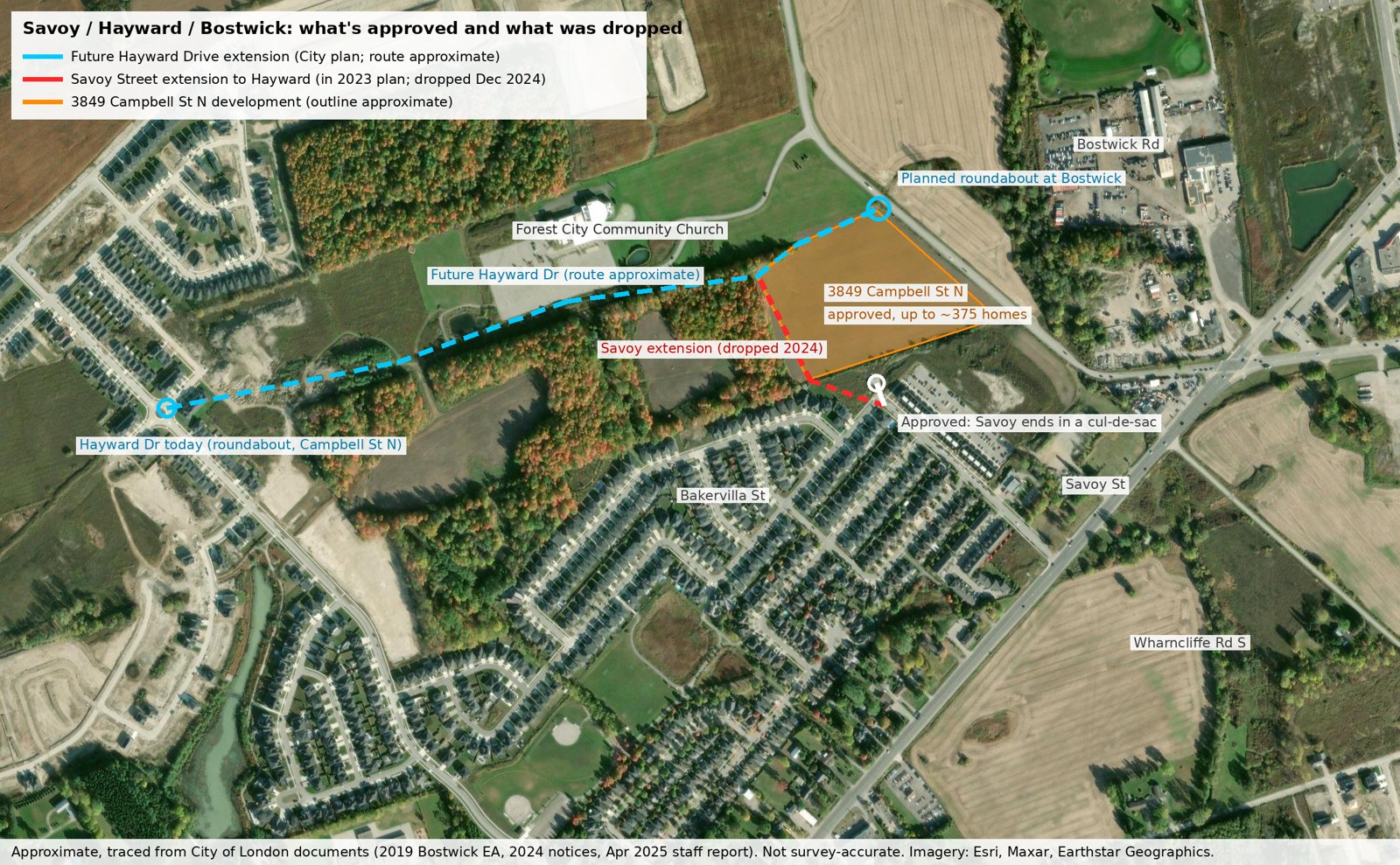
When the development north of Bakervilla was approved last year, City staff recommended extending Savoy north to the future Hayward Drive, which is planned to meet Bostwick at a new roundabout. Several neighbours asked for the same thing. The developer said the road wasn't needed, and City Hall let them drop it, as seems to be the pattern that I am intent on breaking.
If the neighbourhood wants that connection, I'll push to get it put back. Before anything gets built, the City has to approve a site plan, and that’s where the traffic study happens. From what’s publicly available, neither has happened yet, so there should still be time. What are your thoughts? I created a mockup to make it easier to visualize.
!Map of the future Hayward Drive extension, the approved development north of Bakervilla, and the dropped Savoy Street extension (Answered publicly at ward9.online/concerns/#concern-22.)
Climate Action London questionnaire
The City of London should establish more aggressive 2050 mode share targets when they are next reviewed in 2028. It is important that the City move toward more daily trips by walking, cycling and transit given an increasing population, London's GHG emissions slightly increasing and drastically missing CEAP targets and an increasing number of High Density and Medium Density residential buildings. It makes life more affordable for all Londoners.
Strongly disagree. In April 2024 the City set a Mobility Master Plan target of 32.5 percent or more of trips by walking, cycling, and transit by 2050, up from about 23 percent. That target is already being used to justify citywide bike-lane programs, lane takeaways, and 20-year mode-share math as a reason to overrule how people actually travel.
Downtown and other short-trip areas can support walking, cycling, and frequent transit. Ward 9 distances, winter, and ordinary trips with groceries or gear do not. London's winters rule out cycling as a serious year-round option for most people making the kind of trips Ward 9 residents actually need to make.
I will judge each project on its own street, its safety record, its effect on arterial flow, and how people actually want to travel, not how the government wants them to travel. I will not vote for a still-higher 2050 target in 2028 as a substitute for that judgment.
Accessible London Coalition candidate questionnaire
How will you work to improve accessible transportation including conventional transit, Paratransit, taxis and ride sharing?
Paratransit riders report strong on-time performance, at 85% compared with 46% for conventional transit. Their problem is capacity. LTC turns away hundreds of trip requests. More vehicles and scheduling capacity would help, but funding is the constraint.
The taxi issue is economic too, from a different angle. Sixteen of London's 31 accessible-cab licences sit unused, so this isn't a licence shortage. Converting or buying an accessible vehicle runs over $130,000, and it must charge the same fare as a regular cab. The City's bylaw then forces that vehicle off the road at 12 years old, even though every cab already passes an annual City safety inspection regardless of age. I'd replace that flat age limit with the annual safety inspection the City already requires for Vehicles for Hire. And I'd like your opinion: if taxis could charge an increased fare for paratransit in exchange for more accessible cabs on the road, would that be worth exploring? Or off the table?
Ride-sharing isn't filling that gap either. Uber's wheelchair-accessible option only runs in a handful of Canadian cities, and London isn't one of them. The City's Vehicle for Hire bylaw already allows an Accessible Private Vehicle for Hire. Operators aren't putting those vehicles on the road here. I'd like to explore if there's something that London could do to accommodate this.
Urban League Ward 9 debate questions (2026-09-17 debate)
What should London be doing now to prepare for the city it will be 20 years from now?
London shouldn't just use its own long-range plan as a slogan, but as discipline.
Growth should be directed where infrastructure can support it, with roads, transit, water, sewers, schools, and emergency capacity considered before approvals are finalized. We should renew the infrastructure we already own, close critical transportation gaps, and require clear costing for new commitments.
One of those gaps has been open for decades. London still doesn't have a real ring road, and every year we don't build one, we push more raging drivers through neighbourhoods where children play. Council finally voted in April 2025 to open talks on it, but in that same meeting admitted a ring road runs completely counter to their mobility plan, which is built around forcing 32.5 percent of all trips onto bikes, sidewalks, and buses. And this is the problem we face: City Hall constantly trying to make Londoners fit their plans, instead of making their plans fit Londoners. This needs to change.
Along the same thread, we need to ensure London doesn't become a city that taxes itself out of being livable. Every new commitment, be it a ring road or a mess of bike and bus lanes, has to come with a real number attached, because the same growth that builds a bigger city can just as easily build a permanently bigger tax bill if nobody's counting the pennies.
The London Plan's inward-and-upward direction can help control the cost of growth, but only if council follows it consistently, costs its commitments honestly, and reports the results publicly.
London Chamber of Commerce questionnaire
London's growth depends on roads, transit, water and wastewater systems, emergency services and community facilities. How would you determine which investments proceed first, pay for growth fairly and maintain competitive property taxes?
Growth should pay for growth: a subdivision developer covers the roads, water, and servicing capacity a project requires before it's approved, rather than residents living with the shortfall afterward. Existing taxpayers shouldn't backstop growth they didn't ask for.
On sequencing, I'd prioritize water, wastewater, and emergency services capacity already falling behind population growth over new discretionary projects.
Property taxes stay competitive by controlling spending, and I have a specific mechanism for it: my PACT (Pay Accountable to City Taxpayers) bylaw ties councillor and mayoral pay directly to the tax levy, so every point council raises taxes becomes a permanent cut to their own pay. Council just voted itself a next-term raise almost 40% above what they were paid the day they voted for it, while property taxes rose more than 25% over the same multi-year budget. PACT raises the stakes for a council that would burden taxpayers with even higher rates.
Urban League Ward 9 debate questions (2026-09-17 debate)
Residents expect reliable municipal services while facing increasing household costs. How would you balance maintaining services and infrastructure with keeping property-tax increases affordable? Are there areas where London should spend more, or spend less?
Start with the service level residents actually need, then fund it honestly over the asset's full life. Roads, bridges, water, sewers, fire, police, waste collection, and transit reliability deserve priority. New amenities and expansion should wait when the City cannot maintain what it already has without repeated tax pressure. Affordability isn't achieved by deferring maintenance until the bill is larger. It's achieved by prioritizing early, publishing the trade-offs, and refusing commitments without a durable funding plan.
London Decides 2026 questionnaire
Name one thing the people you'd represent will ask you for that city council cannot actually decide. Say plainly what you would tell them, who does hold that decision, and what you would do to move it anyway.
A parent came to me about school bus routes: a stop removed, kids walking a kilometre, and not being able to get a bus home after practice. I told them plainly: a city councillor has no say in that. Day-to-day routing is Southwestern Ontario Student Transportation Services, TVDSB's bus operator. Policy sits with TVDSB's own transportation office. Our elected trustees are Beth Mai and Sherri Moore, covering wards 7, 8, 9, 10, and 13, though TVDSB has been under a provincially appointed supervisor since last year, so trustees aren't currently voting on board policy the way they normally would. What I can do anyway: point residents straight to TVDSB's transportation office, and copy both trustees on it, since trustees still hear from residents and can push things along without a formal vote. I offered to make the introduction myself if needed.
London Chamber of Commerce questionnaire
What changes would you support to increase housing supply and affordability and create neighbourhoods with access to employment, services, transportation and public amenities?
The fastest way to add supply without a subsidy is to cut what City Hall charges and how long it takes.
Price is set by both supply and demand. City Hall barely touches demand: population growth, interest rates, and investment flows are out of the realm of council, but the City has a big effect on how much gets built and how fast. That's where affordability actually gets decided. A City-mandated rent cap does the opposite of what it promises: it shrinks the rental supply landlords are willing to add, making the shortage worse. But every dollar and month City Hall cuts from the cost of building is a dollar that doesn't get passed through to the renter or buyer.
Growth belongs where the London Plan already designates density: downtown, transit villages, and corridors, rather than retrofitted into established single-family neighbourhoods through the one-off exceptions Council keeps granting against its own secondary plans.
Complete neighbourhoods need the roads, water, wastewater, and transit capacity in place before approval, paid for by the growth creating the need rather than by existing taxpayers.
Urban League Ward 9 debate questions (2026-09-17 debate)
What is one thing the City currently spends money on that you believe should receive less funding, and where would you redirect that money?
I wouldn't name a program for a cut without first seeing its service results, legal obligations, and alternatives.
I would reduce funding for activities that can't show a clear public benefit or measurable outcome, beginning with discretionary initiatives rather than core safety, roads, water, transit, libraries, or emergency services.
Any redirected money should be aimed first at renewal of existing infrastructure, and relief from the tax levy for taxpayers. The principle is simple: fund necessities, measure discretionary spending, and stop paying for work that can't show what residents received. The difficult part is forcing the necessary transparency at City Hall to make the correct decisions, but I believe it can be done, with the right leadership.
Constituent concerns (ward9.online/concerns/)
Will you help restore school bus service on Byron Baseline Road, including for after-school activities?
I get the frustration here, but day-to-day routing is run by Southwestern Ontario Student Transportation Services, the group behind the yellow buses for TVDSB, and a city councillor has no vote on that. Our area's elected trustees are Beth Mai and Sherri Moore, covering wards 7, 8, 9, 10, and 13. One thing worth knowing: TVDSB has been under a provincially appointed supervisor since last year, so trustees aren't currently voting on board policy the way they normally would. The most direct path for a policy gap like the after-practice bus issue right now is TVDSB's own transportation office. It's still worth copying both trustees, since trustees keep hearing from residents and can push things along even without a formal vote. Happy to help you find contact info for all of them. (Answered publicly at ward9.online/concerns/#concern-7.)
London and District Labour Council questionnaire
Do you support a change in provincial law that would allow London to charge a vacancy tax for commercial buildings? How will you approach downtown landlords to revitalize economic activity and build a livable city?
My focus for downtown is on what actually gets a vacant storefront filled: cutting the cost and time it takes a small business to open in the first place. A landlord leaves a unit empty when the return on finding a new tenant doesn't clear the cost and delay of permits, inspections, and zoning approvals stacked on top of the lease itself. That's the first cost I'd go after.
Beyond that, downtown revitalization comes back to the basics every other part of the city needs too: reliable transit that actually gets people downtown, streets that are easy to park on or walk to, and predictable approvals for the businesses and housing that bring foot traffic back. Feeling unsafe downtown, from open drug use, disorder, and streets that don't get cleaned, keeps people and customers away as much as any permit delay does. Public drug use is already illegal. I expect the law enforced downtown, as it should be everywhere else in this city. An empty storefront is a signal that opening a business downtown currently costs too much, in dollars and in safety. Fixing both is what fills the space.
Vote Compass candidate questionnaire
London should spend more to improve its public transit service, even if doing so leads to higher fares.
Somewhat agree. Fares are different from taxes. Riders choose to pay for a service they use, and that's a fair way to fund it. If keeping transit viable means adjusting fares, so be it. That's not the same as saying City Hall needs a bigger transit budget. Before committing to more spending, London needs to show current transit dollars are being used well. Fund transit through the people who ride it, not through higher taxes on everyone else, and only grow the budget when the case for it is actually made.
London and District Labour Council questionnaire
What do you consider to be the most important priorities for the City of London?
Two things come before everything else for me: Does council actually listen to the residents it represents, and is the City delivering real value for the tax dollars it already collects.
On the first, too many decisions get made by following a staff recommendation over resident opposition, then defended afterward as inevitable. I want a council that weighs a resident's objection when it reviews a file.
On the second, property taxes have gone up well above inflation three years running. I will not stand for them to increase any more under my watch. I want every dollar the City takes from a hard working Londoner justified against a measurable result: transit that runs where the riders actually are, roads that keep moving, core services delivered efficiently and on budget. Everything else I'm running on, from how the City handles growth to how it spends, comes back to those two questions.
Climate Action London questionnaire
Building height maximums as specified in the London Plan should be strictly adhered to as they represent comprehensive plans for the growth of the city taking into account utility demands, emergency services, mobility plans, and preserving neighbourhood character. Recently, council has been approving many developments that exceed both maximum heights and densities as per the London Plan. Given that place types such as downtown, transit villages and corridors and urban corridors already allow significant building heights to meet housing supply demands and intensification targets, individual exceptions should not be allowed but changes to these height and density maximums should only be addressed through official plan amendments.
Strongly agree. The London Plan already allows 45 storeys downtown and 35 in Transit Villages. Urban Corridors go to 15. Neighbourhood Connector streets are capped at 4. Height belongs where the pipes, roads, and emergency services are built for it.
Council has been granting site-specific exceptions that blow past those caps. On June 23, 2026, Council approved six storeys and 100 units per hectare for 3924, 4012 and 4050 Colonel Talbot Road in Lambeth, above the Southwest Area Secondary Plan's own cap of four storeys and 75 units per hectare. I filed a written objection before the vote, citing the specific policies it violated. Council approved the application anyway, and Ward 9's current councillor voted for it. The pattern repeats: Council approved 16 storeys a year earlier at 6309 Pack Road, against a 9-storey cap. That is the kind of exception I will vote against.
If the citywide height table needs to change, change the table through a proper Official Plan amendment, in public. Do not grant exceptions for specific applicants, especially when it has not been proven that the infrastructure is in place to handle such intensification, and when it is not in character with the surrounding neighbourhoods.
Neighbourhoods London "Building London Survey"
How important are the following factors when evaluating infill construction?
- Height: Somewhat important
- Density: Priority factor
- Setbacks: Priority factor
- Site coverage: Somewhat important
- Traffic volumes and safety: Priority factor
- Appearance: Not important
- Housing type: Somewhat important
- Greenspace/tree removal: Somewhat important
- Neighbourhood need for housing type: Priority factor
- City need for housing type: Not important
London Chamber of Commerce questionnaire
London now has a new Downtown Plan. Which elements would you prioritize and what results should Londoners expect to see during the next Council term? Please address the downtown business environment, public spaces, housing and office conversions, cultural and civic destinations, safety, transportation and implementation accountability.
Council endorsed a 58-action, 10-year plan called Downtown Reimagined in June 2026, built around four priorities: a river district, better public spaces, building on the UNESCO City of Music designation, and a proposed downtown coordinating authority, sometimes called a Downtown Revitalization Authority.
I'd prioritize two things this term: the public-space upgrades, since that work can start without a new funding structure, and downtown safety, since feeling uneasy or unsafe, along with traffic and parking, is the most common reason I hear for avoiding downtown. Public drug use is already illegal. Residents expect police to actually enforce that, rather than let years of informal tolerance stand in for policy. Enforcement standards don't change block by block, but the evidence right now points to downtown needing strict enforcement, officers responding to public drug use the way they would any other offence, and every public space staying open and usable for everyone.
The proposed authority is where caution is warranted: Council endorsed only the concept; mandate, budget, and funding model are still undefined, and I won't support creating or funding it until the scope and a hard budget cap are made public. Housing and office conversions downtown make sense; that's exactly where the London Plan already allows the height and density this city needs, so long as projects stay inside those designated limits rather than becoming the excuse for one-off exceptions elsewhere in the city.
Changes to downtown parking, curb space, and transit access get judged like any project anywhere: proven effect on how people actually get around, not just what a plan assumes.
London Free Press candidate survey
What are your top three priorities, if elected?
1. Making sure every single tax dollar extracted from hard-working Londoners is treated with the respect it deserves.
2. Getting traffic flowing efficiently through the city and planning for construction intelligently.
3. Rein in the ever-expanding government tentacles and redirect that energy into the core functions that Londoners really care about.
No More Noise Municipal Candidate Promise survey
Do you agree to push the province for automated enforcement?
We are asking municipalities to pass formal council resolutions urging the Province of Ontario to amend the Highway Traffic Act so it can allow for automated noise enforcement pilots in our cities.
No. I'm against fixed cameras surveilling London’s citizens on principle, and a noise camera is another fixed camera reading licence plates, so I will oppose them.
Vote Compass candidate questionnaire
London should allocate more of its budget to improving roads, even if it means less funding for other core services.
Somewhat agree. When people picture what government is actually for, roads are usually the first thing that comes to mind. Safe, well-maintained, easily navigable and efficient streets are one of the clearest ways Londoners judge whether their city hall is doing its job. If prioritizing that means fewer dollars for vanity projects and pet initiatives, that is a trade worth making. Roads move people to work, school, and each other. That is core infrastructure, not a nice-to-have, and it deserves to be treated that way in the budget.
Neighbourhoods London "Building London Survey"
How well do you think we're doing at keeping neighbourhood roads safe as we add new infill development (and cars)?
3 (scale 1 We're not doing well to 5 We're nailing it)
Constituent concerns (ward9.online/concerns/)
Traffic on Colonel Talbot & construction of stack and pack them that will ove...?
You're right to be fed up, and staff running the show is one of my biggest reasons for running. Too many decisions follow a staff recommendation over resident opposition and then get defended as inevitable. I want a council that sides with the people who live here instead of with someone in an office downtown.
I filed a written objection before the June 9 planning committee vote on 3924, 4012 and 4050 Colonel Talbot Road, and laid it out in full here: https://ward9.online/articles/3924-colonel-talbot/. It named missing transportation, servicing and stormwater studies, density and height above the Southwest Area Secondary Plan cap, no secured school site, and no recorded consultation. Council approved it on June 23 anyway, and our current councillor voted for it.
I also objected to the 4402 Colonel Talbot rezoning on the old McEachren school site, which asked for 40 units per hectare against a cap of 30. I first wrote about it in June 2025 (https://millartime.substack.com/p/the-proposed-4402-colonel-talbot), and council approved it unanimously in November 2025. What happened after is here: https://ward9.online/articles/4402-colonel-talbot/. The decisions are final, deaf to the objections of area residents.
As councillor, I would oppose developments of this density in our neighbourhoods, full-stop. And for all developments, I would require necessary infrastructure be in place or guaranteed in writing, with stiff penalties for non-compliance, before any approval.
It's also a travesty what was done on Colonel Talbot Road North. Years of construction, and who knows how many tax dollars, only for traffic to move even slower and get more congested. My aim is not to force Londoners to hit some unrealistic target of bicycles and buses that nobody asked for, but to make London adapt to the way Londoners want to live. (Answered publicly at ward9.online/concerns/#concern-16.)
Urban League Ward 9 debate questions (2026-09-17 debate)
The Downtown Plan contains 58 actions, some of which will require new or additional municipal investment. If elected, would you support allocating additional City resources to implement the Downtown Plan? If YES: What types of investments would you prioritize? If NO: Which elements of the Plan would you not support?
I'm not comfortable giving a blanket yes or no answer to a question with so many unknown variables. It depends on the action, and the cost.
I'd prioritize the investments with a direct, measurable public benefit: safety and enforcement in the core, and cleaning and beautification that keeps the area inviting and enjoyable. Those pay for themselves in results people can experience.
What I wouldn't support is open-ended spending on things like programming and promotion, projection art, self-guided tours, late-night bus pilots, more branding for the City of Music designation, that are competing for the same dollars as core services with no way to measure what they bought.
The Downtown Plan is a roadmap, but that doesn't warrant a blank check. Every dollar allocated should be done based on merit.
Climate Action London questionnaire
It is a high priority that the City of London meet the goal in the London Plan that 25% of new housing, in aggregate, (and 40% for secondary plans) is affordable to low- and moderate-income households. London has been falling short on this goal therefore it should commit to all means available to the City to increase the number of new affordable units including leverage of public lands, financial incentives to developers by reducing fees, expedited approval timelines and concierge service team for affordable developments and use of the Canada Housing catalogue of pre-approved designs. Additionally, the City should prevent private developers from turning affordable rental units into expensive ones.
Neither agree nor disagree. I support faster, more predictable approvals and reforms, like pre-approved house designs, that cut building costs for every applicant. Both lower the cost of a unit, market or below-market, without a subsidy or a special track for anyone.
New homes are welcome where roads, water, wastewater, drainage, transit, emergency services, and parks can support the added population. Where that capacity is missing, the infrastructure plan has to come first, with a clear funding source. Existing residents should not be left paying the bill or living with worse service. Growth should pay for the infrastructure it requires.
The London Plan already requires 25% of new housing to be affordable for low- and moderate-income households, the City's incentive program already waives development charges for units locked into a 25-year income-restricted agreement, and Council has since assigned a dedicated staff concierge to walk those specific applications through approvals. That's already more interference in the market than I would like to see.
Moving forward, I will support cutting fees and speeding up approvals across the board, and let the market dictate what class of housing needs more supply to meet demand. Developers already agree to a 25-year affordability term in exchange for the City's fee exemption and concierge service. I do not support the City going further and locking those units, or any others, into a permanent rent cap: this drastically lowers incentives to provide rental units, and leads landlords to abandon necessary maintenance once the capped rent stops covering the cost of upkeep.
Neighbourhoods London "Building London Survey"
Optional: How will your initiatives and policies help to increase the supply of your highest priority selections?
Faster approvals and pre-approved designs cut the time and cost between an idea and a building, so builders can respond to what people need. Growth should pay for growth, so the roads, water and sewers are in place before approval.
Neighbourhoods London "Building London Survey"
How will your development policies and decisions better support local businesses?
Faster, simpler approvals help local builders and contractors most, because small companies can't afford staff to chase paperwork.
Making growth pay for its own roads and sewers also keeps that cost off existing local businesses.
And a developed neighbourhood with happy families is good for business.
London Decides 2026 questionnaire
Point us to one thing you have already done for people in London, before this campaign, that a reader could check and that shows how you would do this job. A web address is welcome.
Before I ran, I read the City's own Official Plan and used it. In June 2025, a developer proposed 31 townhouses on Lambeth's old McEachren school site, all its traffic routed through Marianna Drive's single access point, while Lambeth's one remaining public school is already capped and busing new kids out of the village. I wrote directly to Councillor Hopkins asking her to oppose the whole project, then sent a full written case at my Substack, built on the Plan's own commitments to safe, healthy neighbourhoods and real community engagement. She acknowledged the first email and never answered the second. She voted yes four and a half months later.
That's how I'd do the job: research, offer solutions, represent the will of Ward 9, and hold anyone to account who isn't doing what's best for residents.
Council of Canadians (London Chapter) questionnaire
Is keeping property taxes low a priority for you?
Yes. London has a spending problem, not a revenue problem, and every tax dollar taken is a dollar out of a family's or small business's pocket.
I won't vote for any property tax increase, for any reason during my term.
Growth should pay for growth: new development should cover the roads, water, and sewer capacity it demands, so existing taxpayers aren't subsidizing someone else's expansion.
Vote Compass candidate questionnaire
London should do more to combat climate change.
Strongly disagree. A recent audit found London is off track for its 2030 climate target despite what has already been spent, and says catching up will take still more funding. No more throwing good money after bad. I want real results and accountability for tax dollars. A CBC survey of Londoners this election found homelessness, drugs, roads, and taxes topping resident concerns, while climate did not crack the top ten. Let's focus city hall on what residents are actually asking for.
Vote Compass candidate questionnaire
London should rely more on fees for specific services rather than raising taxes to pay for them.
Somewhat agree. Essential services like roads, water, and safety belong on the tax base; that's what taxes are for. Fees make sense for optional extras like recreation programs, not core services everyone relies on. And even where a fee-for-service model would work, if a private business already does it well, City Hall shouldn't be running it at all. One line I won't cross: I will not support raising tax rates, full stop.
Vote Compass candidate questionnaire
London should apply an additional tax to vacant homes.
Somewhat disagree. Our infrastructure, like roads and schools, is already buckling under the population pressure we have. A vacant home tax might push a few more units into occupancy, but it adds zero infrastructure capacity, not a single road, pipe, or classroom seat. It just squeezes more people onto systems already at their limit, grows the bureaucracy, and puts extra strain on citizens. I'm loath to create new taxes, period. Dead-set against it, regardless of any potential justification. Fix capacity first, then talk about how homes get used.
TREA (Thames Region Ecological Association) environmental questionnaire
Sustainable Growth
Growth needs to go in the right place. It shouldn't get crammed onto neighbourhoods and natural areas that never asked for it. I hold new development to the London Plan's own test: is it sensitive to, compatible with, and a good fit within its surroundings. That test applies to agricultural land and significant natural areas as much as it applies to built-up neighbourhoods. Infrastructure needs to be in place before development begins, for roads and sewers as much as for the natural systems a growing city depends on. Fix capacity first, then build.
Urban League Ward 9 debate questions (2026-09-17 debate)
Many residents say they'd like to cycle or walk more but don't feel safe doing so on our streets. What specific steps would you take in your first term to improve safety for people getting around without a car?
Everything has a price tag, so the benefit has to at least match the cost.
I'd start with a ward-wide gap and hazard list built from collision data, school and transit connections, accessibility concerns, and what residents themselves report.
I'd fix the highest-risk areas and the missing links first, keep them maintained, and inspect the result once construction is done.
A route people can't safely reach or safely cross isn't connected, so the first dollars go where the risk and the daily trips already are. Success would show visible, ranked improvements on the ground.
Writing more lines on a plan without that work doesn't make anyone safer.
Vote Compass candidate questionnaire
Property developers should pay a greater share of the cost of road, water, and energy infrastructure needed to support new housing construction.
Somewhat agree. There's a real difference between an individual building a single home on their own lot and a large developer laying out an entire new subdivision. An individual shouldn't be treated like a corporate developer building hundreds of units. But a developer creating brand new demand for roads, water, and energy capacity should cover a fair share of what that growth requires. Existing taxpayers who already paid for their own infrastructure shouldn't be stuck subsidizing someone else's profit-driven expansion. Growth should pay for growth, at the scale that's actually creating it.
London Decides 2026 questionnaire
Pick the issue you most want to be known for. Where do you feel torn on it, and what is the strongest argument against your own position?
Fiscal responsibility. No wasteful spending, full transparency on every dollar, and no tax hikes. What tears at me is saying no. A resident brings me something worth doing, and the math says the city can't afford it without raising taxes, and I still have to say no.
Here's the case against me. Refusing new revenue can mean deferring maintenance, and deferred infrastructure gets more expensive the longer a city waits. The same taxpayers pay for it eventually, just later, and for a bigger repair bill.
Prioritization is the fix. The full costing that I will be pushing for shows council the real cost of everything, so failing roads and pipes get funded first, and elective extras get delayed or cut.
London and District Labour Council questionnaire
Provide your views on the status of public services and unionized workers for our city. What are your plans for a just economy that supports working people?
Transit operators, water and wastewater crews, and everyone else who keeps this city running in a unionized role do real, skilled work residents depend on every day. I don't doubt that for a second.
Government, at any level, isn't built to engineer a "just" economy. Every serious attempt at it ends up picking winners and creating losers. What actually supports working people is a City that does its own job well: deliver core services efficiently, and keep property taxes and the cost of doing business in London as low as possible. That does more for a working family's paycheque than any citywide economic-justice program could.
I'll judge every City service and every City contract on whether it's delivered efficiently and priced competitively, because that's what keeps taxes from climbing faster than paycheques do. That's the standard I'd apply to how the City treats the people who work for it too: compensation and benefits benchmarked to equivalent private-sector roles, reviewed in the open every term.
ACORN London Municipal Election Candidate Survey on Tenant Protections
What are the top 2–3 priorities in your campaign platform? How do these address the needs of low- and moderate-income Londoners?
First, taxes. I won't support a property tax rate increase during my term after the 20% increase over the past 3 years, and my proposed PACT bylaw cuts council's own pay whenever taxes go up beyond inflation. Any increase comes out of a paycheque, and renters pay it too, because a landlord's expenses show up in the rent.
Second, roads that actually move. Every hour a worker sits in gridlock, or detours around what seems like never-ending construction, is an hour taken from home or the job.
Third, safety at home. When a car or a bike gets hit overnight, somebody has to find the deductible, or the money for a new bike, before the next shift. And nobody should feel like a victim in their own neighbourhood.
London and District Labour Council questionnaire
What would you do to promote local public services and good union jobs in our community? Do you support door-to-door mail delivery? Explain your view.
If a City service is worth having, London residents already know about it and use it. Needing an active promotion campaign to justify its existence is itself a sign the service deserves a harder question: is it worth the tax dollars funding it?
Job creation belongs to the private sector. The City does need to employ people directly for essential services like London Transit, London Water, and City Hall itself, and the people doing that work should be compensated on par with a private-sector equivalent.
In a perfect world, door-to-door mail delivery beats a community mailbox for every household. That's a federal Canada Post decision though, outside what a City Councillor can control.
For local jobs more broadly, my focus is on what council controls: the cost and speed of getting a business open or expanded here. Every month a permit or request sits waiting, or a fee gets added to a project, is a month a local employer isn't hiring or a dollar that isn't going towards providing jobs. Removing that friction is the most direct way council can get out of a local employer's way.
Urban League Ward 9 debate questions (2026-09-17 debate)
London City Council has just adopted a new 10-year Downtown Plan and a new Economic Development Strategy. Both identify downtown as an important component of London's economic future. At the same time, downtown investment is likely to be a significant issue in this election, with some Londoners calling for continued investment and others questioning whether downtown receives too much of the City's attention and resources. What role should downtown play in London's future, and how would you rank downtown revitalization among your priorities as an elected official?
Downtown should be a thriving part of the city where people can do business, live, and enjoy entertainment while feeling safe and secure. Downtown matters the way every part of London does.
But I'm running to represent Ward 9, and when downtown's priorities compete with Ward 9's roads, parks, and services for the same attention and the same dollars, I'll always lean the same direction. While every area matters in this city, a councillor's job is to prioritize their own ward.
London Chamber of Commerce questionnaire
What role should arts, culture and the creative industries play in London's economic and community development? How should the City support cultural organisations, artists, venues, festivals and creative businesses while ensuring that municipal investment produces lasting public value?
While arts, culture, and creative industries can add economic and civic value to London, that value ranks below essential services when taxpayer dollars are on the line. Roads, water, police, and fire come first.
The City can promote London's arts scene without funding it directly. Marketing and cutting the red tape around venues and events cost taxpayers far less than grants, and private and philanthropic support grows the sector better than a Council vote does. If it's not actually garnering voluntary support from private individuals, does it really warrant forcing taxpayers to pick up the tab?
London already runs the London Arts Council's Community Arts Investment Program, about $800,000 a year, plus heritage and tourism-tax-funded culture spending. I'm not planning to cut what exists, but if London's budget ever forces real tradeoffs, arts funding is exactly the kind of spending that gets reduced before essential services do.
Constituent concerns (ward9.online/concerns/)
E-scooter safety. Kids riding e-scooters at high speeds without helmets...?
A kid flying down a residential street or a sidewalk on an e-scooter with no helmet is a frightening thing to watch.
Here's where the rules stand. Riders have to be 16 or older, and 16 and 17 year olds must wear a helmet. Scooters are banned from sidewalks and capped at 24 km/h, and they belong in bike lanes, on multi-use pathways or on roads posted at 50 km/h or less. Council extended the pilot in May, and the by-law holds parents responsible when a child under 16 rides on City property. So the rules exist. But, rules without teeth are just a sheet of paper flapping in the wind.
As with many of our problems, the answer isn't more rules. It's enforcement of the rules already on the books. But that's the tricky part. Enforcement is (ideally) targeted based on data like incident reports, so the best course of action is likely to report violations to the City's bylaw enforcement office at 519-661-4660 or [email protected], or to London Police on their non-emergency line at 519-661-5670. (Answered publicly at ward9.online/concerns/#concern-17.)
CCAL (Concerned Citizens Association of London) questionnaire
Londoners have been hit with repeated property tax increases that far outpace inflation — a compounded tax levy increase of roughly 26% over four years — driven by overspending and frivolous spending on non-essential items. Council has shown it will not discipline itself without a hard rule.
Will you support a binding policy that any property tax increase above the rate of inflation requires a public referendum, and what specific spending lines would you cut first to stay under that ceiling?
I would, but my own standard already goes further: I won't support any property tax increase during my term, for any reason, not just increases above inflation.
I've also drafted the Pay Accountable to City Taxpayers bylaw, which permanently cuts council pay for any levy increase at all through this whole coming term, then only for increases above inflation after that.
On specific spending cuts, the Climate Change Reserve Fund already has about $967,000 sitting unallocated, so I'd reject any push to restore its contributions to the old $1 million a year until that backlog clears. The Community Arts Investment Program, about $800,000 a year, ranks below essential services like roads, water, and safety, and it's the kind of discretionary spending that goes first if push comes to shove.